

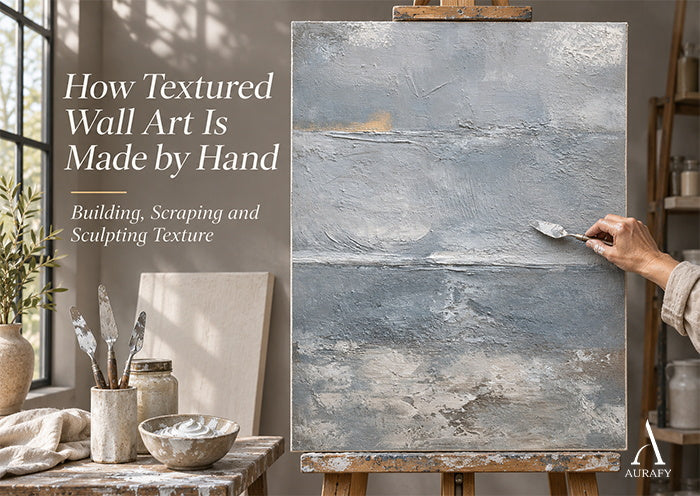
How Textured Wall Art Is Made by Hand: Building, Scraping and Sculpting Texture

Curious how textured wall art is made? Two AurafyArt canvases offer a useful starting point. AURA035 uses palette-knife impasto built and scraped in multiple passes, while AURA045 features hand-sculpted ridges refined with a knife. This guide explains what those tool actions can accomplish, using the documented product descriptions as the starting point and clearly separating them from general craft interpretation.
For a broader introduction to raised-surface artwork, see our 2026 Ultimate Guide: What Is 3D Textured Wall Art?
How Do Hand Tools Build Raised Texture on Canvas?
Artists can work applied surface material with tools to build relief, scrape or reshape it, sculpt ridges and refine edges. The specific technique varies by artwork. Each verb describes a different action:
- Building means adding material to create raised areas.
- Scraping means dragging a tool across material, which can flatten, thin or redistribute it and may leave dragged edges.
- Sculpting means pushing material into a deliberate raised form, such as a ridge.
- Refining means returning to a form with a tool to adjust its edge or line.
The term that ties these actions together is impasto: material applied thickly enough that tool marks remain visible. In impasto work, the surface can record how the tool moved. A knife pressed and lifted can leave a different edge than a knife dragged flat, which is one reason two textured canvases can feel different even when the same kind of tool is involved.
These actions do not follow a mandatory order, and different artworks may emphasize them differently. The four actions below are not a fixed production sequence; they are a way to understand what a tool can do to a textured surface.

AURA035: Building and Scraping Texture in Multiple Passes
How is AURA035's texture made? Its documented method uses palette-knife impasto built and scraped across multiple passes on canvas.
The AURA035 textured seascape canvas is a vertical piece in cool slate blue, soft steel gray, warm taupe and off-white or cream. Its product description identifies palette-knife impasto, built and scraped in multiple passes.
Here, a pass can be understood as one instance of working the knife over an area. The product description confirms that both building and scraping were part of the work and that the process happened more than once. It does not specify how the two actions alternated, so no particular sequence should be assumed.
As a general craft interpretation, scraping can sometimes expose or blend what lies beneath, flatten a high spot or leave a dragged edge. Those are possible effects of the action, not a claim that each effect occurred on this particular canvas. The practical takeaway is that the relief comes from repeated tool work rather than a single application, which may suit someone who wants a surface that feels layered rather than uniform.
The vertical AURA035 Minimalist Seascape Texture Canvas Minimalist Seascape Texture Canvas-Cool Blue & Taupe Painting-AURA035 is the product example discussed here.

AURA045: Hand-Sculpting Ridges and Refining Them With a Knife
How are AURA045's raised ridges formed? Its documented technique involves hand-sculpted parallel impasto arcs refined with a palette knife.
The AURA045 Flowline textured canvas is also vertical, in warm cream and linen white. Its product description identifies hand-sculpted impasto ridges running in parallel arcs, refined with a palette knife and arranged in even bands with clear margins.
The emphasis here shifts from layering to shaping. Sculpting a ridge means pushing material into a raised line, and forming several ridges as parallel arcs suggests repeating a curve by hand. Refinement with a knife could involve tidying an edge or evening a line, though the exact finishing motions are not specified. Those details should be understood as possibilities rather than documented operations.
What the description does establish is that the raised surface is organized as distinct, hand-formed ridges. That is a different kind of work from building and scraping, even though both approaches rely on a palette knife.
The vertical AURA045 Flowline Texture Painting Flowline Texture Painting-Cream & Linen Tones-AURA045 is the second product example.

Why These Two Texture-Making Approaches Are Different
Does every handmade textured canvas follow the same process? No universal process is established. AURA035 and AURA045 document different working approaches, and neither proves the steps used for every artwork.
Set the two descriptions side by side. AURA035 centers on building and scraping across multiple passes, so its surface reflects repeated tool work that both adds to and works back across the material. AURA045 centers on form: ridges are sculpted into parallel arcs and then refined with a knife, giving the surface distinct raised lines.
What they share is specific: both describe physical, tool-shaped impasto on canvas, and both name the palette knife. The comparison stops there. Two product-specific accounts do not add up to a single recipe for every AurafyArt canvas.
For a buyer, the practical point is that "textured" is not one thing. A canvas worked through building and scraping may offer a varied, layered surface, while one with sculpted ridges may offer repeated raised forms. The technique line on a product page is a useful clue to the kind of relief described.

What Product Descriptions Can Tell You About the Making Process
The public product descriptions for these two canvases confirm the tool, the general actions and the palette. They do not identify the texture material, how the canvas is prepared, how thick the relief is, how long anything takes to dry or cure, or whether a protective coating is used.
The About Us page adds context: the brand describes a made-to-order model and collaboration with independent artists. Those are the brand's own statements, not a record of how any individual canvas was produced.
When you shop, look for the technique line, note what it names, and treat anything beyond it as a question for the seller. If a specific material or finish matters to you, ask before ordering. This helps keep product-specific information separate from assumptions about a studio's wider process.

To compare technique descriptions across more textured work, browse the 3D Textured Painting collection. You can also read our earlier guide to handmade textured wall art for a broader overview.
Frequently Asked Questions

What does impasto mean in textured canvas art?
Impasto describes material applied thickly enough that tool or brush marks remain visible and the surface stands in relief. It names a way of applying material, not a specific formula or thickness.
Why might a palette knife be used for both building and scraping?
A palette knife typically has a flat, flexible blade, so the same tool can lay material down, drag it across the canvas or pull it back. Adding, redistributing and removing material are all tool actions, which is why one knife can serve several purposes.
Is AURA045's sculpted-ridge method the same as AURA035's?
No. AURA035's page describes palette-knife impasto built and scraped in multiple passes, while AURA045's describes hand-sculpted parallel ridges refined with a knife. They share the palette knife and physical impasto, but the documented approaches differ.
What texture paste does AurafyArt use?
The specific paste formula is not provided in the public product descriptions, which do not name ingredients or a brand. If the material matters to your purchase, ask the seller directly before ordering.
Share:
Blue Minimalist Wall Art: Choosing Muted Blue That Still Reads Blue
Earth-Tone Minimalist Wall Art: Brown Tones Without a Rustic Look