


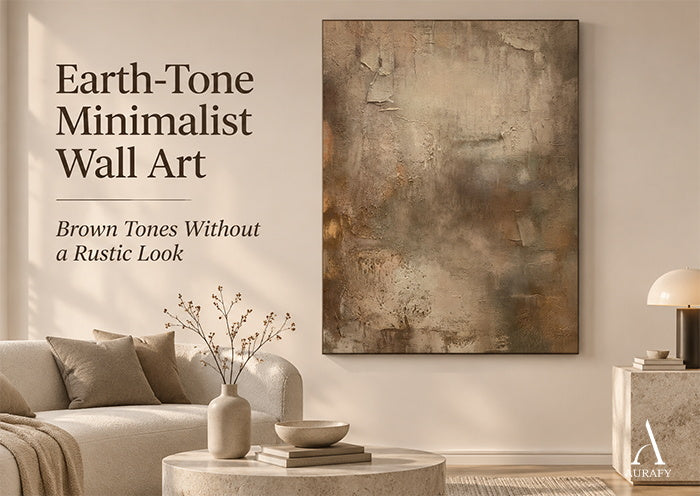
Earth-Tone Minimalist Wall Art: Brown Tones Without a Rustic Look

Brown on a wall is only a color. Whether earth-tone minimalist wall art reads as rustic or restrained depends on how the painting is built and what surrounds it, not on the hue alone. This guide gives you a three-part test for judging brown minimalist art: the tonal field, the material relationship, and the visual breathing room.
What Makes Brown Minimalist Art Different From Rustic Decor?
How can brown minimalist wall art avoid looking rustic? Through tonal continuity, restrained boundaries, and low decorative complexity. When brown reads as one connected surface, without themed motifs or busy accents, it can support a minimalist impression. The surrounding room still shapes that impression.
Rustic decor tends to rely on decorative cues: pronounced grain, themed accessories, or pairings chosen to signal a style. A brown canvas can sit outside that world if it offers none of those cues. No color is inherently rustic or modern. What matters is how much the eye has to sort through: patches of competing color, hard edges, strongly patterned areas, or a cluster of nearby accessories.

Read Brown as One Tonal Field, Not a Collection of Accents
What makes a brown tonal field feel minimalist? Gradual color transitions, softened edges, and few competing structures. It does not depend on a fixed color ratio or a contrasting accent to offset the brown.
In a connected field, one brown moves into the next, and you notice shifts in warmth and depth more than boundaries. In a collection of accents, the brown is divided into distinct shapes or bands that each ask for attention, and the piece begins to read as decorative.
A tonal field can still contain recognizable marks, such as brushwork or layered passages. The question is whether those marks stay subordinate to the whole or break it into separate parts.
Ask yourself three things when comparing options:
- Do edges soften into neighboring tones, or stop abruptly?
- Does a strong diagonal, grid, or border push your eye in one direction?
- Could you describe the piece in one sentence, or does it need a list?
Low contrast is not the same as dull. A restrained painting can still reward a long look.

How Can Layered Texture Stay Visually Restrained?
Texture and pattern overlap. Textured marks can form a pattern, so the useful question is how prominent they become. Repetition, strong contrast, and a clear organizing grid push texture toward graphic pattern. Subtle variation that shows up mostly as shifting light and shadow keeps it in the background.
When shopping, compare two photographs if available: one of the whole piece and one close up. At full view, the canvas should still read as a cohesive field. In the detail shot, you may see layering and softness, but ideally nothing that competes with the overall composition. If the full image already feels busy, the surface is probably asserting itself more than a restrained room needs.
Photographs have limits. Images and display settings may not accurately represent physical texture or color, so treat them as evidence of composition and contrast, and ask for more information about anything you cannot judge.

Where Negative Space Matters in Brown Minimalism
How does negative space work with earth-tone minimalist art? It works on two levels: visually subdued areas inside the composition, and clear wall around the canvas. Neither requires a blank or white area.
Many shoppers assume minimalism means exposed white canvas. In brown work, the subdued passage is often a stretch of low-contrast tone where the surface activity is minimal. That region can serve the role white space plays in a sparser piece by giving the eye somewhere to settle.
The second kind of space lies outside the artwork. A painting crowded by shelves, sconces, and a second small print has less room to be read as a single statement, however restrained it is internally. No precise measurement is needed. Stand back and check whether the canvas can be seen on its own, without surrounding objects creating competing focal points.
Because low contrast can look like emptiness from across a room, step closer too. A restrained piece still has a surface worth examining.

Compare Brown Artwork With the Materials Already in Your Room
Should brown minimalist art match the room's materials? Not literally. Evaluate the visual relationship instead. A restrained, softly textured canvas may be worth comparing against smoother surroundings, where it can add a surface distinction without requiring more styling.
Consider one possible arrangement: a stone console with subdued veining and a plainly upholstered sofa. If those surfaces are fairly uniform, a brown canvas with layered, low-contrast texture could introduce a different kind of surface without competing. Stone varies widely, though, and strong veining or high-contrast coloring can be visually active in its own right. These are hypothetical examples, not required pairings, and the result depends on your actual furnishings.
Now picture a room with patterned textiles, a heavily grained wood piece, and a canvas. The artwork joins a crowded set of surfaces, and the surrounding materials may contribute more to a rustic impression than the painting itself. In that case, simplifying nearby surfaces may help more than changing the art.

AURA104: A Vertical Brown Field With Soft Transitions
As one concrete example, the Earthen Veil brown abstract canvas (AURA104) is a vertical piece in a warm brown tonal palette. The listing describes a warm brown minimalist abstract canvas with handcrafted textured brushstrokes.
Applied to the three-part test:
- Tonal field: The composition is described as moving through gradual tonal transitions and avoiding strong contrast, which points toward a connected field rather than separate patches.
- Material relationship: Layered texture introduces visible surface variation, which may contrast with smoother furnishings. Whether that suits your room depends on what else is in view.
- Breathing room: The listing does not identify an overt structural direction, which may support a less directional reading of the composition. It does not establish any literal empty areas, so judge the quiet tonal transitions in the images yourself.
This is one example, not proof of a universal rule. The listing describes the canvas as hand-painted and made to order, though that production has not been independently witnessed. Because photographs cannot fully convey texture or true color, study the images closely and judge the piece against your own light and wall.
The vertical AURA104 Earthen Veil brown abstract canvas Earthen Veil-Brown Abstract Field-AURA104 is the product example discussed in this guide.

The Final Brown Minimalism Test Before Buying
Sort each piece on your shortlist into one of three outcomes:
- Choose it when the tonal field is connected, the texture stays subtle, and the wall around it leaves room for the piece to be read on its own.
- Adjust the context when the artwork suits you but nearby objects compete with it. Edit the room first.
- Compare further when the piece looks strongly patterned, the surface is hard to judge from photos, or you are unsure the brown you see is the brown you want.

Explore Minimalist Brown Wall Art
If a soft, low-contrast brown field sounds like what you are after, take a closer look at the Earthen Veil brown abstract canvas. To compare it with other restrained pieces, browse the minimalist wall art collection.
For another perspective on pairing brown and beige in warm-neutral interiors, read our Brown and Beige Abstract Wall Art for Warm Neutral Interiors guide.
Frequently Asked Questions
What if my existing furniture has prominent grain or pattern?
Treat the furniture as the main visual voice and look for a canvas that stays quiet beside it: gradual transitions, softened edges, and no strong directional structure. If the combination still feels crowded, simplify nearby accessories before deciding the art is the problem.
Does minimalist brown artwork need white negative space?
No. Negative space can be a visually subdued passage inside the painting or clear wall around it. Neither requires exposed white canvas, and a fully painted brown surface can still feel open.
What should I ask if product photographs do not reveal the surface clearly?
Request additional detail images, ideally taken in different light, and ask how the surface is described: layered, flat, or with raised marks. Also ask whether the photographed color is a close representation, since displays vary.
Can brown abstract art pair with smooth stone furniture?
It can, depending on the stone. If the veining and contrast are subdued, a canvas with subtle layered texture may add a different surface without much visual noise. Test the combination in your own room rather than treating it as a rule.
Share:
How Textured Wall Art Is Made by Hand: Building, Scraping and Sculpting Texture
Vertical Minimalist Wall Art: Working with Narrow Walls and Clean Lines