


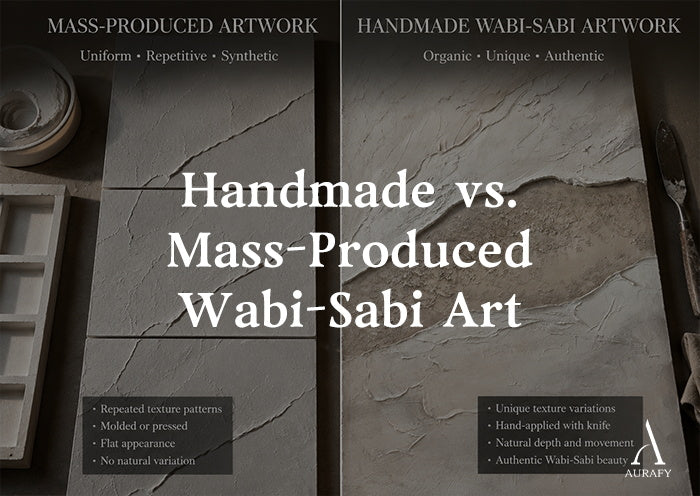
Handmade vs. Mass-Produced Wabi-Sabi Art

Direct Answer: How to Identify Genuine Handmade Wabi-Sabi Art

Identifying authentic wabi-sabi art is not about finding a piece that looks imperfect. It is about understanding the relationship between the artwork’s materials, making process, and the transparency of the seller or studio behind it.
A genuinely handmade textured artwork often shows evidence of human decisions:
unique tool marks
natural variation in texture
subtle differences across the surface
visible choices made during the creative process
A mass-produced imitation may copy the appearance of handmade texture through printing, molds, or repeated production methods, but it often lacks the individual variation created when an artist shapes each surface.
However, handmade does not automatically mean wabi-sabi. A piece can be handmade without expressing the deeper ideas associated with wabi-sabi, which include impermanence, simplicity, and appreciation of natural variation.
The most reliable approach is to evaluate both the physical artwork and the seller’s transparency.
Handmade vs. Mass-Produced Textured Art: Key Differences

|
Evaluation Point |
Handmade Studio Artwork |
Mass-Produced Imitation |
|
Surface marks |
Individual tool movements and variations |
Repeated patterns or identical surface effects |
|
Texture formation |
Created through an artist’s process |
Often reproduced through printing, molding, or automated production |
|
Surface variation |
Natural differences between pieces |
Highly consistent repetition |
|
Production information |
Studio can explain materials and process |
Limited information about how the artwork is made |
|
Customization |
May allow changes in size, color, or composition |
Usually fixed designs from existing inventory |
|
Provenance |
May include artist details, studio information, or production records |
Often identified only by generic product information |
No single feature proves authenticity by itself. A careful evaluation should consider multiple signals together.
The 8-Point Checklist for Evaluating Textured Artwork

1. Look for Individual Surface Variation

Handmade textured artwork usually contains small differences across the surface.
These may include:
uneven ridges
changing pressure marks
subtle shifts in material thickness
variations that appear naturally during the making process
These details do not need to look random. In skilled work, they are usually the result of intentional artistic decisions.
Mass-produced pieces often rely on repeated patterns, where the same texture appears in the same way across many units.
2. Examine Tool Marks and Surface Movement

The visible traces of making can reveal how an artwork was created.
A palette knife, brush, or hand-applied tool may leave:
directional movements
layered transitions
changes in pressure
unique surface rhythms
These marks are difficult to reproduce identically across many pieces.
However, the absence of visible marks does not automatically mean a piece is not handmade. Some artists intentionally create smoother surfaces.
The question is whether the surface reflects a deliberate artistic process.
3. Check the Edge and Border Details

The edges of textured artwork can provide useful information.
Hand-shaped surfaces may show:
natural transitions
slight irregularities
variation where materials meet
Factory-produced pieces often have more uniform edges because they are designed for repeated manufacturing.
Again, edge appearance should be considered alongside other evidence rather than used as the only authenticity test.
4. Understand the Materials Used
A transparent seller should be able to explain the basic materials involved.
Useful questions include:
What creates the texture?
Is the surface built by hand or reproduced from a mold?
What is the artwork substrate?
What finishing process is applied?
Materials alone do not determine artistic value, but clear information helps buyers understand what they are purchasing.
5. Ask About the Production Process

One of the strongest indicators of authenticity is whether the seller can describe how the artwork is made.
A studio producing handmade work should usually be able to explain:
how the surface is formed
how colors are applied
how variations occur
how the piece is prepared before delivery
A seller who only provides finished product images and cannot explain the process offers less evidence for evaluation.
6. Request Photos or Videos of the Actual Piece

Online images can make different production methods look similar.
Before purchasing, consider asking for:
current photos of the actual artwork
close-up texture images
short studio videos
progress images during creation
This is especially important for textured artwork because surface depth, material quality, and finishing details are difficult to judge from a single listing image.
7. Review Studio Transparency

A trustworthy seller does not need to make exaggerated claims.
Useful signs include:
clear material descriptions
realistic production information
consistent examples of previous work
willingness to answer detailed questions
Transparency helps buyers understand whether they are purchasing a handmade artwork, a reproduction, or something in between.
8. Consider Customization Options
Customization can be a useful indicator of a studio’s working method.
A studio creating artwork individually may be able to discuss:
alternative sizes
color adjustments
composition changes
room-specific recommendations
However, customization alone does not prove handmade production. Some manufacturers also offer customization services.
It should be considered together with other evidence.
10 Questions to Ask Before Buying Textured Artwork
Before purchasing a piece marketed as handmade, consider asking:
How is the texture created?
Is the surface individually shaped or reproduced from a mold?
Can you provide photos or video of the actual finished piece?
What materials are used to create the texture?
Is each artwork individually produced or repeated from the same design?
Can you share examples of the production process?
Who creates the artwork, and is the studio information available?
Are variations between pieces expected?
Does the artwork include any production documentation?
What support is provided if the artwork arrives damaged?
A transparent seller should be comfortable answering these questions.
Handmade Does Not Automatically Mean Wabi-Sabi
One of the most common misunderstandings is treating “handmade” and “wabi-sabi” as the same concept.
They are related, but they describe different things.
Handmade refers to the process of creation. It describes whether a human directly shaped, painted, assembled, or modified the artwork.
Wabi-sabi refers to an aesthetic sensibility connected with imperfection, impermanence, simplicity, and appreciation of natural change.
A perfectly polished handmade artwork may not express wabi-sabi.
A machine-assisted artwork may borrow visual elements associated with wabi-sabi.
The important distinction is understanding both the physical process and the artistic intention.
Do Machines Make Artwork Inauthentic?
Not necessarily.
Modern studios often use tools throughout production.
For example:
a machine may cut a wooden support
equipment may help prepare materials
digital tools may assist with planning
These steps do not automatically remove artistic authenticity.
The more important question is whether the visible artistic surface was created through meaningful human decisions or simply reproduced mechanically.
A hand-shaped textured surface and a repeated molded pattern may involve different levels of artistic involvement, even if both contain physical texture.
How to Evaluate Wabi-Sabi Art Online

Buying artwork online requires a different approach because you cannot immediately touch the surface.
Look for:
Clear Process Information
A seller should explain:
materials
production approach
expected variations
finishing methods
Consistent Studio Evidence
Useful evidence may include:
process images
studio videos
detailed artwork photos
examples of previous pieces
Honest Descriptions
Be cautious of absolute claims such as:
“completely unique” without explanation
“ancient technique” without context
“authentic Japanese wabi-sabi” used only as a marketing phrase
Cultural and artistic terms should be used carefully.
Understanding Cultural Authenticity
Wabi-sabi should not be reduced to a visual formula of beige colors, rough surfaces, or unfinished objects.
It is a broader Japanese aesthetic idea connected with accepting imperfection and recognizing the effects of time and change.
A textured artwork may be inspired by wabi-sabi principles without being a traditional Japanese object.
Likewise, a handmade artwork created outside Japan may express qualities associated with wabi-sabi, such as material honesty and appreciation of variation.
Cultural authenticity depends on how the term is used and whether it respects the underlying concept rather than simply applying a fashionable label.
Frequently Asked Questions
How can I tell if textured art is handmade?
Look for evidence of an individual making process, such as unique surface variation, visible tool decisions, and clear information about how the artwork was produced. No single detail proves authenticity, so evaluate multiple signals together.
Is handmade artwork always original?
Not necessarily. A handmade piece may still be part of a repeated series. Originality depends on factors such as whether each piece is individually created, how much variation exists, and how the artist defines the work.
Is machine-assisted artwork fake?
No. Many artists use tools and equipment during production. The important distinction is whether the artistic surface and creative decisions are individually formed or mechanically reproduced.
Does handmade automatically mean wabi-sabi?
No. Handmade describes the production process. Wabi-sabi describes an aesthetic approach centered on imperfection, impermanence, simplicity, and material awareness.
What should I ask a seller before buying wabi-sabi wall art?
Ask about the materials, production process, surface creation, variations between pieces, and whether they can provide photos or videos of the actual artwork.
Choosing Artwork With Confidence

Authentic wabi-sabi wall art is not defined only by rough texture or imperfect appearance. The strongest pieces combine thoughtful material choices, visible craftsmanship, and a clear connection between the artwork and the person who created it.
When choosing textured artwork, focus less on whether it looks “imperfect enough” and more on whether the piece has a believable story of materials, process, and artistic intention.
A transparent studio should make that process easy to understand.
Share:
Plaster vs. Oil vs. Acrylic: Best Medium for Textured Art?
Wabi-Sabi Colors: Beige, Gray & Earth Art