


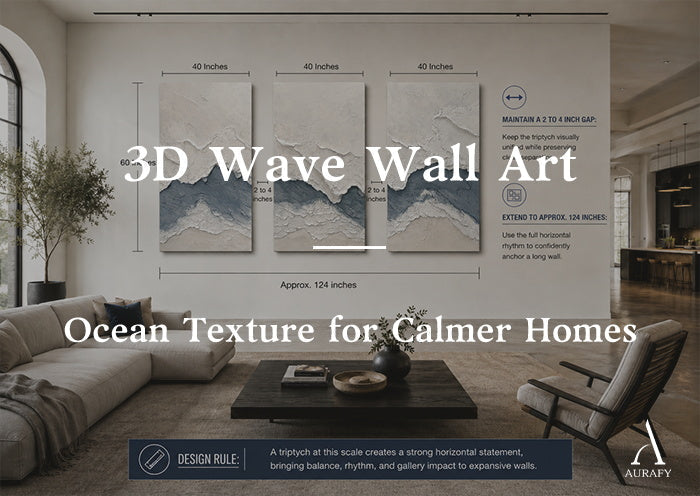
- Display 3D wave wall art to bring the fluid, rhythmic movement of ocean swells into a contemporary home as a physical surface rather than a flat image.
- Choose a calming 3D ocean textured canvas over a flat seascape print — the raised surface changes visually as the light moves through the day.
- Use heavy impasto 3D ocean wall art to soften the hard, straight lines of a modern interior with organic, flowing form.
- Hang 3D beach wall art under a 45-degree angled spotlight to deepen the wave channels and highlight the crests with warm directional shadow.
- Clean wave formations with a soft-bristle brush or compressed air — never use liquid or chemical cleaners on the surface.

Home is where people come to recover. From noise, from screens, from the relentless pace of a working day.
Few natural environments do this as effectively as the ocean. The rhythmic movement of waves, the layered sounds of water, the visual depth of open water — these sensory qualities are consistently associated with lowered stress and restored calm. People seek them out. They book coastal holidays around them. They return to them.
3D wave wall art brings that quality to the wall of a room. Not as a photograph of the sea — a flat image has none of the dimensional quality that makes ocean environments calming — but as a physical surface with real depth, real shadow, and real movement as the light changes. The wall becomes something closer to a low-relief sculptural landscape than a decorative panel.
Calming 3D Ocean Textured Canvas: What Makes the Surface Work

The term calming 3D ocean textured canvas is specific. It describes a piece that works on two levels simultaneously: the physical and the emotional.
The physical surface
In a handmade wave piece, the ocean is not depicted — it is built. The artist applies heavy-body modeling paste with wide-blade palette knives, creating ridges and channels that represent wave crests and troughs in actual physical relief. The highest points of the surface may project 15 to 20 millimeters from the canvas base. The deepest channels may recede to near the canvas surface.
Under angled light, these ridges cast genuine shadows onto the channels below them. The shadows shift as the light angle changes. In the morning, they angle one way. By afternoon, they angle another. At night under a warm spotlight, they deepen and sharpen. The surface is never exactly the same twice.
The emotional quality
The calming effect of a wave piece is not simply about color or subject matter. It comes from a specific visual quality: rhythmic repetition with organic variation. The waves repeat — there is a consistent movement direction, a consistent wave scale — but no two waves are identical. This combination of pattern and variation is the same quality that makes real ocean waves calming to watch. The eye follows the rhythm without being demanded to stop anywhere specific.
A handmade calming 3D ocean textured canvas delivers this quality at the level of the surface itself, not just the composition. The physical variation in ridge height, the slight irregularity in wave spacing, the raw quality of the crest edges — all of these create the visual rhythm that makes the piece easy and restorative to live with.
3D Ocean Wall Art vs. Traditional Seascape Painting

The difference between 3D ocean wall art and a conventional seascape painting is not a matter of style. It is a matter of dimension.
A traditional seascape is fixed.
The image is painted on a flat surface. The shadows in the waves are painted — they are marks of pigment, not actual shadows. Under any light condition, the painting looks the same. The image is static from the moment it is finished.
A 3D ocean piece responds to its environment.
When morning light enters from a window at an angle, the raised wave crests catch a line of highlight along their upper face. The recessed channel between waves falls into shadow. The piece reads differently at 8am than it does at noon. Switch on a warm spotlight in the evening and the surface transforms again — deeper, more dramatic, more clearly sculptural.
This responsiveness is what makes 3D ocean work function as more than decoration. The surface participates in the room's atmosphere. It changes with the light the way the ocean changes with the weather — not radically, but continuously and perceptibly. Living with it is a different experience from living with a static image.
It breaks the room's geometry.
Modern interiors are built on straight lines. Walls meet at 90 degrees. Furniture sits in rectangular footprints. The ceiling is flat. In this context, the continuous, irregular curve of a wave composition is a powerful counterpoint. The organic movement of the wave forms softens the angularity of the room without introducing color complexity or pattern that competes with the interior's palette.
3D Beach Wall Art: Pairing Guide by Interior Style
|
3D Wave Palette |
Complementary Room Materials |
Visual and Emotional Balance |
|
Deep cobalt / white foam |
White micro-cement floors / pale grey fabric sofa / brushed steel surfaces |
Modern gallery: the deep blue wave creates a single bold focal point in an otherwise color-free room — maximum contrast, maximum presence |
|
Warm sand / oat white |
Raw linen curtains / white oak coffee table / woven grass rug |
Coastal wabi-sabi: color is removed entirely — the tactile quality of the sandy paste resonates with the linen and timber around it |
|
Soft teal / deep sage |
Saddle leather armchair / mid-century walnut furniture / brass wall lights |
Organic modern: the low-saturation ocean tone balances the warm heaviness of dark timber; cool and warm tones meet without conflict |
|
Pale grey-blue / warm white |
Japandi interiors with pale timber and neutral textiles |
Quiet coastal calm: the restrained blue tone adds a suggestion of water without introducing strong color into a neutrals-only palette |
|
Terracotta and warm cream |
Natural stone flooring / raw plaster walls / olive and earth tones |
Mediterranean coastal: warm earth tones reframe the wave subject in an inland, sun-baked landscape context |
Why Ocean Wave Art Demands Handmade Production

Ocean and wave compositions are unforgiving of mechanical repetition.
The defining quality of a wave is its organic irregularity. No two waves in nature are identical. The crest heights vary. The trough depths vary. The spacing between waves is never perfectly even. This variation is not a defect — it is the quality that makes waves visually interesting and emotionally calming.
A machine-pressed wave panel has none of this variation. Every crest is the same height. Every trough has the same profile. Every section of the surface reflects light at the same angle. Under a spotlight, the uniform repetition reads immediately as manufactured. In a room designed around natural materials and organic form, this mechanical quality is immediately out of place.
At AurafyArt, every wave piece is made to order in our dedicated artist studio. No molds, no templates, no inventory. When an order arrives, an artist begins the piece from scratch on a full-size heavy-duty canvas.
The artist mixes the modeling paste to the right consistency for wave work — fluid enough to flow slightly under the knife, stiff enough to hold its form as it sets. The wave crests are built in multiple passes, each one adding height and definition to the previous. The trough channels are cut and shaped between the crests, their depth varying naturally as the knife pressure adjusts.
No two passes of the knife are identical. The slight variation in pressure, speed, and direction that occurs naturally in hand-applied work is exactly what gives a wave piece its organic quality. The irregularities in the surface are not mistakes. They are what makes the piece look like water rather than plastic.
Two coats of UV-resistant, low-VOC matte varnish seal the finished surface. This protective layer prevents yellowing, reduces dust adhesion, and maintains the matte surface quality that gives ocean work its natural, water-like appearance.
How to Light a 3D Wave Piece Correctly

Wave compositions have significant surface projection — the distance between the highest crest and the deepest trough can reach several centimeters on a heavily built piece. This surface depth requires precise lighting to perform correctly.
Step 1: Position the spotlight 12 to 15 inches from the wall
This is the most important adjustment for deeply textured wave work. If the spotlight sits too close to the wall — the standard 8 to 10 inch position used for flatter work — the highest wave crests cast a large shadow onto the lower section of the canvas. The lower waves and trough details fall into near-total darkness. Moving the light outward to 12 to 15 inches gives the beam a shallower entry angle that clears the top crests and reaches the full canvas height.
Step 2: Maintain a 30 to 45 degree beam angle
The beam should travel across the face of the canvas rather than directly down onto it. At 30 to 45 degrees, the light slides along the wave surface — catching the lit face of each crest and dropping the trough channels into shadow. This is the angle that reveals the full dimensional range of the piece and produces the wave shadow effect that makes the composition read as genuinely three-dimensional.
Step 3: Check coverage from normal viewing distance
Before fixing the spotlight permanently, check the full canvas from 6 to 10 feet away. The entire surface — from the top wave crests to the bottom trough channels — should receive even illumination without any dark band across the lower section. If the bottom third is significantly darker than the rest, move the spotlight further from the wall by 2 to 3 inches and recheck.
Use warm white bulbs
2700K to 3000K bulbs are the right choice for all wave work. Warm light enhances the oceanic quality of blue and teal tones, making them read as deep and rich rather than flat. For sandy and neutral wave pieces, warm light brings out the earthy, sun-bleached quality of the palette. Cool white bulbs above 4000K flatten the tonal depth of wave surfaces and make the piece look grey and cold — the opposite of the calming, enveloping quality the piece is designed to deliver.
Frequently Asked Questions
Does dust collect in the wave channels, and will the surface yellow or crack over time?
Light dust does settle in the recessed trough channels over time. The UV-resistant matte varnish applied to every piece reduces static charge on the surface, which slows dust adhesion compared to an unsealed surface. For cleaning, use a wide soft-bristle brush — a large makeup brush or a clean natural-bristle decorating brush — to sweep gently along the direction of the wave movement every two to three weeks. For deep trough channels, use short bursts from a can of compressed air. Never use a damp cloth, water, or any chemical cleaner near the surface. On cracking: the flexible acrylic modeling paste used in every piece cures to a resilient surface that moves slightly with the canvas rather than against it. Applied in layers with proper curing time between sessions, it does not develop the brittle character that causes cracking in lower-quality products. On yellowing: the acid-free materials and UV-resistant varnish prevent yellowing under normal indoor light conditions indefinitely.
What size works best for a 3D wave piece in a living room?
For placement above a sofa, a piece between 36 and 48 inches wide works well for most standard three-seat configurations. This covers roughly two-thirds of the sofa width and creates the visual connection between the artwork and the furniture that makes the arrangement feel resolved. For a standalone feature wall — particularly a double-height wall or a wide open-plan living space — a piece of 40 × 60 inches or larger fills the wall with the authority the wave composition needs to read as a significant presence rather than a decorative panel.(Tips:How to Size a Large Abstract Painting for Your Wall)
Can a 3D wave piece work in a room that is not a coastal or beach-themed interior?
Yes — and this is where neutral-palette wave pieces perform best. A wave piece in warm sand, oat, or pale greige removes the literal ocean reference and leaves the organic, flowing form as the primary quality. In a wabi-sabi, Japandi, or modern minimalist interior with no coastal theme, a neutral-toned wave piece reads as abstract movement rather than seascape. It adds organic curvature and material depth without introducing a theme that the rest of the room does not reference. The emotional quality — the sense of rhythm and calm — remains. The literal subject matter recedes.
The Rhythm the Room Was Missing
A room without movement is a room held in suspension. The furniture stays still. The walls stay flat. The only change is the people moving through it.
3D wave wall art introduces the one quality that architecture cannot — organic, continuous movement encoded in a surface. The waves do not move. But the shadows they cast do. And as those shadows shift through the day, the room itself seems to breathe.
That is what the ocean does. And it is what a well-made wave piece brings home.
Share:
Leaf Texture Painting: Wabi-Sabi Wall Decor Guide
3D Animal Wall Art: Custom Pet Portraits & Wildlife Guide