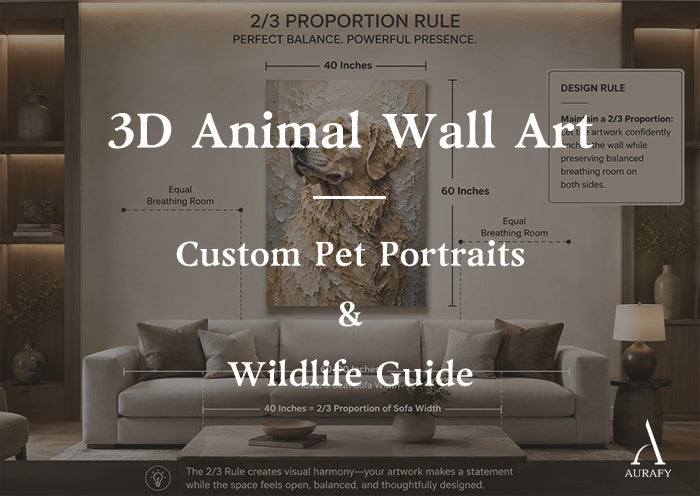
- Display 3D animal wall art to bring playful organic form and tactile personality into a contemporary interior without disrupting its sophistication.
- Commission a customized 3D pet portrait art piece to capture the unique fur texture, facial structure, and character of your companion in physical relief.
- Hang deeply sculpted 3D animal wall painting on a feature wall to break the clinical coldness of a modern minimalist interior with organic, living form.
- Position textured animal artwork under 45-degree angled track lighting to define the sculpted facial features and deepen the fur micro-shadows.
- Clean intricate animal texture surfaces using a soft-bristle brush or compressed air — never use liquid or chemical sprays on the surface.

Home decoration has shifted. The sample-room aesthetic — coordinated, neutral, interchangeable — no longer satisfies the way it once did. People want their homes to say something specific about them.
Animal subjects offer a direct route to that specificity. A bird, a horse, a lion, a beloved dog — these subjects carry immediate emotional resonance. They introduce life, personality, and organic form into spaces that can otherwise feel static and impersonal.
The challenge is execution. A flat photographic print of an animal often reads as casual or juvenile in a carefully considered interior. The surface has no presence. The image competes with the room rather than contributing to it.
3D animal wall art takes a fundamentally different approach. The subject is not printed — it is built. Fur, feathers, facial structure, and body form are constructed in physical relief using sculptural paste applied by hand. The surface has real depth. Under angled light, the texture of the fur catches genuine shadows. The piece reads as art — as an object with material quality and presence — not as a decorative panel.
Customized 3D Pet Portrait Art: A Physical Memorial

Of all the categories within animal 3D art, customized 3D pet portrait art occupies the most personal position.
A flat photograph of a pet captures a moment. A 3D portrait captures something different — the physical structure of the animal itself. The way a particular dog's ear folds. The specific shape of a cat's nose. The depth of the eyes. These are structural qualities that a flat image suggests but cannot fully convey.
The portrait is a physical reconstruction.
When an artist builds a 3D pet portrait, they work from multiple reference photographs — ideally from several angles — to understand the three-dimensional structure of the animal's face and body. The ears are not drawn; they are built up from the canvas in modeling paste, at their actual relative height and angle. The nose bridge is raised. The eye sockets have depth. The fur is applied as directional strokes with different knife pressures to create coarse, fine, and curling textures that mirror the specific coat of that individual animal.
The result is not a likeness — it is a relief sculpture.
Two different dogs of the same breed will produce two different portraits. The slight difference in ear fold, the specific shape of the muzzle, the texture of the coat — all of these are captured in the construction. The piece is genuinely specific to the individual animal.
This specificity is what makes customized 3D pet portrait art meaningful as an object. It is not a generic animal image. It is a portrait in the truest sense — a study of a particular individual, rendered in a medium that gives the subject physical presence on the wall.
The commission process typically begins with the owner submitting photographs from the front, three-quarter, and profile angles. The artist uses these to map the structural dimensions before building begins. Production takes 10 to 14 days, with each layer curing fully before the next is applied.
3D Animal Wall Painting in Modern Interior Styles

3D animal wall painting works in modern interiors when two conditions are met: the color palette is restrained, and the subject is rendered with artistic abstraction rather than photographic literalism.
A heavily naturalistic animal painting — realistic color, detailed background, representational composition — belongs in a traditional or eclectic interior. In a contemporary minimalist or Japandi space, it introduces a level of visual complexity that competes with the room's restraint.
An abstract or near-abstract animal piece — the form of an eagle, the silhouette of a horse, the structural qualities of a lion — built in textured relief with a limited, neutral palette does something entirely different. It contributes organic form without pattern or color noise. It belongs in the room.
In a cold, hard-surfaced modern interior
When a room is built on concrete floors, steel fixtures, and straight-edged furniture, a bold wildlife piece — an eagle, a bear, an abstract big cat — adds the one quality the space lacks: organic irregularity. The curves of an animal form counter the right-angle geometry of the architecture. The rough texture of the fur surface contrasts with the smooth, reflective surfaces around it. The room becomes a dialogue between the natural and the constructed.
Choose dark, earthy tones for bold wildlife work in these spaces — charcoal, weathered grey, matte black. The palette keeps the piece within the room's cool, controlled register while the animal subject introduces the organic quality the space needs.
In a warm, material-rich organic modern space
In a room with walnut furniture, woven textiles, and warm neutral tones, a more fluid animal subject — flying birds, an abstract horse form — works well. The organic movement of these subjects echoes the natural material quality of the room around them. Choose tones that relate to the existing palette: warm ivory, soft sage, pale clay. The piece extends the material conversation of the room rather than interrupting it.
3D Animal Art Pairing Guide
|
3D Animal Theme |
Recommended Palette |
Complementary Materials & Style |
|
Customized pet portrait |
Warm oat / soft grey-brown / pale ivory |
Bouclé armchair / natural stone coffee table — warm neutrals let the portrait's emotional quality lead without color competition |
|
Bold wildlife relief (eagle, lion, bear) |
Matte black / weathered grey / charcoal |
Black leather seating / micro-cement walls / steel fixtures — the dark palette suits industrial and gallery minimalist interiors |
|
Fluid bird or horse forms |
Soft sage / deep teal / aged brass accents |
Walnut credenza / woven rug / rattan elements — organic movement of the subject balances the weight of dark timber |
|
Abstract big cat silhouette |
Warm sand / clay / dusty terracotta |
Linen upholstery / raw plaster walls / ceramic vessels — earthy tones keep the subject naturalistic without disrupting a neutral palette |
Why Animal Art Specifically Requires Handmade Production

The human eye is extremely sensitive to animal form. We are wired to read faces — to interpret eyes, muscle structure, and the direction of fur growth — with a precision we do not apply to abstract or geometric surfaces.
This sensitivity makes machine-pressed animal art panels immediately unconvincing.
When every strand of fur is pressed at the same height and angle, the surface reads as pattern rather than texture. The eyes have no depth because the mold cannot produce the subtle dimensional variation of an actual eye socket. The ears are the same on every piece because they were cast from the same form. Under a spotlight, the uniform surface reflects light mechanically — and the piece looks like what it is: a manufactured panel.
Handmade animal work produces a fundamentally different result.
At AurafyArt, every piece is made to order in our dedicated artist studio. An artist builds each piece from scratch using palette knives of different profiles — wide blades for large structural elements, fine-pointed knives for fur detail and facial features. The paste is mixed to different consistencies for different parts of the composition: stiffer for structural elements that need to hold height, more fluid for fine fur strokes.
The fur is applied in directional strokes that follow the actual growth direction of the coat — forward across the forehead, outward along the cheeks, downward along the neck. The variation in stroke depth and direction creates the tonal variation that makes fur look like fur rather than a uniform textured surface.
Facial features receive the most careful attention. The eyes are built with layered depth — a recessed socket, a raised iris, a surface that catches light differently from the surrounding fur. The nose is raised at its specific angle. The ears are constructed at their actual proportion and fold.
Every animal portrait is unique. The variation in the surface — in every stroke, every edge, every transition — is what gives the piece its life.
Two coats of UV-resistant, low-VOC matte varnish seal the finished surface, protecting both the structural integrity of the paste and the long-term stability of any color applied to the piece.
How to Light 3D Animal Art Correctly

Animal pieces — particularly pet portraits and wildlife relief work — have significant surface variation. The facial features project substantially from the canvas background. This depth requires specific lighting to perform correctly.
Step 1: Position the spotlight 12 to 15 inches from the wall
This is the critical adjustment for deeply sculpted animal work. If the spotlight sits too close to the wall, the prominent facial features — ears, brow ridge, muzzle — cast large shadows onto the lower sections of the face. The eyes and mouth area fall into near-total darkness. The piece loses most of its expressiveness.
Moving the light outward to 12 to 15 inches flattens the entry angle enough to clear the highest structural elements and allow even illumination across the full face of the composition.
Step 2: Maintain a 30 to 45 degree beam angle
The beam should travel across the face of the canvas at a shallow angle rather than hitting it from directly above. At this angle, the light catches the lit face of each raised element — the brow ridge, the nose, the raised fur strokes — and drops the recessed areas into precise shadow. The facial structure reads clearly. The fur texture separates into individual strands of highlight and shadow rather than reading as a uniform surface.
Step 3: Adjust for the specific subject
Portrait pieces with strong forward projection — a face facing directly outward from the canvas — benefit from slightly off-center lighting. Position the spotlight slightly to the left or right of the piece's central axis rather than directly in front of it. This side offset gives the three-dimensional face more directional shadow and prevents the face from reading as flat under the light.
Wildlife pieces with strong directional movement — a bird in flight, a horse at speed — work best with lighting aligned to the direction of movement. Light from the direction the subject faces creates the most natural-looking shadow on the body forms.
Use warm white bulbs throughout
2700K to 3000K bulbs enhance the warmth of fur tones and give neutral-palette animal pieces the richness they need to read as present and alive. Cool white bulbs flatten the surface and make neutral tones look grey and cold — removing the warmth that gives animal subjects their character.
Frequently Asked Questions
Does fur texture collect dust, and how do I maintain the piece without a glass cover?
The gallery-grade UV-resistant varnish applied to every AurafyArt piece reduces static charge on the surface, which slows dust adhesion significantly. The matte finish does not attract dust in the way that glossy surfaces can. For routine maintenance, use a wide soft-bristle brush to sweep gently along the direction of the fur strokes every two to three weeks. For recessed areas around facial features and between fur layers, use short bursts from a can of compressed air. Never use a damp cloth, water, or any chemical cleaner on the surface. Moisture in the recessed texture channels can affect the modeling paste over time. Dry cleaning is all the piece requires.
How long does a customized 3D pet portrait take to produce?
A standard pet portrait commission takes 10 to 14 days of production time from the date the reference photographs are approved. Complex compositions — multiple subjects, full-body portraits, or pieces with extensive background detail — may require up to 21 days. This time reflects the layered construction process: each session builds on a fully cured previous layer, and rushing the curing time between layers is the primary cause of cracking in lower-quality work. The production window is included in the delivery estimate provided when your commission is confirmed.
What reference photographs should I provide for a pet portrait?
Provide photographs from at least three angles: directly facing the camera, three-quarter profile from the left, and three-quarter profile from the right. High-resolution images taken in natural light are significantly more useful than low-light or heavily filtered photographs. If the fur has distinctive markings — patches, stripes, specific color areas — include close-up detail photographs of these areas. The more structural information the artist has, the more specific and accurate the portrait will be. If you are unsure which photographs to select, contact us before submitting and we will advise on what works best for the specific breed and subject.
A Wall That Remembers
The best objects in a home carry meaning. They connect to something — a relationship, a memory, an experience of the natural world.
3D animal wall art does this in a way that abstract or purely decorative work cannot. It introduces a subject with inherent life and presence. It creates an object with physical depth and material quality that rewards attention. And in the case of a pet portrait, it creates something irreplaceable — a permanent, three-dimensional record of a companion, built to last.
The wall gains more than decoration. It gains company.
Share:
3D Wave Wall Art: Ocean Texture for Calmer Homes
3D Horse Wall Art: Placement & Lighting Guide