


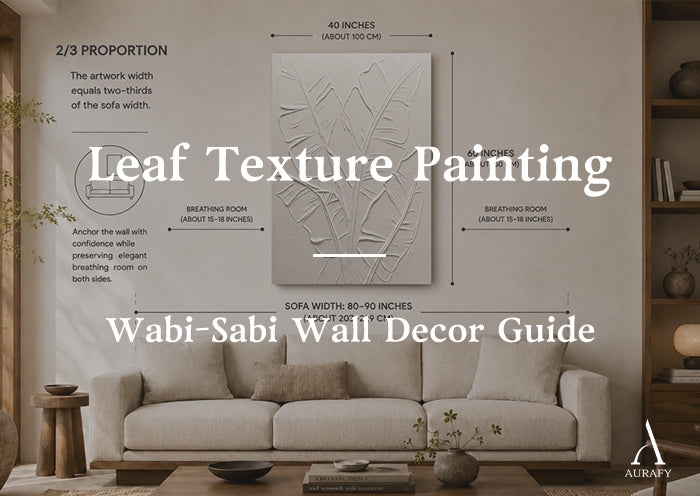
- Display leaf texture painting to bring raw botanical silhouettes and organic movement into a minimalist living space.
- Choose authentic wabi-sabi style 3D leaf wall art over flat prints — real physical depth celebrates natural imperfection in a way no print can.
- Use deeply sculpted 3D tree wall art to connect hard interior architecture with warm, wood-focused furniture.
- Position botanical 3D canvas under 45-degree angled track lighting to cast soft, directional shadows across the leaf vein structures.
- Clean delicate leaf texture artwork with a soft dry brush or compressed air — never use liquid or chemical cleaners near the surface.

Wabi-sabi and Japandi interiors work because they use real materials. Raw linen, solid oak, unglazed clay, worn stone — surfaces with texture, variation, and the honest marks of how they were made.
The walls are often the last element to receive this treatment. A flat botanical print above an oak credenza looks fine in a photograph. In person, beside the genuine grain of the timber and the rough weave of the linen, the printed surface reads as exactly what it is — ink on a flat canvas.
Leaf texture painting closes this gap. A piece where leaf and branch forms are built up in physical relief — with real depth, real shadow, and the natural imperfection of a hand-made surface — belongs in the material conversation of a wabi-sabi or Japandi room. It does not hang on the wall. It participates in the room.
The Aesthetic Logic of Wabi-Sabi Style 3D Leaf Wall Art

Wabi-sabi is built on three principles: imperfection, impermanence, and incompleteness. These are not limitations to work around. They are the qualities the aesthetic celebrates.
Wabi-sabi style 3D leaf wall art embodies all three.
The leaf forms in a handmade piece are not geometrically perfect. The veins do not run in perfectly parallel lines. The edges of leaves are not smoothly outlined — they taper, break, and curl at the tips in ways that mirror what leaves actually do. These variations are not mistakes in the execution. They are evidence of the hand and the process, and in wabi-sabi terms, that evidence is the work's highest quality.
The surface speaks the same language as the room.
The material used to build a leaf texture piece — acrylic modeling paste in a neutral, matte finish — has a quality similar to dried clay or compressed earth. It is dense, slightly granular in the recessed areas, and completely matte. This surface quality aligns directly with the materials that wabi-sabi and Japandi interiors favor: unglazed ceramics, raw linen, natural stone, solid untreated timber.
In a room built on these materials, a leaf texture piece does not introduce a new material language. It continues the existing one onto the wall. The connection is immediate and felt rather than consciously noted.
It works without color.
A piece in warm sand, oat, pale greige, or natural clay adds material depth to a wall without adding color complexity. The composition reads through shadow and form alone. In a room that has already committed to a narrow, restrained palette, this restraint is not a limitation — it is what makes the piece compatible with everything around it.
3D Tree Wall Art as a Spatial Anchor

For larger rooms — open-plan living spaces, high-ceiling dining rooms, wide entryways — a piece built around tree or branch forms serves a specific spatial function that leaf-scale work alone cannot.
3D tree wall art introduces vertical and horizontal scale to a composition. A tree trunk form extending upward across a large canvas draws the eye along its length and creates a visual axis in the room. Branch forms extending outward from the central trunk establish a horizontal spread that fills wall space with purposeful form rather than decoration.
In a room with high ceilings, this upward orientation makes the ceiling feel intentionally tall rather than simply empty. In a wide open-plan space, it provides the central visual anchor that prevents the room from reading as a series of disconnected furniture arrangements.
The piece extends the furniture narrative upward.
In wabi-sabi and Japandi interiors, the furniture is often the strongest material statement in the room — the grain of an oak dining table, the weathered surface of a solid timber sideboard. A 3D tree wall art piece hung above these pieces extends their material language vertically. The rough, organic texture of the plaster surface echoes the grain of the timber below it. The wall becomes part of the furniture composition rather than a neutral background behind it.
Pairing Guide: Leaf Texture Art with Japandi and Wabi-Sabi Materials
|
3D Palette |
Complementary Room Materials |
Visual Balance Principle |
|
Warm sand / oat white |
Raw linen curtains / pale white oak table / natural wool sofa |
Classic Japandi: consistent warm, low-saturation tones eliminate visual conflict — the leaf vein shadows become the room's only micro-detail |
|
Clay greige / weathered grey-brown |
Micro-cement floors / charred timber furniture / rough clay ceramics |
Dark-toned wabi-sabi: the slightly gritty grey texture mirrors the carbon quality of charred wood and amplifies the time-worn atmosphere |
|
Soft sage green |
Jute rug / rattan armchair / warm white walls |
Organic modern: a single restrained plant tone cuts through a warm-neutral room without competing with the natural material palette |
|
Pale warm ivory |
Travertine side table / linen upholstery / brushed brass fixtures |
Quiet luxury: ivory petal and leaf forms sit naturally against the honeycomb texture of travertine — both surfaces reward close attention |
Why Handmade Craft Defines This Category

Botanical wall art exposes production quality more directly than abstract work. When the subject is a leaf or a branch — a form the eye knows from the natural world — any mechanical repetition reads immediately as artificial.
A machine-pressed leaf panel has uniform vein depth across the full surface. Every branch fork sits at the same angle. Every leaf edge has the same profile. Under a spotlight, the surface reflects with a consistent, predictable regularity that looks nothing like the natural world it references. In a wabi-sabi room designed around honest, varied materials, this uniformity is a significant problem.
At AurafyArt, every piece is made to order in our dedicated artist studio. No molds, no templates, no inventory. When your order arrives, an artist starts the piece from scratch.
The artist begins by mixing the modeling paste to the right consistency for that composition. Botanical work requires a paste that holds fine detail — narrow vein lines, thin leaf edges — without becoming brittle. The mixture is adjusted piece by piece.
The leaf and branch forms are built in stages. The primary structure — the main leaf bodies and branch forms — is applied first and left to cure fully. Secondary detail — the vein network, the edge variations, the overlapping leaf layers — is added in subsequent sessions, each one building on a fully cured foundation. This layered process takes 10 to 14 days for a complex botanical composition.
The natural variation that results from this process is irreplaceable. The slight asymmetry between the left and right sides of a leaf. The vein line that deepens unexpectedly in one section. The leaf edge that lifted slightly during application and left a thin, sharp curl. These are the marks that make the piece look like it came from nature rather than from a factory.
Two coats of UV-resistant, low-VOC matte varnish seal the finished surface. This protective layer prevents yellowing, reduces dust adhesion, and maintains the matte quality that gives botanical work its natural, organic character.
How to Light Leaf Texture Art: Step-by-Step

Leaf and vein structures are fine-scale. The shadow channels are narrow — often only a few millimeters wide. Bringing out the full detail of these structures requires precise light placement.
Step 1: Install the spotlight 12 to 15 inches from the wall
This is further from the wall than the standard recommendation for simpler 3D work. Botanical pieces with projecting leaf forms need this additional distance to allow the light to clear the outermost elements and reach the full canvas surface without creating a dark shadow band beneath the overhanging leaves.
If the light source is too close to the wall, the upper leaf edges cast large shadows onto the lower sections of the composition. The lower detail — often the most intricate part of the piece — becomes invisible. Moving the light outward flattens the entry angle enough to prevent this.
Step 2: Maintain a 30 to 45 degree beam angle
The beam should travel across the face of the canvas — not down at it from directly above. This shallow angle is what sends light into the vein channels rather than over them. Under a 30 to 45 degree beam, each narrow vein channel catches shadow on one face and light on the other. The micro-contrast this creates gives the surface its botanical depth and detail.
Step 3: Confirm even coverage before fixing the light position
Switch on the spotlight in its planned position and check the full canvas from normal viewing distance — typically 6 to 10 feet. Look specifically at the bottom third of the composition: if this area is significantly darker than the upper two-thirds, the spotlight is too close to the wall or angled too steeply. Adjust before making the installation permanent.
Use warm white bulbs throughout
2700K to 3000K bulbs enhance the warm, earthy tones of neutral botanical work. They make sandy and oat-toned surfaces glow with the same warmth as natural morning light. Cool white bulbs above 4000K make the same tones look flat and grey — which removes the natural, organic quality that makes botanical 3D work worth choosing.
Frequently Asked Questions
Does dust collect in the leaf vein channels, and will the surface yellow over time?
Dust does settle in recessed channels over time — this is true of any textured surface with fine detail. The UV-resistant varnish applied to every AurafyArt piece reduces the static charge on the surface, which slows dust adhesion compared to an unsealed surface. For cleaning, use a wide soft-bristle brush to sweep gently along the direction of the vein lines every two to three weeks. For deep recesses, use short bursts from a can of compressed air directed into the channels. Never use a damp cloth or any liquid near the surface — moisture in the recessed channels can cause the modeling paste to absorb humidity and eventually develop micro-cracks. On yellowing: the acid-free base materials and UV-resistant varnish prevent yellowing under normal indoor conditions. A piece hung away from intense direct sunlight will maintain its original tone for decades.
What size works best for a wabi-sabi or Japandi living room?
For placement above a sofa or sideboard, a piece between 36 and 48 inches wide is appropriate for most standard three-seat sofa configurations. This covers roughly two-thirds of the sofa width — the proportion that design professionals consistently recommend. For a standalone feature wall with no furniture anchor below it, a larger format — 40 × 60 inches or more — fills the wall decisively and allows the botanical forms to read at the scale that gives them their full presence. Leaf and vein detail scales well — a larger piece reveals more surface complexity at viewing distance rather than simply looking like a bigger version of a smaller piece.
Can leaf texture painting work alongside real plants in the same room?
Yes — and this is one of the most effective pairings in a wabi-sabi or Japandi context. Real plants bring living form and seasonal change. A 3D leaf piece brings permanent, sculptural form in the same botanical language. The combination reinforces the same design intention rather than creating competition. Position the 3D piece as the wall anchor and allow living plants to occupy floor and surface positions where natural light reaches them. The result is a layered botanical environment where the wall, the surfaces, and the floor all participate in the same visual language.
The Wall Becomes Part of the Room
In a wabi-sabi or Japandi interior, every surface carries meaning. The grain of the timber, the weave of the linen, the rough glaze of the ceramic vessel — all of these communicate the room's philosophy before anyone sits down.
Leaf texture painting brings that philosophy to the wall. It introduces the irregular beauty of natural botanical form as a physical surface rather than a printed image. It connects the wall to the furniture below it through shared material language. And it changes through the day as the light moves across it — alive, in the most modest and considered way.
The room becomes whole.
Share:
3D Floral Painting: Organic Modern Wall Decor Guide
3D Wave Wall Art: Ocean Texture for Calmer Homes