


- Textured plaster art is highly durable. Once cured, the surface holds its three-dimensional form without sagging or cracking over time.
- No machine can replicate the natural marks left by a hand-held palette knife. Every handmade plaster piece is genuinely one of a kind.
- Plaster is the ideal material for minimalist plaster wall decor and wabi-sabi spaces — its matte surface catches light in a way no print can match.
- Daily care is simple: use a soft brush to remove dust. Avoid all chemical cleaners.
Most printed wall art has the same problem. It looks flat. It adds color, but no weight. No presence. No sense that something real is hanging on the wall.
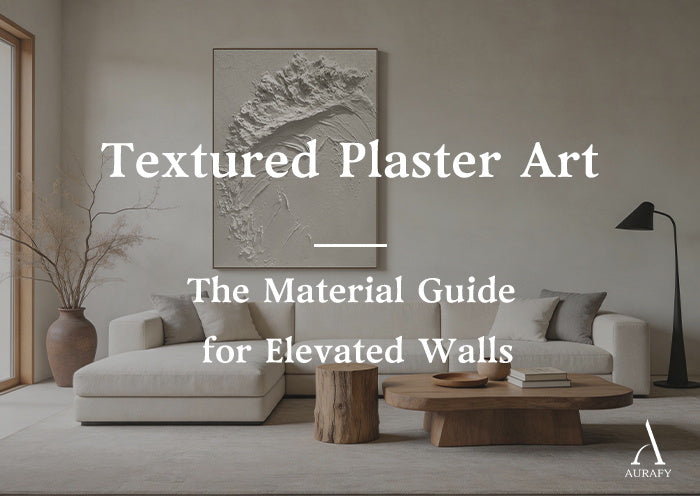
Textured plaster art solves this. Plaster is one of the oldest materials in art and architecture — and in 2026, artists are using it in entirely new ways to reshape what a wall can feel like. The result is a category of handmade work that brings genuine depth, warmth, and texture to even the most minimal space.
This guide breaks down what makes plaster unique as an art material, why handmade always beats machine-made, and how to care for your piece once it is on the wall.
Beyond Flat: What Makes Plaster Texture Painting Different

Not all texture materials are equal. Plaster texture painting uses professional-grade modeling paste — a dense, sculptural compound that behaves differently from standard acrylic paint or gesso.
Here is what sets it apart.
It holds serious thickness. Modeling paste can be built up to several centimeters without losing its shape. It dries hard, not rubbery. The ridges and peaks you see in the finished piece are permanent — they will not flatten or sag over time.
It resists cracking. When applied correctly in layers and allowed to cure fully between sessions, quality plaster compound bonds tightly to the canvas or panel beneath it. The result is a surface that handles normal indoor temperature and humidity changes without developing fine cracks.
It captures light beautifully. Plaster dries to a naturally matte finish. This is important. A matte surface does not bounce light back directly — it scatters it softly across the ridges and valleys of the texture. Under a warm spotlight or natural sidelight, this creates the kind of quiet, layered shadow that makes a piece look alive. No glossy print can produce that effect.
Handmade vs. Machine-Made: Why It Matters in 3D Wall Texture Painting

Walk through any mass-market home decor store and you will find 3D wall texture painting that looks impressive in a photograph. In person, the difference is immediate.
Machine-pressed texture is uniform. Every ridge repeats at the same angle, the same depth, the same distance apart. It reads as pattern, not art. Your eye adjusts to it within seconds and stops seeing it.
Handmade plaster work is the opposite.
The artist controls everything in real time.
At AurafyArt, each piece begins with the artist mixing the plaster compound by hand — adjusting the density based on what the composition needs. Thicker for bold, architectural ridges. Looser for soft, flowing lines. No two batches are identical.
The palette knife does the rest.
Every stroke is a decision. The angle of the blade, the pressure applied, the speed of the pull — all of these leave a different mark on the surface. Some strokes build up sharp peaks that catch hard light. Others drag the paste into long, smooth sweeps. Some edges are left raw and unfinished, and those raw edges are often the most expressive parts of the piece.
The small imperfections are not mistakes. They are the work.
A slight asymmetry in a ridge. A place where the paste lifted unexpectedly and left a jagged edge. These are the marks that tell you a human made this — and they are the marks that keep the eye moving across the surface long after a machine-made piece has become invisible.
This is the difference that 3D wall texture painting by hand delivers. It is not just texture. It is evidence of a process, and that evidence is what gives the work lasting visual interest.
The Natural Fit: Minimalist Plaster Wall Decor and the Spaces That Need It

Minimalist interiors have a specific problem that most people do not name directly.
When a room strips away pattern, ornament, and color contrast, it risks feeling empty rather than calm. The solution is not to add more objects — it is to add material richness. And that is exactly what minimalist plaster wall decor provides.
Plaster art introduces texture without introducing noise. It adds visual weight without adding color. A monochromatic or near-neutral piece on a white or warm-grey wall gives the eye something to rest on — and something to explore — without breaking the stillness of the space.
What to pair it with:
Plaster art works best alongside natural, tactile materials. Raw linen cushions. An oak dining table with visible grain. A jute rug. Unglazed ceramic vessels. These materials share the same honest, unfinished quality as the plaster surface itself — and together they create a room that feels considered and calm.
Color guidance:
For the plaster piece itself, white, off-white, warm sand, and soft grey tones integrate most naturally into minimalist and Japandi spaces. If the room already carries warm tones — terracotta, warm timber, brass — a plaster piece in warm ivory or pale ochre will feel at home immediately.
For a broader look at how 3D art works across different rooms and layouts, see our complete guide: [What Is 3D Textured Wall Art? The 2026 Ultimate Guide]
How to Clean Plaster Wall Art: A Step-by-Step Guide

Plaster art is more durable than it looks — but it does need gentle, regular care. Follow these steps to keep your piece in excellent condition for years.
1. Dust regularly with a soft brush. Use a clean, dry soft-bristle brush — a wide makeup brush or a soft paintbrush works well. Brush gently along the ridges in one direction to lift dust away from the surface. Do this every two to four weeks. Regular light dusting prevents buildup from settling into the low areas of the texture.
2. Use compressed air for hard-to-reach areas. For deep recesses where a brush cannot reach, a can of compressed air (the kind sold for electronics) clears dust without any physical contact. Hold the can upright and use short bursts from a safe distance.
3. Treat light marks with a barely damp cloth. If a light mark or smudge appears on the surface, use a clean microfiber cloth with the smallest possible amount of water. Press gently on the mark — do not rub or scrub. Allow the area to air dry completely before touching it again.
4. Never use chemical cleaners. Avoid anything containing alcohol, bleach, ammonia, or general-purpose household cleaners. These break down the protective varnish layer on the surface. Once that layer is damaged, the plaster beneath becomes vulnerable to moisture and staining. There is no easy way to repair it. Dry methods are always the safest choice.
Plaster Is Not Just a Material — It Is a Language
The best way to understand textured plaster art is to stop thinking of it as decoration.
A flat print covers a wall. A handmade plaster piece changes it.
It introduces shadow where there was none. It adds weight and warmth to a room that reads as too smooth, too uniform, too easy to look past. It gives the wall a surface worth looking at — one that shifts through the day as the light moves, and one that carries the visible memory of how it was made.
Plaster has been used by artists and builders for thousands of years. The reason it is still here — and still relevant — is simple. No material is better at turning a flat surface into something that feels like it belongs to the physical world.
That is what your wall deserves.
👉 Explore the AurafyArt Original Handmade 3D Textured Collection — Give your bare walls the physical presence and changing shadows they deserve.
Looking for your piece? Browse the AurafyArt collection of handmade textured plaster art — or contact us(email:info@aurafyart.com) to discuss a custom size made specifically for your space.
Share:
2026 Ultimate Guide: What Is 3D Textured Wall Art?
Texture Painting on Canvas: Art vs. Prints