


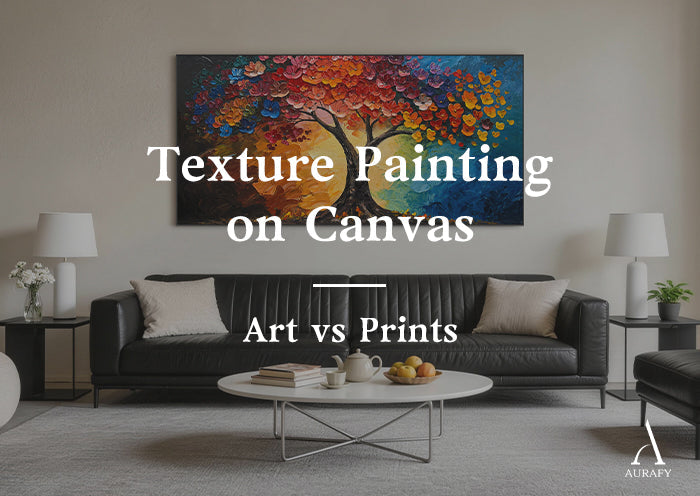
- Texture painting on canvas uses real physical depth to create light and shadow — something no flat print can do.
- Every handmade textured canvas is unique. The brushstrokes and knife marks cannot be copied or reproduced.
- Textured canvas wall art is the fastest way to add a sense of quality and weight to a living room or feature wall.
- 3D canvas art holds greater long-term value than mass-produced prints — both emotionally and as a collected object.
You spent real money on a canvas print. You hung it on the wall. And somehow it still looks like a poster.
This is one of the most common frustrations in home decorating. The image might be beautiful. The colors might be right. But something is missing — and that something is physical presence.
Texture painting on canvas is what fills that gap. It is not just a different style of art. It is a different category of object — one that has real thickness, real surface variation, and a visual quality that changes as the light in your room changes throughout the day.
Flat Print vs. 3D Canvas: What Is the Actual Difference?

This is the question most buyers do not think to ask until they see both options side by side. The table below shows the key differences clearly.
|
|
Flat Canvas Print |
Texture Painting on Canvas |
|
Light and shadow |
Fixed. Looks the same under any light. |
Changes throughout the day. Angled light creates new shadows across the surface. |
|
Surface feel |
Smooth and uniform. |
Physical ridges and peaks left by the palette knife. |
|
Visual weight |
Thin. Can look flat even at large sizes. |
Carries the presence of a low-relief sculpture. Holds its own in large spaces. |
|
Uniqueness |
Identical copies exist. |
No two handmade pieces are the same. |
|
Production |
Machine printed in minutes. |
Hand-built over multiple days. |
|
Longevity of interest |
The eye adjusts to it quickly. |
Surface complexity keeps the eye engaged over time. |
The core difference comes down to this: a flat print shows you an image. A plaster texture painting on canvas gives you an object.
One hangs on the wall. The other lives on it.
Why Handmade Textured Canvas Has Greater Lasting Value

Mass production is efficient. But efficiency is not what makes art worth keeping.
Every handmade piece is unrepeatable.
When an artist builds a textured canvas by hand, the result is shaped by dozens of small, real-time decisions. How thick to mix the paste. How much pressure to apply with the knife. When to stop. Even if the same artist sets out to make two identical pieces, the surface marks will diverge. The texture goes where the hand takes it — and no two hands move exactly the same way twice.
This is not a limitation. It is the entire point.
The process takes days, not minutes.
Take 3D flower painting on canvas as an example. To build a single flower in relief, the artist applies one layer of modeling paste, shapes the basic form, and waits for it to cure fully — often overnight. Then comes the next layer: refining the petals, adding depth to the center, building the edges up into sharp, light-catching ridges. Then curing again. Then color, applied as thin washes that settle into the low areas and leave the high points bright.
A single flower can take two to three sessions. A full composition takes weeks.
That time is in the object. You can see it in the surface. And that is something a machine-printed canvas will never carry.
The piece holds a human connection.
A print is a file rendered by a machine. A handmade textured canvas holds the decisions, the pace, and the attention of the person who made it. That difference is not abstract — most people feel it immediately when they stand in front of the real thing.
How to Choose Textured Canvas Wall Art for Your Living Room
The living room is the room most people want to get right — and the room where the wrong art choice is most visible. Textured canvas wall art for the living room works especially well here because the scale and the social function of the space both reward strong visual presence.
Here is how to choose well.
Get the size right first.
The most common mistake is buying too small. As a starting point, the width of your artwork should cover roughly two-thirds of the width of the sofa or furniture below it. A piece that feels bold in a shop will often read as modest on a large wall. When in doubt, go larger.
Match the tone to the room.
If your living room carries dark or heavily saturated furniture — deep navy, charcoal, rich timber — a high-texture piece in off-white, warm ivory, or pale sand will lift the space without competing with what is already there. The texture does the visual work. The neutral tone keeps the balance.
If the room is already light and neutral, a textured canvas in a slightly deeper earth tone — warm taupe, soft clay, dusty stone — adds depth without breaking the calm.
Think about the light source.

Textured canvas art performs best on walls that receive angled natural light or that you can light with a track spotlight. A flat wall lit only from directly above will not show the surface at its best. Position the piece where light can cross it from the side, even partially. The shadows that appear are what make the texture worth having.
For a deeper look at how plaster and texture materials behave in different spaces, see our material guide: [Textured Plaster Art: The Material Guide for Elevated Walls]
Frequently Asked Questions
Will texture painting on canvas crack over time?
It depends entirely on the materials and technique used. Low-quality texture work — applied too thickly in a single layer, or made with rigid compound — is prone to cracking as the canvas flexes. At AurafyArt, we use a professional-grade flexible modeling medium that moves with the canvas rather than against it. Each layer is applied gradually and allowed to cure fully before the next is added. This process produces a surface that handles normal indoor temperature and humidity changes without developing cracks.
Canvas has no glass cover — is it harder to maintain?
Actually, the opposite is true. Framed prints under glass create reflection problems and make cleaning more awkward. An unframed textured canvas is straightforward to maintain. Use a soft dry brush every few weeks to sweep dust from the ridges. For any light marks, press gently with a barely damp microfiber cloth and allow it to air dry. No special products are needed. The protective varnish coat applied during production handles the rest.
Your Wall Deserves More Than a Poster
Flat canvas prints have their place. But if you want a wall that holds attention — that looks different in the morning than it does at night, that carries real weight in the room, that rewards a close look — a print is not going to get you there.
Texture painting on canvas is the step up. It brings the surface of the wall to life. It introduces the kind of material depth that makes a room feel complete rather than decorated.
The difference between a room that looks designed and a room that just looks furnished often comes down to one piece. One wall. One object with enough presence to anchor everything around it.
Ready to find yours? Explore the AurafyArt collection of Handmade Texture Paintings on canvas — and find the piece that makes your wall worth looking at.
Share:
Textured Plaster Art: The Material Guide for Elevated Walls
Easy Texture Painting: DIY vs. Professional Wall Art