


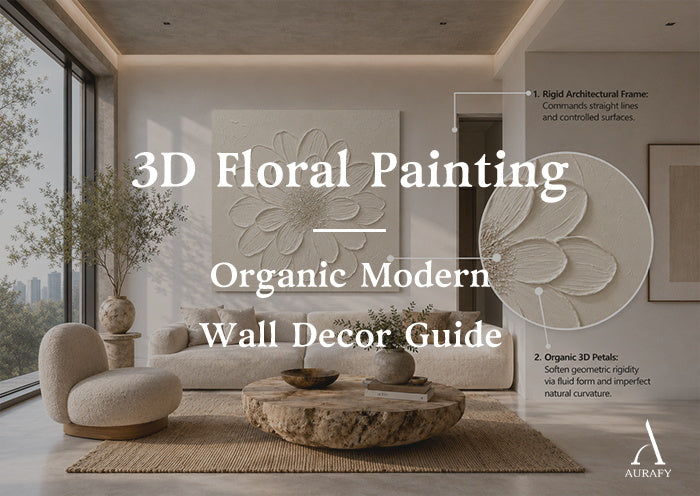
- Display 3D floral painting to bring soft, organic silhouettes and tactile warmth into a modern interior without introducing visual clutter.
- Choose handmade 3D textured flower wall decor over flat floral prints — individually sculpted petals catch light and cast micro-shadows that flat prints cannot produce.
- Use heavy impasto texture painting flowers in organic modern spaces to soften hard architectural angles with natural, flowing forms.
- Position 3D flower wall art under 45-degree angled track lighting to maximize the botanical shadow depth across each petal layer.
- Clean delicate floral artwork using a wide soft-bristle brush or dry compressed air — never use liquid or chemical cleaners near the surface.

Organic modern interiors have a specific challenge. The furniture is clean and considered. The palette is restrained. The materials are natural. But the walls remain flat — and flat walls, in a room designed around texture and organic form, are the weakest element in the composition.
Flat floral prints do not solve this. A printed botanical image adds pattern, but it adds no physical depth, no shadow, no sense that the surface is alive. It reads as decoration, not as art.
3D floral painting is different. When individual petals are built up in relief — layer by layer, by hand, using sculptural paste — the surface becomes genuinely three-dimensional. Each petal casts its own shadow. The composition changes as the light in the room changes. And the organic, imperfect quality of the hand-made surface echoes the natural materials around it in a way that no print can.
The Aesthetic Power of Handmade 3D Textured Flower Wall Decor
The defining quality of handmade 3D textured flower wall decor is that each element of the composition has its own physical presence.
In a flat floral print, all petals sit at the same level. The depth is suggested by shading, not created by the surface. From any angle, the composition looks identical.
In a handmade 3D piece, each petal is built independently. The artist determines the direction each petal faces, how far it curls at the edge, how steeply it rises from the background surface. Two petals built by the same hand on the same day will not be identical. The variation is the point.
The curved edges soften a room's geometry.
Most rooms are built on straight lines — ceiling planes, floor lines, window frames, door frames, and the rectangular footprints of furniture. Organic modern design works against this rigidity by introducing curved, natural forms. A 3D floral piece with layered, softly curved petals performs this function on the wall itself.
The irregular, wave-like edges of heavy impasto petals break the visual dominance of the straight lines around them. The surface does not impose pattern or color — it introduces form. A piece in off-white, warm ivory, or pale sand contributes organic curvature without disrupting the room's color restraint. The result fits naturally within the organic modern philosophy of controlled naturalism.
The surface rewards proximity.
In most rooms, art is experienced from a distance. A floral 3D piece also rewards close viewing in a way that flat art cannot. The individual petal edges, the slight variations in surface depth, the narrow shadow channels between overlapping petals — these details are fully visible only at arm's length. A guest who approaches the piece will find a level of craft detail that changes their understanding of what they are looking at.
3D Flower Wall Art Through the Day: A Living Surface
One of the strongest arguments for 3D flower wall art is that it is not a fixed image. It changes continuously as the light in the room changes.
Morning and afternoon natural sidelight
When natural light enters from a window at an angle — low morning sun, or afternoon light crossing the wall diagonally — it travels across the petal surfaces at a shallow angle. The raised edges of each petal catch a bright highlight along their uppermost face. The recessed areas between overlapping petals fall into shade.
The transition between highlight and shadow shifts gradually through the day as the sun moves. By mid-morning the shadows sit differently than they did at 8am. By late afternoon the entire composition reads with a warmth and depth that was not present at noon. The piece lives on the wall rather than simply hanging on it.
Evening under artificial light
Switch on a warm spotlight positioned at 45 degrees from the wall and the piece transforms completely.
The directional light catches every raised petal edge sharply. The shadow channels between petals deepen. The composition reads as a sculptural relief — closer in character to carved stone or ceramic work than to a conventional painting. The botanical subject matter, which reads as warm and natural in daylight, reads as refined and architectural under a focused evening light.
This range — from soft and organic to bold and sculptural — gives a 3D floral piece an adaptability through the day that makes it genuinely worth living with over years.
How Texture Painting Flowers Are Built: The Craft Behind the Surface

The physical quality of a texture painting flowers piece depends entirely on how it was made. The construction method is what determines whether the surface holds its form for years or begins to crack within months.
The problem with applying texture all at once
Modeling paste applied in a single thick layer traps moisture at the core. As the outer surface cures, it forms a skin. The moisture beneath that skin continues to evaporate slowly — and as it does, it contracts. The result is fine cracking on the surface, often invisible at first and progressively more visible over time.
Professional floral texture work avoids this through a layered, time-controlled process.
How a single flower is built correctly
The artist begins with the base — the center of the flower and the first layer of petals, applied thinly and allowed to cure fully in ambient conditions. This takes a full day under normal studio temperature.
Once the base layer is stable, the artist builds the next tier of petals on top — adding height, adjusting the curvature of each petal edge, and beginning to define the specific character of the composition. This layer also cures fully before the next is applied.
The process continues over 10 to 14 days for a complex floral composition. Each session adds detail and height. Each curing period ensures the structural integrity of everything below it.
The finished surface is not simply thick — it is layered, with each element bonded properly to what is beneath it. This construction is what gives the piece its physical lifespan.
The protective finish
Every AurafyArt floral piece receives two hand-applied coats of UV-resistant, low-VOC matte varnish before shipping. This seal protects the surface from atmospheric moisture, prevents the white and neutral tones from yellowing over time, and maintains the matte surface quality that gives the piece its natural, organic appearance.
Pairing 3D Floral Art with Organic Modern Interiors

|
3D Floral Palette |
Complementary Room Materials |
Visual and Emotional Balance |
|
Matte gallery white / warm oat |
Raw linen upholstery / natural oak table / brass fixtures |
Classic organic modern: the texture of linen and the surface of the plaster work share the same honest, natural material language |
|
Grey-green / warm moss tones |
Pale grey micro-cement floors / matte black metal shelving / tan saddle leather |
Modern eclectic naturalism: the muted plant tone softens black metal and cool grey without introducing a competing color statement |
|
Dusty blush / warm terracotta petals |
Bouclé fabric armchair / travertine coffee table |
Warm organic luxury: the natural pores of the travertine and the layered petal texture create complementary material richness |
|
Soft sage / pale celadon |
White-washed timber / woven jute rug / natural clay ceramics |
Quiet botanical harmony: cool-toned petals sit naturally alongside earthy neutrals and handmade ceramic forms |
The general principle: choose a petal tone that shares one quality with the dominant material in the room — either its warmth, its texture quality, or its tonal value. The 3D surface will carry the connection across any color gap.
How to Light 3D Floral Art Without Creating Shadow Blind Spots

Floral 3D pieces have more surface variation than geometric or abstract works — the layered petals can project several centimeters from the canvas background. This makes correct lighting especially important, and makes incorrect lighting especially damaging to the visual result.
The blind spot problem
When a spotlight sits too close to the wall or angles too steeply downward, the outermost petals cast a large shadow onto the lower section of the composition. This shadow covers some of the most detailed areas of the piece — the lower petal layers and the base of the flower forms — in near-total darkness. The upper petals are well-lit. The lower section is lost.
The correct approach
Install the spotlight or track head 12 to 15 inches from the wall — further than the standard recommendation for flat or low-relief work. This additional distance gives the light a shallower entry angle, which allows it to clear the top petal edges and reach the full height of the composition without creating a shadow band at the bottom.
Maintain the beam angle at 30 to 45 degrees from the wall surface. At this angle, the light travels across the full face of the composition, catching individual petal edges with fine highlight lines and dropping the inter-petal channels into micro-shadows that give the piece its sculptural depth.
Confirm coverage before finalizing the installation
Switch on the light in its intended position and check the full canvas surface from a normal viewing distance — typically 6 to 10 feet. Confirm that all four sections of the canvas receive even illumination and that no section falls into a dark band caused by petal shadow. Adjust the spotlight position or angle before permanently fixing it.
When positioned correctly, the light transforms a botanical 3D piece from a well-made decorative object into something that reads as a private museum exhibit — every petal edge caught, every shadow channel precise, the full physical depth of the composition revealed.
Frequently Asked Questions
Does dust collect inside the petal gaps, and will the surface yellow over time?

Dust does settle into the recessed areas between overlapping petals over time. The protective varnish applied to every AurafyArt piece reduces static charge on the surface, which slows dust adhesion significantly compared to an unsealed surface. For cleaning, use a wide soft-bristle brush — a large makeup brush or a wide watercolor brush — to sweep gently along the direction of the petal curves every two to three weeks. For deep inter-petal recesses, use short bursts from a can of compressed air directed into the gaps. Never use a damp cloth, water, alcohol, or any liquid cleaner near the surface. On the yellowing question: the UV-resistant varnish and the acid-free base materials used in every piece prevent yellowing under normal indoor conditions. A piece hung away from direct intense sunlight will maintain its original tone indefinitely.
What size works best for a 3D floral piece in a living room?
For placement above a sofa, a piece between 36 and 48 inches wide works well for most standard three-seat sofas. This places the artwork in the correct proportion to the furniture below it — covering roughly two-thirds of the sofa width. For a standalone feature wall without furniture below, a larger format — 40 × 60 inches or more — is appropriate. Floral 3D work reads well at generous scale because the individual petal detail remains visible from across the room while the overall composition reads as a coherent form. Avoid sizing down for a large wall — a small floral piece on a large wall looks like a botanical illustration rather than a significant artwork.
Can a 3D floral piece work in a room that already has real plants?
Yes — and this is actually one of the most effective combinations. Real plants introduce living form, color, and seasonal variation. A 3D floral piece on the wall introduces permanent, sculptural form in the same botanical language. The two do not compete — they reinforce the same design intention. Position the wall piece in an area with good artificial light for evening display, and allow the living plants to sit where they receive the natural light they need. The combination of living and sculptural botanical elements creates the layered, organic atmosphere that organic modern interiors are built around.
A Flower That Does Not Fade
The appeal of a 3D floral piece is not just visual. It is material. The petals are real — built from physical substance, by hand, over time. They cast real shadows. They change with the light. They carry the marks of the process that made them.
3D floral painting brings the organic quality of the natural world to a surface where nature cannot actually grow. It introduces the softness of botanical form into a room built on straight lines and smooth materials. And it does this permanently — without water, without care, without the cycle of growth and decay.
The wall stays in bloom.
Share:
Textured Framed Wall Art: The Complete Frame Guide
Leaf Texture Painting: Wabi-Sabi Wall Decor Guide