


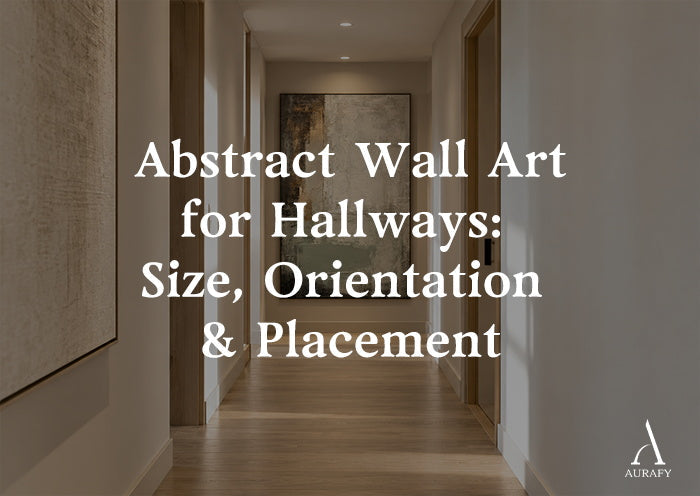
Abstract Wall Art for Hallways: Size, Orientation & Placement

Hallways call for different sizing logic than most rooms, since there's usually no furniture to measure against and the art is seen up close, in passing, rather than from across a room. The two main choices are an end-wall destination piece, sized to the wall it terminates, and a side-wall sequence, sized and spaced for rhythm rather than a single focal width. This guide covers both, along with the clearance and safety considerations that matter most in a walked space.
End Wall or Side Wall: Two Different Jobs
What's the difference between end-wall and side-wall hallway art?
An end wall, the wall walked toward at the close of a hallway or a stair landing, works as a destination piece, usually seen head-on from a distance, so a single, moderately scaled piece filling a meaningful portion of the wall tends to read well. A side wall, by contrast, is passed rather than approached, and often suits a sequence of pieces or one narrower piece rather than a single wide one, since a hallway's width rarely allows for much horizontal spread.

Sizing Without Furniture to Measure
How do I size art for a hallway with no furniture nearby?
Since hallways usually lack furniture to size against, it helps to think in terms of the wall segment itself rather than a furniture-based percentage. A loose starting guideline is to keep a single piece at roughly 40 to 60 percent of the available wall segment width, leaving enough surrounding wall that the piece doesn't feel wedged between doorways or corners. This is a different ratio from the furniture-width guidance used elsewhere in the home, since a hallway wall segment functions differently from a sofa or console.
| Wall segment width | Art width at ~40% | Art width at ~60% |
|---|---|---|
| 24 in | 10 in | 14 in |
| 30 in | 12 in | 18 in |
| 36 in | 14 in | 22 in |
| 48 in | 19 in | 29 in |
Treat these as a loose starting point rather than a rule. A narrow hallway with a tall ceiling can often carry a taller vertical piece than the width alone suggests.
Why Vertical Formats Tend to Win
Why is vertical orientation so common in hallways?
Hallways are usually narrow with proportionally tall walls relative to their width, so a vertical piece tends to fit the available space more naturally than a horizontal one. AURA187 Modern Abstract Blue Beige Gold Wall Art for Living Room Modern Abstract Blue Beige Gold Wall Art for Living Room - AURA187 and AURA023 Modern Textural Abstract Wall Art - Sage Green & Earth Neutrals
 Modern Textural Abstract Wall Art-Sage Green & Earth Neutrals-AURA023 are both available in multiple orientations, which makes it possible to use the same palette in a vertical format for a hallway even where a horizontal version is used elsewhere in the home. For more on choosing between shapes, see our Orientation guide.

Clearance and Frame Depth
Why does clearance matter more in a hallway than in other rooms?
Hallways are walked through, not just viewed, so physical clearance matters in a way it doesn't in a living room or bedroom. Leave enough space between the art and anything on the opposite wall, a doorway swing, or a stair handrail, so that a passing shoulder or an open door doesn't make contact with the frame. Where a hallway is especially narrow, a shallower frame profile can reduce how far the piece projects into the walking path. This is worth checking against the hallway's actual width before finalizing placement, since it affects everyday use, not just appearance.

Close Viewing Changes What Works
Because hallway art is usually seen from a few feet away rather than across a room, texture and surface detail tend to register more than they would above a sofa or bed. A piece with visible texture, like the weathered surface style found in AURA027 Urban Erosion Painting - Rust & Neutral Tones Urban Erosion Painting-Rust & Neutral Tones-AURA027, can read as more dimensional in a hallway than it might from a distance, simply because passersby are close enough to notice it.
Consistent Height Along a Run
How high should hallway art be hung, and does it need to be consistent?
A commonly used starting reference centers art around 57 to 60 inches from the floor, similar to gallery-standard eye level. Along a run of multiple pieces on a side wall, keeping that center height consistent from piece to piece matters more than in most rooms, since inconsistent heights are easy to notice when walking past several pieces in sequence. Stair hallways are a common exception: many people angle the height gradually to follow the stair's rake rather than keeping every piece at a single fixed height, so the art tracks the sightline while climbing.
Lighting Along the Hallway
Hallways often rely on a single overhead fixture or recessed lighting rather than the layered lighting found in living spaces, and they may get little or no natural daylight if there's no nearby window. Consistent, adequate lighting along the run is worth checking specifically, since a piece that looks fine near a doorway can go dim and flat further down the hall if the lighting doesn't carry evenly.

Deliberate Negative Space
Not every hallway needs to be filled. A single well-placed piece on an end wall, framed by open wall space on either side, often reads as more considered than a hallway lined with art from end to end. Empty wall space isn't wasted space in a narrow hallway; it gives the eye somewhere to rest between pieces and keeps the clearance discussed above from feeling crowded.

Common Mistakes to Avoid
- Applying furniture-based sizing to a hallway. Without a sofa or console to measure against, the furniture-width guideline doesn't translate directly.
- Choosing horizontal art for a narrow wall. It rarely fits the proportions as comfortably as a vertical piece.
- Ignoring clearance. A frame that projects too far into a narrow walking path becomes a practical hazard, not just a design choice.
- Inconsistent hanging height along a run. Uneven heights are more noticeable in a hallway than almost anywhere else in the home.
- Overcrowding the walls. Filling every available inch can make a narrow hallway feel smaller rather than more finished.
Bringing It Together
Hallway art comes down to working with a narrow, walked space rather than a furnished one: size to the wall segment, lean vertical, protect clearance, and leave some negative space rather than filling every wall. Our General Abstract Wall Art guide and Hallway page both cover related sizing and styling principles in more depth.
FAQ
What size art should I use in a hallway?
Without furniture to size against, a loose starting guideline is 40 to 60 percent of the available wall segment width, adjusted for ceiling height and how much surrounding wall space you want to leave.
Should hallway art be vertical or horizontal?
Vertical usually suits hallways better, since the walls are typically narrow and proportionally tall. Horizontal pieces can struggle to fit comfortably in that kind of space.
How high should I hang art along a hallway?
A starting reference around 57 to 60 inches from the floor, measured to the center of the piece, works for most runs. Keep the height consistent from piece to piece, except along a staircase, where many people angle it to follow the stair's rake.
Do I need to worry about clearance for hallway art?
Yes. Because hallways are walked through, leave enough space around the frame to avoid contact with passing shoulders, open doors, or handrails, and consider a shallower frame in especially narrow hallways.
Share:
Abstract Art for Dining Rooms: Size, Color & Sideboard Placement
Horizontal vs Vertical vs Square Abstract Art: Which Shape Fits Your Wall?