


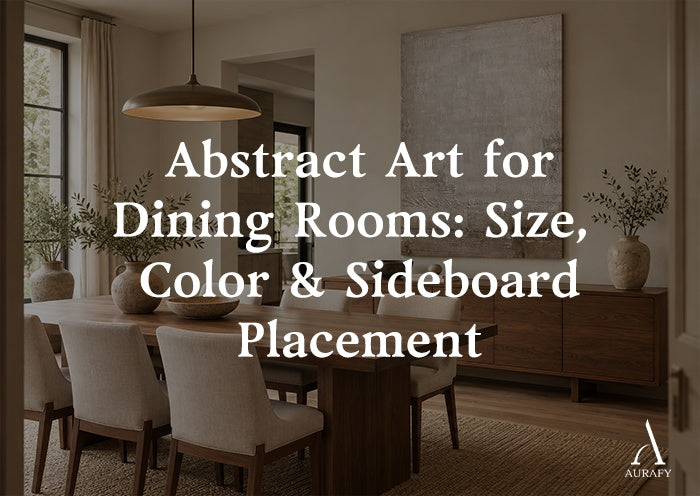
Abstract Art for Dining Rooms: Size, Color & Sideboard Placement

Dining room art usually falls into one of three situations: above a sideboard, on a wall beside or behind the table itself, or filling an otherwise empty focal wall. Each calls for different sizing and viewing logic, though the sideboard scenario can borrow the same starting guidance used elsewhere in the home, roughly 60 to 75 percent of furniture width with a modest visual gap above it. This guide walks through all three.

Situation One: Above a Sideboard
How big should art be above a sideboard?
Measure the sideboard's width and use a starting range of about 60 to 75 percent of that figure. A 60-inch sideboard suggests roughly 36 to 45 inches; an 84-inch sideboard suggests roughly 50 to 63 inches. Leave a visual gap in the range of 6 to 10 inches between the top of the sideboard and the bottom of the art as a first estimate, then adjust based on the sideboard's height and how tall the wall feels above it.
| Sideboard width | Art width at ~60% | Art width at ~75% |
|---|---|---|
| 48 in | 29 in | 36 in |
| 60 in | 36 in | 45 in |
| 72 in | 43 in | 54 in |
| 84 in | 50 in | 63 in |

These figures are calculated guidance, not the dimensions of any specific piece. Check a listing's actual measurements before ordering.
A sideboard wall is also where a diptych can work well. AURA025 Off-White Taupe Wabi Sabi Diptych Wall Art Off-White Taupe Wabi Sabi Diptych Wall Art – Neutral Set of 2 AURA025, offered as a set of two pieces in off-white and taupe, is meant to be considered as one combined width against the sideboard rather than as two independent purchases. Panel sizing and spacing should be confirmed on the product listing rather than assumed.
Situation Two: Beside or Behind the Dining Table
What works on a wall next to or behind the table itself?
This wall doesn't have a furniture width to size against in the same way, since the table usually runs perpendicular to it rather than against it. Instead, consider how the wall reads from a seated position around the table. A single, moderately scaled piece centered on the wall segment tends to work better than something sized to the entire wall, since guests mostly view it while seated at eye level rather than standing back. Leave enough surrounding wall space that the piece doesn't compete with sconces, windows, or door casings nearby.
Situation Three: An Empty Focal Wall
How should I size art for a dining room wall with no furniture beneath it?
Without a sideboard or table to measure against, base the size on the wall itself and the room's proportions rather than any single furniture-width formula. A large, uninterrupted wall can often take a substantial single piece or a well-spaced pair, while a smaller wall segment calls for something more modestly scaled so it doesn't crowd doorways or adjacent furniture. Stand at the entrance to the room and check the proportions before committing, since a dining room is often viewed as a whole from the doorway before anyone sits down.
Seated and Standing Sightlines
Dining rooms are viewed from two different eye levels: standing, when entering or moving around the table, and seated, for the length of a meal. Art hung purely for the standing view can sit oddly high once everyone is seated. It helps to check the piece from a dining chair as well as from the doorway, particularly for anything above a sideboard that sits behind the head of the table.

Color Relationships With Wood, Stone, and Metal
Dining rooms tend to combine more hard materials than other rooms: wood tables, metal chair frames or light fixtures, sometimes stone or tile. Art that repeats one of these tones tends to feel considered rather than incidental.
- Warm wood tables generally pair well with beige, off-white, terracotta, and gold tones. AURA027 Urban Erosion Painting - Rust & Neutral Tones
 Urban Erosion Painting-Rust & Neutral Tones-AURA027, with its muted terracotta and charcoal set against beige and off-white, is a useful reference for a dining room built around warm wood and darker metal accents.
 - Cooler or mixed settings, such as a table with black or brushed metal legs alongside lighter walls, can take a palette with one cool note. AURA187 Modern Abstract Blue Beige Gold Wall Art for Living Room
 Modern Abstract Blue Beige Gold Wall Art for Living Room - AURA187, in blue, beige, off-white, and gold, can work in a dining room as well as a living room, since its gold accent still bridges warmer wood tones nearby.
 - Stone or tile flooring often has its own undertone, warm or cool, worth checking against the art in the same way you'd check wall paint.

One Large Piece or a Diptych
Should I choose a single piece or a diptych for the dining room?
Both suit a sideboard wall; the choice comes down to the wall's proportions and how much visual movement you want. A single large piece tends to feel more settled and is usually simpler to center. A diptych, such as AURA025Off-White Taupe Wabi Sabi Diptych Wall Art – Neutral Set of 2 AURA025, can suit a wider sideboard or a wall that benefits from more rhythm, but the two panels need to be considered as one combined width, with even spacing between them, rather than placed independently, and exact panel dimensions and spacing should always be confirmed on the listing.

Lighting in the Dining Room
Dining rooms are often lit by a combination of a central fixture, wall sconces, and candles or a table lamp during meals, alongside daylight earlier in the day. Warmer light in the evening tends to favor beige, terracotta, and gold tones, while daytime light can read cooler and flatter. If the room includes metallic-accented art, check for glare from directly opposite a window or a bright overhead fixture, since that's often exactly where the main seat at the table looks.
Common Mistakes to Avoid
- Sizing sideboard art to the wall instead of the sideboard. This is one of the most common oversizing mistakes in dining rooms.
- Forgetting the seated sightline. Art that looks right standing can sit oddly high once everyone is seated for a meal.
- Assuming diptych panel sizing without checking the listing. Combined width and spacing should be confirmed against the actual product, not estimated.
- Ignoring the room's hard materials. Wood, metal, and stone tones influence the room as much as wall color does.
Bringing It Together
Across all three dining room situations, the same logic holds: size to the furniture or wall segment in front of you, check the piece from a seated position, and let the room's wood, metal, or stone tones guide the palette. Our General Abstract Wall Art guide covers sizing principles in more depth, and our Dining Room page has further room-specific ideas.
FAQ
How wide should art be above a dining room sideboard?
A starting range of 60 to 75 percent of the sideboard's width is a reasonable first estimate. An 84-inch sideboard suggests roughly 50 to 63 inches, though wall height and room proportions can justify adjusting.
What size art works on a dining room wall with no furniture beneath it?
Without a furniture width to measure against, base the size on the wall's own proportions and how the room reads from the doorway, rather than applying a furniture-based formula.
Should I choose one large piece or a diptych for my dining room?
Either can work above a sideboard. A single piece is usually simpler to center, while a diptych can suit a wider wall or add rhythm, provided both panels are treated as one combined width and their exact sizing is confirmed on the listing.
Does dining room art need to match the table or chairs?
Not exactly, but repeating a tone from the table's wood, the chair frames, or any metal fixtures tends to make the room feel more cohesive than choosing art in isolation from those materials.
Share:
Abstract Wall Art for Bedrooms: Size, Color & Placement Guide
Abstract Wall Art for Hallways: Size, Orientation & Placement