


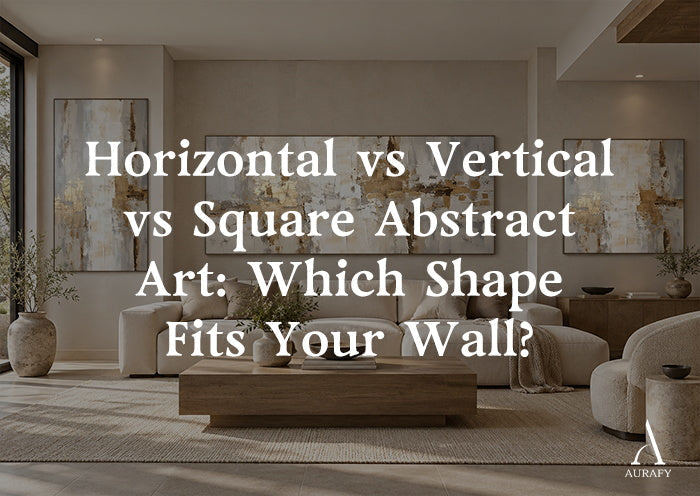
Horizontal vs Vertical vs Square Abstract Art: Which Shape Fits Your Wall?

Orientation is one of the first decisions in choosing abstract art, and it's largely dictated by the wall or furniture it's paired with: wide furniture generally calls for horizontal art, narrow or tall walls generally call for vertical, and awkward in-between spaces often suit square. This guide compares how the three shapes perform across the most common wall types in a home.
Why Orientation Comes Before Color
Palette and style are easier to adjust to a room than shape is. A piece that's the wrong orientation for its wall tends to look mismatched regardless of how well the colors work, while a piece in the right orientation tends to forgive a wider range of color choices. That's why it's worth settling orientation early, ideally before narrowing down a specific palette.

Orientation by Wall and Furniture Type
Which orientation suits which wall?
The table below summarizes typical starting guidance. As with sizing, these are defaults rather than fixed rules; a specific wall's proportions or ceiling height can shift the better choice.
| Wall or furniture type | Typical best fit | Why |
|---|---|---|
| Sofa wall | Horizontal | Echoes the wide, low shape of the furniture |
| Bed or headboard | Horizontal | Same logic as a sofa wall |
| Sideboard or console | Horizontal | Matches wide, low furniture |
| Fireplace wall | Square or horizontal | Often needs to sit within a mantel's width without crowding it |
| Narrow hallway wall | Vertical | Fits tall, narrow proportions |
| Stairwell | Vertical | Follows the rise of the stair and a narrow wall |
| High ceiling, otherwise unfurnished wall | Vertical | Draws the eye upward and fills height |
| Compact, centered wall (no wide furniture) | Square | Balanced proportions suit a wall with no dominant width |

Why does a fireplace wall sometimes take a square piece instead of horizontal?
A mantel often isn't as wide as a sofa or sideboard, so a horizontal piece sized to the usual furniture-width guidance can end up narrower than expected. A square piece can fill the vertical space above the mantel more comfortably, particularly where the chimney breast itself is narrow.
Horizontal Art: Where It Works Best
Horizontal pieces suit any wall anchored by wide, low furniture: sofas, beds, sideboards, and long consoles. The shape echoes the furniture beneath it, which is part of why the standard furniture-width starting guidance is built around horizontal pieces by default. Horizontal art can struggle on narrow walls, where even a moderately sized piece can end up nearly touching adjacent doorways or corners.
Vertical Art: Where It Works Best
Vertical pieces suit hallways, stairwells, and any wall that's taller than it is wide. They also work well in rooms with high ceilings, even above furniture, where a vertical piece can help balance the extra height rather than leaving it visually empty above a smaller horizontal one.
What does "available in multiple orientations" actually mean for a piece?
It means the same overall composition, the full artwork as a unit, is offered as separate horizontal, vertical, and square versions, not that a single physical piece can be rotated or reconfigured. AURA187 Modern Abstract Blue Beige Gold Wall Art for Living Room Modern Abstract Blue Beige Gold Wall Art for Living Room - AURA187, AURA485 General Abstract Art White Beige Metallic Gold
 General Abstract Art White Beige Metallic Gold Impasto Texture Tactile Surface Modern Organic Canvas AURA485, and AURA010 Abstract Earth Texture Wall Art - Soft Sand Tones
 Abstract Earth Texture Wall Art-Soft Sand Tones-AURA010 are each confirmed available in horizontal, vertical, and square formats, which makes it possible to keep the same palette consistent across a hallway, a living room, and a bedroom, even though each of those walls may call for a different shape. Specific dimensions for each orientation should be confirmed on the individual product listing.
Square Art: Where It Works Best
Square pieces are the most flexible of the three, and tend to suit walls without a strong dominant width or height, such as a compact accent wall, a landing, or a space above a fireplace. Square is also a reasonable default when unsure which of the other two shapes fits better, since it tends to read as balanced across more settings than either horizontal or vertical extremes.

Multi-Panel Art and Total Width
How do I size a multi-panel or diptych piece, and is that the same as a single piece's orientation?
A multi-panel set is a different consideration from a single piece offered in multiple orientations: it's several panels meant to be hung together as one composition. When sizing one, measure the total combined width, including the gaps between panels, and apply the usual furniture-width guidance to that total rather than to each panel individually. A pair of panels meant to span roughly 50 to 63 inches above an 84-inch sofa, for example, should have their combined width land in that range, not each panel on its own. Keep spacing between panels even, and confirm exact panel dimensions and recommended spacing on the product listing rather than estimating.

Mixing Orientations in One Room
It's common, and often useful, to use more than one orientation within the same room: a horizontal piece above the sofa and a narrower vertical piece on an adjacent accent wall, for instance. This tends to work best when the pieces share a palette or style family, since a shared color thread keeps mixed orientations feeling coordinated rather than mismatched. Designs offered in multiple orientations make this easier to plan deliberately.

Common Mistakes to Avoid
- Defaulting to horizontal everywhere. It's the most common shape, but it doesn't suit every wall, particularly narrow or tall ones.
- Choosing vertical for a wide, low furniture wall. It tends to look stranded above a sofa or bed rather than anchored to it.
- Sizing each panel of a multi-panel set independently. The combined width, not each piece, is what should be checked against the furniture-width guidance.
- Ignoring ceiling height. A very tall wall can make even a well-sized horizontal piece look small relative to the space above it.
- Mixing orientations without a shared color thread. Multiple shapes in one room can look scattered without something visually tying them together.

Bringing It Together
Choosing a shape starts with the wall or furniture in front of you: match orientation to the table above, size multi-panel pieces by their combined width rather than panel by panel, and lean on a shared palette if mixing shapes within one room. Our General Abstract Wall Art guide and Orientation page cover related sizing principles in more depth.
FAQ
Is horizontal or vertical better for above a sofa?
Horizontal is the more common and generally better fit, since it echoes the wide, low shape of the sofa. Vertical can work on a narrower section of wall but usually needs supporting elements, like lamps, to avoid looking stranded.
What orientation works best for a narrow hallway?
Vertical is typically the better fit, since hallway walls are usually narrow and proportionally tall, which suits a vertical shape more naturally than a wide horizontal one.
How do I size a diptych or multi-panel piece for my wall?
Measure the combined width of all panels together, including the gaps between them, and apply the same furniture-width guidance you'd use for a single piece, confirming exact panel sizing and spacing on the listing rather than estimating.
Can I use different orientations in the same room?
Yes, and it's a common approach, such as a horizontal piece above a sofa paired with a vertical piece on a nearby wall. It tends to work best when the pieces share a palette or style, so the room still reads as coordinated.
Share:
Abstract Wall Art for Hallways: Size, Orientation & Placement
Neutral Abstract Wall Art: Beige, Cream, Brown & Gold for Modern Interiors