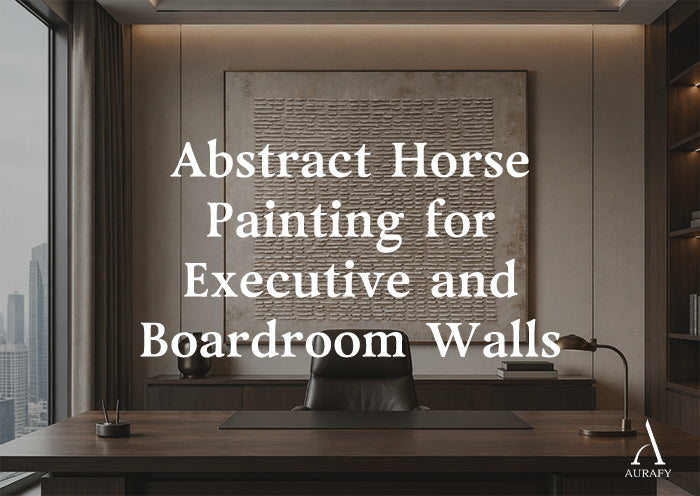
- Commission a black and white abstract horse painting to anchor corporate walls — hand-sculpted muscle relief and sweeping mane markers replace predictable figurative art with quiet, grounded authority.
- Abstract horse art works in executive spaces specifically because it conveys power through form rather than through literal representation — the subject is recognizable but the treatment is architectural.
- For a boardroom side wall, the total artwork width must cover at least two-thirds of the conference table length to hold visual weight in a large professional space.
- Install spotlights 12 to 15 inches from the wall at 30 to 45 degrees — commercial flat LED panels eliminate all shadow depth and must be supplemented with directional track lighting.
- The anti-static varnish on every AurafyArt piece means cleaning staff can maintain the piece with compressed air or a soft brush — no liquids, no chemicals, no specialist maintenance.
Most executive offices and corporate boardrooms make one of two decorating mistakes with wall art.
The first is the realistic horse painting — dramatic, colorful, overtly symbolic. The subject communicates ambition directly. However, the execution feels forced, and the visual language belongs to a different era.
The second is the flat decorative panel — neutral, inoffensive, entirely forgettable. It fills the wall without commanding it. In a room where the furniture and materials have been chosen with considerable care, a piece that draws no attention at all is simply a missed opportunity.
Styling a black and white abstract horse painting for an executive space is the path between these two failures. The horse subject carries the associations the space requires — strength, movement, controlled power. Yet, the abstract treatment removes the literal and the illustrative.
What remains is sculptural. It is a surface of physical ridges and channels built from the structural language of the animal's form, expressed without depicting the animal directly.
Translating Power into 3D Relief: The Abstraction Principle

The difference between a realistic horse painting and an abstract one is not simply a style preference. In a corporate context, it is a distinction between two different kinds of visual authority.
A realistic horse painting makes an explicit statement. The subject is legible, the symbolism is clear, and the viewer's response is predetermined. This literalness can read as decorative rather than authoritative — a collection of symbols rather than a considered visual environment.
An abstract horse painting in 3D relief works differently:
The muscle structure becomes geometry
The forms that define a horse in motion — the mass of the chest, the curve of the haunches, the structure of the shoulder — translate into raised planes and carved channels on the canvas surface. These forms carry the visual weight and physical tension of the animal without depicting it directly.
The viewer responds to the force of the composition before consciously identifying its origin. This is the quality that suits a corporate environment. The piece communicates strength through material presence — through the actual physical weight of the built-up surface — rather than through illustration.
The mane becomes line
The artist pulls a wide-blade palette knife from the base of the canvas upward in a single sustained stroke. This loads the surface with a ridge that carries the speed and direction of the gesture. The stroke is not drawn — it is carved. The ridge has a lit face and a shadow face, reading as entirely structural.
A series of these vertical strokes — varying in height, width, and edge quality — creates a surface that suggests the movement of a mane without depicting hair. Under directional light, the strokes cast genuine shadows. The composition shifts as the light changes, meaning the piece lives on the wall rather than simply occupying it.
Material Dialogue: Abstract Relief Against Executive Interiors

Modern executive offices and boardrooms are built on materials that are precise, reflective, and hard-edged: black walnut executive desks, polished marble accent walls, high-gloss lacquered cabinetry, and Italian leather seating. These surfaces share a quality — they are perfectly controlled and uniformly finished.
This precision is exactly what makes an abstract horse piece in heavy impasto relief effective in these environments.
The modeling paste surface is its opposite in every material dimension:
· Where the marble is smooth, the paste is textured.
· Where the lacquer is reflective, the paste is matte.
· Where the leather is evenly grained, the paste is irregular — the result of real-time decisions made by a hand moving across a canvas.
This contrast is not a clash; it is a material dialogue. The precision of the executive environment gains depth and humanity when placed alongside something genuinely hand-made. Conversely, the hand-made piece gains authority from the quality of the materials around it.
A black white painting abstract masterpiece becomes the room's most human element. It is the one surface that could not have been manufactured to specification, carrying the clear evidence of individual craft. In a room where everything else has been engineered to a tolerance, this quality is immediately noticed and universally appreciated.
Sizing for Executive Spaces: Boardroom vs. Private Office

The scale requirements for a corporate boardroom and a private executive office are different — and both differ from residential sizing rules.
The boardroom side wall
A conference table for 10 or more people typically runs 120 to 180 inches in length. The side wall visible to everyone seated at the table is the primary display surface in the room.
When executing how to style abstract horse painting black and white in meeting rooms, the artwork width must cover at least two-thirds of the table length to hold visual weight from the far end of the room. For a 144-inch table, this means artwork spanning at least 96 inches wide.
A single 40" × 80" canvas will not fill this wall. A triptych of three 40" × 80" panels — spanning approximately 124 inches including the gaps — approaches the correct proportion.
The Seating Axis: Position the panels at eye level from a seated position — with the center of the arrangement at approximately 48 to 50 inches from the floor. Boardroom viewing is primarily from a seated position, and the eye-level calculation reflects this.
The executive desk: the power wall
The wall behind the primary chair in an executive office serves a specific function. It is the visual background for the person in the chair — visible to every person who enters the room and in every video call made from that position.
Choose a single large-format piece for this position. A black white painting abstract at 40" × 60" or larger provides enough visual mass to read clearly as a significant object rather than a decorative accent.
· The Gap: The bottom edge of the canvas should sit 8 to 10 inches above the top of the chair back. This gap connects the art to the furniture position without crowding it.
· The Alignment: The piece should be centered on the desk width, not centered on the full wall. This anchors the art to the furniture and the person in the chair rather than to the architectural envelope of the room.
Lighting Executive Art: Solving the Commercial Flat-Light Problem
Commercial offices face a specific lighting challenge for wall art that residential spaces rarely encounter. The standard ceiling lighting in most corporate environments — recessed LED panels or fluorescent grid fixtures — produces flat, directionless light that falls vertically from above and fills the room evenly.
This flat layout eliminates shadow depth in a 3D relief piece. Under flat overhead lighting, the channels between ridges receive light from above and lose their shadow. The entire dimensional quality of the surface disappears, leaving the piece looking like a flat canvas with an uneven surface.
The supplementary track lighting setup
1. The Offset: Install adjustable narrow-beam track spotlights on the ceiling, positioned 12 to 15 inches from the wall surface. This position is closer to the wall than most commercial lighting is installed, requiring a dedicated track.
2. The Angle: Set the beam angle at 30 to 45 degrees from the wall surface. At this angle, the light travels across the face of the canvas rather than down onto it.
The mane ridge strokes catch light along their upper face. The muscle form channels fall into deep shadow. The piece reads as genuinely three-dimensional. For a large boardroom piece spanning 100 or more inches, use two or three track heads spaced across the artwork width, all positioned at the same distance and aimed at the same angle to ensure even shadow quality.
Bulb specification for corporate use
Most commercial spaces use 4000K to 5000K cool white lighting throughout. While appropriate for reading and screen work, cool light damages the visual quality of black and white textured art, making the black areas appear grey and the white areas look cold blue-grey.
For the dedicated spotlights serving the wall art, use 2700K to 3000K warm white bulbs. The contrast between the warm light on the artwork and the cooler ambient light in the room creates a gallery-like distinction. The artwork reads as deliberately lit, which is exactly the effect a boardroom installation should achieve.
Durability in High-Traffic Commercial Environments

Corporate spaces are more demanding on art maintenance than residential spaces. Air conditioning systems circulate air continuously, bringing dust from ductwork. Meeting rooms are used heavily throughout the week. The art on the walls cannot require specialist maintenance or regular removal for cleaning.
Why the anti-static varnish matters in commercial use
Every AurafyArt piece receives two hand-applied coats of low-VOC, anti-static, UV-resistant matte varnish. In a commercial space with continuous air circulation, this determines whether the piece is practically maintainable at all.
The anti-static varnish significantly reduces the electrostatic charge on the canvas surface. A surface with high static charge actively draws airborne particles, causing them to bond to the surface and accumulate in the texture channels. A surface with reduced static charge allows particles to rest loosely so they can be displaced by air movement rather than requiring mechanical scraping.
The commercial cleaning protocol
Cleaning staff can maintain the piece using one of two dry methods, neither of which requires the piece to be removed from the wall:
· Compressed Air: Direct short bursts from a can of compressed air into the texture channels, keeping the can at least 6 inches from the surface. The loose particles displace immediately. This takes under two minutes and fits easily into normal office cleaning rotations.
· Soft-Bristle Brush: Sweep a long-handled soft brush gently along the direction of the palette knife strokes — following the vertical mane lines and the horizontal muscle forms. The loose particles sweep away cleanly.
Important: Never use damp cloths, water sprays, or chemical cleaning products on any textured art surface. Moisture introduced into the texture channels bypasses the varnish protection and can affect the modeling paste structure over time.
The Wall Behind the Decision Maker
A corporate space makes statements without speaking. The quality of the furniture, the material of the floor, the presence or absence of art on the walls — all of these communicate something about the organization before a conversation begins.
A black and white abstract horse painting in 3D relief communicates a specific thing: that the person in this room understands the difference between visual weight and visual noise. It shows that quality, material, and individual craft belong alongside precision materials in a serious professional environment.
This is not a decorative statement. It is an architectural one.
The wall behind the chair is the most visible surface in the executive office. Fill it with something that earns the position it occupies.
Explore the AurafyArt commercial and executive collection — and contact us to discuss a custom commission for your specific wall dimensions and corporate environment.
Share:
Abstract Lines for High-Ceiling Walls: A Visual Guide
Abstract Portrait Art for Foyers and Entry Walls