


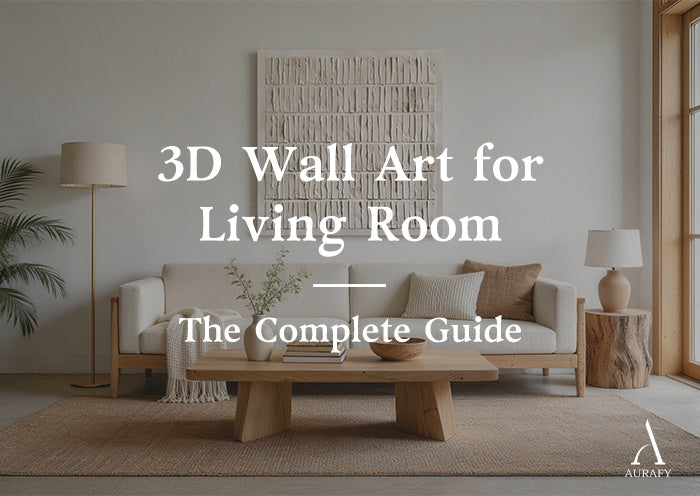
- The width of your artwork should cover two-thirds to three-quarters of the width of your sofa or the furniture below it.
- Hang the piece so its center sits 57 to 60 inches from the floor — this aligns with the average eye level and feels natural from a seated position.
- 3D wall art for living room spaces works best with directional light. A spotlight angled at 30 to 45 degrees from the wall brings out the full depth of the textured surface.
- Modern Japandi living room wall art — in neutral, textured finishes — softens the hard edges of electronics and contemporary furniture without disrupting the room's calm.
The living room is the room people see first. It sets the tone for the entire home.
And yet, it is also the room where decorating mistakes are most common. A small framed print above a large sofa. A canvas that sits too high on the wall. Art that looks fine in isolation but disappears in the context of the room around it.
3D wall art for living room spaces solves these problems in a way flat prints cannot. A piece with real physical depth and surface texture carries enough visual weight to hold its own against large furniture, high ceilings, and wide walls. It does not need a frame or a grouping to justify its presence. It earns the wall on its own terms.
This guide gives you the practical rules for size, placement, lighting, and style — so the piece you choose actually works in the room you have.
Size and Scale: Getting the Proportions Right

Scale is the decision that most determines whether a piece succeeds or fails in a living room. Too small, and the art looks like an afterthought. Too large, and it overwhelms the room. The good news is that there are clear, reliable guidelines.
The sofa proportion rule

For art hung above a sofa or a console table, the width of the artwork should cover roughly two-thirds to three-quarters of the furniture below it.
In practical terms: if your sofa is 90 inches wide, aim for artwork — or a grouped arrangement — between 60 and 68 inches wide. This proportion creates a visual relationship between the furniture and the wall above it. The art feels anchored rather than floating.
This rule applies whether you choose a single large piece, a diptych, or a triptych. What matters is the total width of the arrangement, not the number of panels.
Large walls without furniture

When a wall has no furniture to anchor it — a wide expanse above a fireplace, or a feature wall visible from across an open-plan space — the scale question becomes more important, not less.
In these situations, an oversized single piece is almost always the right answer. A work that measures at least 48 inches on its longest side will begin to hold the wall. For very large walls, 60 inches or more is appropriate.
Vertical compositions work well on tall walls with limited width. A triptych arrangement — three panels of equal size hung in a horizontal row with small gaps between them — is one of the most effective solutions for wide, low walls where a single piece would need to be impractically wide to fill the space.
The most common mistake
Buying too small. Almost without exception, the artwork that looks bold in a shop or looks generous in a product photograph will appear smaller on an actual living room wall than expected. If you are deciding between two sizes, choose the larger one.
(Tips:Want to know how to choose the right-sized paintings for your home?You can read this article.[The Art of Scale: How to Choose the Right Wall Art Size for Any Space])
Style Fit: Modern Japandi Living Room Wall Art

The living room brings together more materials, textures, and surfaces than any other room in the home. Sofas, cushions, rugs, timber, metal, ceramics — all of these compete for attention simultaneously.
Modern Japandi living room wall art works particularly well in this context because it adds material richness without adding visual complexity.
The Japandi aesthetic — a blend of Japanese minimalism and Scandinavian warmth — is built around natural materials in restrained, neutral palettes. Raw linen, solid oak, unglazed ceramic, woven jute. These materials share a common quality: they have surface texture and natural variation. They feel made rather than manufactured.
A 3D textured wall piece in off-white, warm sand, or soft grey carries exactly this quality. Its matte, irregular surface echoes the tactile language of the room's other natural materials. It adds depth and warmth without introducing a new color or pattern that competes with what is already there.
There is also a practical dimension to this. Most modern living rooms contain hard, reflective surfaces — televisions, glass coffee tables, metal light fixtures. These surfaces read as cold and sharp. A large-format textured piece on the wall behind the sofa provides a counterbalance: something organic, matte, and soft that absorbs the harshness of those surfaces and makes the room feel more comfortable to sit in.
This is the emotional function of modern Japandi living room wall art. It is not purely decorative. It changes how the room feels, not just how it looks.
Lighting: How to Activate 3D Wall Painting for Living Room Spaces

The difference between a textured piece that looks remarkable and one that looks ordinary often comes down entirely to lighting. The surface depth of a 3D work only becomes visible when light crosses it at an angle. Without directional light, the shadows disappear — and with them, the entire dimensional effect.
Ceiling spotlights and track lighting
The most effective approach is a recessed spotlight or track head positioned on the ceiling, 12 to 18 inches out from the wall, angled downward and toward the surface of the piece. This position sends light raking across the textured surface from above — deepening every shadow and highlighting every ridge.
Use warm white bulbs in the 2700K to 3000K range. These produce the soft, golden quality of light that enhances the earthy tones typical of neutral textured work. Cool daylight bulbs (5000K and above) flatten the shadows and give the surface a harder, less inviting quality.
A dimmer switch is worth adding if the budget allows. The ability to control light intensity lets you adjust the drama of the textured effect for different times of day and different uses of the room.
Natural sidelight
If your living room receives strong natural light from a window to one side of the feature wall, this can be the best light source of all. Morning and afternoon light — when the sun sits low and strikes the wall at a shallow angle — creates extraordinarily rich shadow across a textured surface. The effect shifts through the day as the angle changes.
Position the piece on a wall that receives this kind of angled natural light when possible. North-facing walls with a window to one side are ideal. Avoid walls that receive only flat, frontal light — the overhead midday sun or a large window directly opposite the piece. These light sources illuminate the surface evenly, which eliminates shadow contrast and flattens the texture.
What to avoid
Flat overhead ambient lighting is the least effective option for 3D wall painting for living room display. It illuminates the surface from above and slightly in front, filling in the shadows rather than creating them. If your living room relies primarily on recessed downlights positioned directly above the wall, add a dedicated picture light or an adjustable track head aimed specifically at the piece.
Made to Order: Art Built for Your Specific Room
The living room is the most important room in the home to get right — and it is the room where a generic, off-the-shelf piece is most likely to fall short.
At AurafyArt, every piece is made to order. Nothing is produced in advance and held in inventory. When you place an order, a professional artist in our Shenzhen studio begins building your piece from scratch — mixing the paste to the right consistency for that composition, working the surface by hand, and allowing each layer to cure fully before the next is applied.
This process takes time — typically 7 to 14 days of production before the piece is ready to ship. That lead time is not a logistical limitation. It is a direct result of making the piece correctly.
It also means that what arrives at your home has never existed before. The texture on your wall — the specific arrangement of ridges, the exact depth of each stroke, the precise quality of the edges — is unique to your piece and your room. No other home has it.
For the living room, the room that defines the tone of your entire home, that distinction is worth having.
Frequently Asked Questions
How high should I hang wall art in a living room?
The standard guidance is to position the center of the artwork at 57 to 60 inches from the floor. This range corresponds to average eye level when standing, and it also reads well from a seated position on a sofa. When hanging art above a sofa or console, aim for a gap of 6 to 8 inches between the top of the furniture and the bottom edge of the frame or canvas. This gap connects the art to the furniture below it without making the piece feel cramped against the sofa back.
Should I choose one large piece or a group of smaller ones?
For 3D textured work, a single large piece almost always outperforms a grouped arrangement. The dimensional effect of textured art requires enough surface area to read clearly — small pieces lose the shadow variation that gives the work its impact. If your wall is very wide and a single piece would need to be impractically large, a diptych or triptych of matching panels is the best alternative. Keep the gaps between panels narrow — 1 to 2 inches — so the arrangement reads as a unified composition rather than individual pieces placed close together.
Does 3D wall art work above a television?
It is not the ideal placement. Televisions draw the eye strongly when in use, and the wall above them becomes a secondary focal point at best. More practically, the heat generated by some television units can affect the surface of textured art over time. If the television wall is the only viable wall for a large piece, position the art on the wall adjacent to the television rather than directly above it — this creates two distinct focal points in the room and avoids the heat issue entirely.
Can I commission a custom size?
Yes. All AurafyArt pieces are made to order, which means custom dimensions are available as standard. If you need a piece to fit a specific wall width, fill a precise space between architectural elements, or match a particular proportion, contact us before ordering and we will confirm the available options for that composition.
The Right Art Changes the Room
A living room without a strong focal point feels unresolved. The furniture might be excellent. The layout might be considered. But without something on the wall that earns its place, the room never quite comes together.
3D wall art for living room spaces provides that focal point — with the additional quality of a surface that rewards attention, changes with the light, and carries the evidence of the hand that made it.
Get the size right. Position it at eye level. Light it from an angle. And choose a piece made by hand, specifically for your room.
For guidance on choosing oversized 3D pieces for large-format walls, see our in-depth sizing guide. Or explore the full AurafyArt living room collection to find the piece that anchors your space.
Share:
3D Geometric Wall Art: Space, Shadow, and Illusion
3D Wall Art for Bedroom: Calm, Texture, and Rest