

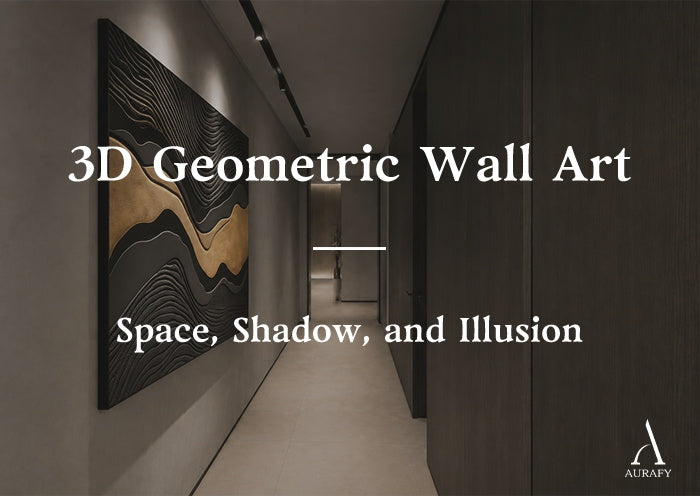
- 3D geometric wall art uses physical raised lines to interact with light — creating the convincing illusion of depth on a flat wall surface.
- Neutral geometric textured art removes color from the equation, directing the eye entirely toward the interplay of shadow and form.
- Geometric lines are particularly effective in small spaces and narrow corridors, where they can visually extend the room.
- Every AurafyArt geometric piece is made to order by hand — no molds, no machine pressing, no repeated pattern.
A few lines on a wall should not be able to make a room feel larger. And yet, with the right execution, they do.
This is the quiet power of 3D geometric wall art. It works by exploiting something fundamental about how the human eye reads surfaces. When light strikes a raised geometric line at an angle, it creates a sharp contrast between highlight and shadow. The brain interprets that contrast as depth. A flat wall appears to recede, advance, or open outward — depending on the geometry used and the angle of the light source.
The result is one of the most effective visual tools available in interior design: art that does not just sit on a wall, but actively reshapes how the wall is perceived.
The Physics of Illusion: How 3D Illusion Wall Painting Works

Understanding the mechanism behind the effect makes it easier to use well.
When a raised geometric line sits on a flat surface, it creates two distinct zones: a lit face and a shadow face. Under a direct or angled spotlight, the contrast between these two zones is sharp and immediate. The human visual system is highly sensitive to this kind of contrast — particularly along straight edges and angular intersections.
The brain does not process this contrast as a texture. It processes it as depth.
This is the core principle behind 3D illusion wall painting. The surface is physically flat — or nearly so — but the shadow information it delivers tells the brain something different. The result is a perceived three-dimensionality that can be surprisingly convincing, especially under controlled lighting conditions.
Different geometric configurations produce different spatial effects:
Parallel lines draw the eye along their length and create a sense of distance. On a short wall, horizontal parallel lines push the boundaries of the room outward. On a corridor wall, they extend the perceived length of the space.
Radiating or V-shaped compositions direct the eye toward a central vanishing point. This creates a strong sense of depth and makes the wall appear to recede — particularly effective in compact rooms where the actual ceiling height or wall depth is limited.
Intersecting grids and layered planes create a focal point that holds the eye in place. These compositions work well as centrepieces on feature walls, where the goal is engagement rather than spatial extension.
The key variable in all of these is light. Without directional light — a spotlight, a track head, or strong natural sidelight — the shadow contrast that generates the illusion is reduced or lost entirely. Position the light source at 30 to 45 degrees from the wall surface for the strongest result.
Less Color, More Depth: The Case for Neutral Geometric Textured Art

Color is powerful. But in geometric texture work, it often works against the piece rather than for it.
When a geometric surface carries strong color — particularly warm or saturated tones — the eye responds to the color first. The texture and shadow become secondary. The spatial illusion that makes geometric 3D work compelling is diminished because attention is divided.
Neutral geometric textured art solves this by removing color from the competition entirely.
In a piece finished in off-white, warm sand, pale grey, or soft stone, there is nothing for the eye to anchor to except the surface itself. The shadows become the subject. Every ridge and recess reads with full clarity. The geometric composition — the lines, the angles, the intersections — delivers its full spatial effect without interference.
This restraint is also what makes neutral geometric work so broadly compatible with contemporary interior styles.
In a wabi-sabi space, the matte, earthy surface of a neutral geometric piece echoes the tones of raw plaster, unfinished linen, and aged timber. In a Japandi interior, the precision of the geometric lines provides the structured quality the style requires, while the neutral tone keeps the temperature warm. In a modern minimalist room, a neutral geometric piece on a white wall reads as pure form — clean, resolved, and visually authoritative without adding color complexity.
The restraint is the point. And in geometric texture work, restraint consistently produces the strongest result.
Handmade vs. Machine-Pressed: Why It Matters for Geometric Work

Geometric art might seem like the category where machine production would have the clearest advantage. Lines are straight. Angles are precise. A mold should be able to reproduce a geometric composition perfectly — and at scale.
In practice, machine-pressed geometric work has a visible problem.
The lines are too uniform. Every ridge sits at exactly the same height. Every edge reflects light at exactly the same angle. The surface lacks variation, and that lack of variation is what makes it read as industrial rather than considered. The eye adjusts to the pattern within moments, and the piece becomes invisible.
Handmade geometric work behaves differently — even when the composition itself is structured and precise.
At AurafyArt, every geometric piece is made to order in our Shenzhen studio. The lines are built by hand using a palette knife and sculptural paste — not pressed from a mold. This means that while the overall composition follows a deliberate geometric structure, the individual lines carry the natural variation of the hand that made them.
A slight shift in pressure along a stroke changes the height of the ridge. A fractional change in the knife angle alters the sharpness of the edge. These variations are subtle — often invisible from a normal viewing distance — but they are what give the surface its life. Under a spotlight, each section of a handmade geometric line reflects light slightly differently. The result is a surface that rewards close attention and continues to reveal itself over time.
This is what made-to-order means in practice. Not a choice from a catalog. A piece built specifically for you, in which every line carries the mark of the hand that placed it.
Displaying Geometric Wall Art: Room-by-Room Guidance

The placement decisions you make with geometric 3D art directly affect how well the spatial illusion performs. These are the most important principles.
Narrow corridors and hallways
This is where geometric art performs most dramatically. A composition based on converging or V-shaped lines — positioned so the vanishing point sits at eye level at the far end of the corridor — creates a strong sense of depth that makes the space feel significantly longer. Choose a piece with strong directional lines rather than a centered, symmetrical composition. The goal is to guide the eye forward, not to stop it.
Living rooms and open-plan spaces
In larger rooms, geometric art works best as a single dominant piece on a feature wall, rather than as part of a grouped arrangement. The spatial illusion requires space around it — both on the wall and in the room — to read clearly. Surround it with negative space. Keep adjacent surfaces clean. Let the piece carry the wall on its own.
Compact rooms
For rooms that feel smaller than you would like, horizontal parallel-line compositions on the wall opposite the door create the most immediate sense of spatial expansion. The eye follows the lines outward and perceives the room as wider than it is. Avoid compositions that are strongly centered or circular in compact spaces — these draw the eye inward and can make the room feel smaller.
Lighting setup
In every context, a narrow-beam spotlight or adjustable track head positioned at a 30-to-45-degree angle to the wall is the correct lighting approach. Warm white bulbs (2700K–3000K) produce the right quality of shadow — soft enough to read as depth, sharp enough to define the geometry clearly.
Frequently Asked Questions
Does 3D geometric wall art work in a room with limited natural light?
Yes — and in some respects it works better. In rooms with strong, variable natural light, the shadow pattern on a geometric piece changes constantly through the day, which can be visually dynamic but also unpredictable. In a room lit primarily by artificial light, you control the light source completely. A single well-positioned spotlight gives you consistent, optimal shadow contrast at all times. Install a dimmer if you want to adjust the intensity of the effect for different times of day.
How precise are the geometric lines in a handmade piece?
Precise enough to read clearly as geometric, but not mechanically perfect — and that distinction matters. The lines in a handmade geometric piece follow a deliberate compositional structure, but they carry the natural variation of the hand. This variation is what prevents the piece from reading as industrial. Under close inspection, each line has a slightly different profile, a slightly different edge quality. From a normal viewing distance, the composition reads as crisp and structured. Up close, it reads as made — and that is the quality that gives it lasting visual interest.
A Wall That Works for the Room
3D geometric wall art is one of the few decorative choices that actively improves the spatial quality of a room rather than simply adding to it.
Used well, it makes walls appear deeper, rooms feel larger, and spaces read as more considered and resolved. The effect is not accidental — it comes from the specific combination of physical surface depth, directional light, and geometric composition working together.
A handmade piece brings one additional quality that no machine-produced work can: the evidence of individual craft in every line. That evidence is what makes the difference between a wall that looks decorated and a wall that looks designed.
Browse the AurafyArt geometric collection — and commission a made-to-order piece that gives your wall a new dimension.
Share:
Contemporary 3D Wall Art: Bold Texture for Modern Spaces
3D Wall Art for Living Room: The Complete Guide