


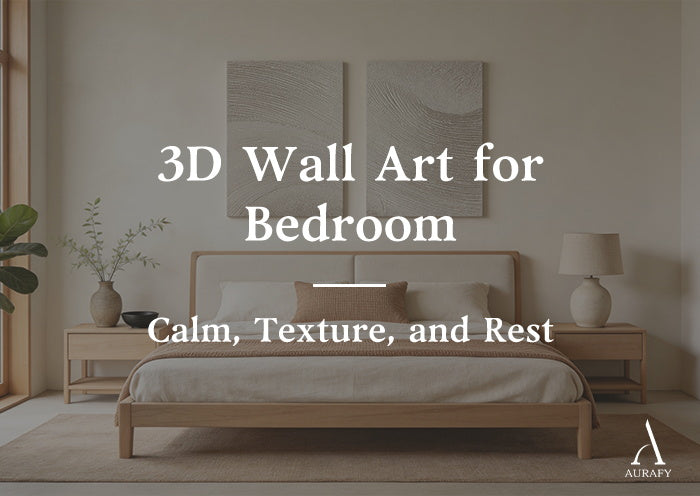
- When choosing 3d wall art for bedroom spaces, avoid sharp geometric lines and strong colors. Soft curves and neutral tones—warm sand, oat, dusty clay—are the perfect starting point.
- Relaxing wabi sabi bedroom wall art uses organic, borderless textures to reduce visual stimulation and support a sense of calm.
- A high-quality, handmade 3D canvas is the most practical way to bring textured depth to a bedroom, without the high cost, disruption, or permanence of full-wall texture paint.
Most people treat the bedroom as the last room to decorate. The living room gets the attention, the budget, and the careful decisions. The bedroom gets whatever is left.
This is worth reconsidering.
The bedroom is the one room where the goal is not to impress—it is to decompress. Every surface, every material, and every object in that room either supports rest or works against it.
Using 3d wall art for bedroom decoration serves a specific function that flat prints simply cannot. A textured surface with soft, organic depth gives the eye something to settle on. It’s not something to read or interpret, but something to simply rest against. That quiet quality is exactly what makes it the right choice for a sleep space.
Why Wabi-Sabi Texture Works Best in a Bedroom
Not all 3D wall art belongs in a bedroom. The bold geometric compositions and high-contrast sculptural work that perform beautifully in a living room can feel far too demanding in a space designed for rest.
Relaxing wabi sabi bedroom wall art takes the exact opposite approach.
Wabi-sabi—the Japanese aesthetic built around imperfection, impermanence, and natural simplicity—produces a highly specific kind of surface: soft, irregular, without sharp edges or repeating patterns. The texture moves across the canvas the way clouds shift or the way water shapes sand. No two areas are identical. There are no hard lines and no visual tension.
This surface quality has a measurable effect on how the room feels, driven by two key elements:

Color That Signals Rest: The tones most associated with wabi-sabi interiors (oat, warm sand, dusty clay, pale stone, soft ivory) are not simply neutral. They mimic the quality of natural light at its softest—early morning or the hour before sunset. The brain associates these warm tones with safety, not alertness.
Texture as Quiet Company: In a room stripped back to its essentials, a softly textured wall piece fills the space with enough visual interest to feel complete, without adding "noise." Organic 3D texture occupies a perfect middle ground that flat art struggles to achieve.
3D Canvas vs. Wall Decals vs. Texture Paint: An Honest Comparison

When people want textured depth in a bedroom, they typically weigh three options. Here is how they compare in practice:
1. 3D Wall Decals (The Compromise)
When searching for budget options, many turn to 3d wall decals for bedroom applications. However, they are often the most disappointing. The surface is thin plastic or vinyl that catches light unnaturally. Edges tend to lift over time due to temperature and humidity fluctuations. Up close, it reads exactly as what it is: a sticker. It is the visual opposite of the handmade warmth a bedroom needs.
2. Texture Paint (The Commitment)
Considering a texture paint bedroom makeover? While full-wall texture paint delivers genuine surface depth and can look excellent, the limitations are purely practical. The process is disruptive (requiring an empty room for days), and the cost of materials and professional application is significant. Most importantly, it is permanent. Changing it means resurfacing the entire room.
3. Handmade 3D Canvas (The Sweet Spot)
A large-format handmade piece provides the textural richness of a painted wall concentrated on a single canvas. It installs in minutes, can be easily repositioned, and carries a warmth and intentionality that full-wall painting rarely achieves. For most bedrooms, the canvas is the most practical and most effective choice.
From Studio to Bedroom: How Each Piece Is Made
The bedroom is the most personal room in the home. It matters what is in it—and what it is made of.
Every AurafyArt piece is made to order in our studio. We carry no pre-made stock. When an order arrives, an artist begins building the piece from scratch:
Safe Materials: We use non-toxic, flexible modeling paste and low-VOC varnishes. There are no off-gassing concerns—a critical factor for a room where you sleep with closed windows.

Patient Craftsmanship: The paste is applied by hand with palette knives, allowing each layer to cure fully in natural conditions. This 7 to 14-day process guarantees the surface will not crack over time.
What arrives at your door is something built specifically for you. The texture on your bedroom wall exists nowhere else in the world.
How to Hang and Light a Bedroom Piece

Placement and lighting in a bedroom require a different approach than in a living room. The goal is warmth and softness, not drama.
Hanging Height Position the bottom edge of the canvas 8 to 10 inches above the top of the headboard (or mattress). This gap creates a visual connection between the bed and the art without making the piece feel crowded.
Width Relative to the Bed The artwork should span roughly two-thirds of the width of the bed. For a standard King-size bed (76" wide), aim for artwork in the range of 48" to 56" wide.
Lighting: Warm, Indirect, and Gentle Avoid cool white spotlights aimed directly at the artwork. Instead, use warm white bulbs (2700K to 3000K) in bedside wall sconces or concealed LED strips. Let the light graze the textured surface gently from the side or below. This creates soft shadows that shift slightly with the ambient light, making the art part of the room's atmosphere rather than a demanding focal point.
Frequently Asked Questions
Is a large 3D canvas safe to hang above a bed?
Yes, absolutely. Canvas pieces are significantly lighter than framed glass prints. A 40x50 inch handmade canvas typically weighs between 3 and 6 pounds. Use two hanging points (with wall anchors for drywall) to distribute the weight evenly, and it will be perfectly safe.
What size works best above a King or Queen bed?
Queen Bed (60" wide): 40 to 48 inches wide.
King Bed (76" wide): 48 to 56 inches wide.
Tip: Keep the 8 to 10-inch gap above the headboard to maintain perfect proportions.
Can I use 3D wall art in a bedroom with low ceilings?
Yes—and it’s often the best choice! A vertically oriented piece with soft, upward-flowing texture draws the eye up, making the ceiling feel higher. Avoid wide horizontal compositions in these spaces.
A Bedroom That Feels Like Rest
The bedroom does not need to make a statement. It needs to feel like somewhere you want to be.
Beautiful 3d wall art for bedroom spaces provides exactly the quality a sleep environment requires: depth without demand, texture without tension, and the quiet warmth of something made by hand. It is a small change that makes the room feel fundamentally different.
Ready to transform your space? [Browse the AurafyArt Best Sellers Collection] – Soft, handmade, and made to order for your sanctuary. Found this guide helpful? Hover over any image to save it to your Pinterest Bedroom Decor board for future inspiration!
Share:
3D Wall Art for Living Room: The Complete Guide
3D Office Wall Art: Upgrade Your Workspace