


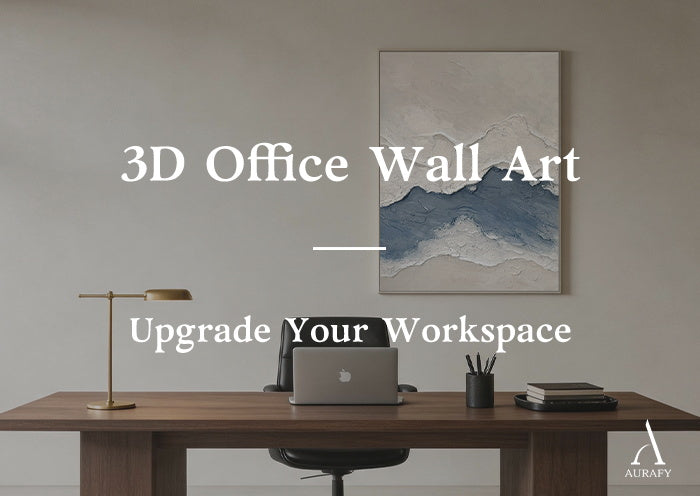
- 3d office wall art breaks up a blank wall without adding visual distraction—making it one of the few decorative choices that supports focus rather than competing with it.
- For remote workers, minimalist 3d art for home office spaces creates a clean, professional video call background that communicates taste without revealing too much personal space.
- In a meeting room or executive office, handmade textured wall decor signals attention to detail, creative thinking, and a commitment to quality—before a word is spoken.
Your office says something about you before you do.
Whether it is a corporate boardroom, a private office, or a desk in the corner of a spare room, the space you work in shapes how others perceive you—and how you perceive yourself.
3d office wall art occupies a specific and useful position in this context. It is not decorative in the conventional sense. It does not add color, pattern, or imagery that competes for your attention. Instead, it adds physical depth and surface texture: a quiet visual presence that makes the space feel considered and complete without distracting from the work happening in front of it.
This guide covers why textured wall art works particularly well in professional environments, how to use it in a home office, and what to look for when choosing a piece for a corporate setting.
Why Workspaces Need Textured Wall Decor

The case for textured wall decor in an office is partly aesthetic and partly practical. Both are worth understanding.
Textured Surfaces Reduce Eye Strain: Most professionals spend 8 to 10 hours a day looking at flat digital screens at a fixed focal length. A three-dimensional textured surface on the wall gives the eye a genuinely different task, requiring it to shift focus across varying depths. That small change provides real relief from screen fatigue.
Neutral Textures Stabilize the Room's Mood: Color psychology is real. Highly saturated colors raise alertness in the short term but increase stress over a full working day. Neutral tones—warm whites, oat, greige, clay—do the opposite. They support sustained concentration and reduce ambient stress.
A handmade 3D piece in a neutral earth tone does not just look professional. It actively makes the room easier to work in.
The Home Office Case: Minimalist Art and the Video Call Problem

Remote work has created a decorating challenge that did not exist a decade ago: the background wall. Every video call puts your workspace on display. A messy bookshelf, a bare white wall, or a busy piece of art all send a signal—and not always the one you intend.
Using minimalist 3d art for home office spaces solves this cleanly:
The Perfect Video Backdrop: A single handmade textured piece in off-white or warm sand reads on camera as considered and intentional. Because the texture is physical rather than printed, it catches the light in a way that reads as genuinely three-dimensional, even on a compressed video feed.
Defining the Work Boundary: Working from home blurs the line between personal and professional life. Hanging a specific piece of art in your office area creates a subtle visual cue that this is where work happens. The space becomes associated with focus and output rather than relaxation.
Corporate and Executive Spaces: What 3D Abstract Art Communicates
In a meeting room or senior office, the art on the wall is part of the environment your clients and colleagues experience. It shapes their impression of the organization before the meeting even begins.
3d abstract art in these settings does specific, heavy lifting:
Communicating Openness: Abstract composition communicates a willingness to operate beyond fixed frameworks and conventional thinking—a quality highly valued in technology, finance, and design industries.
Signaling Craft and Quality: A piece that is clearly made by hand communicates attention to detail. The same values that go into handmade artwork (skill, patience, and individual attention) are the exact values professional firms want associated with their own work.
The Ultimate Icebreaker: A textured piece with strong visual presence gives visitors something to respond to naturally, creating a low-pressure opening before the formal agenda begins.
Why Professional Spaces Need Genuinely Handmade Work

If the goal is to project professionalism, the art on the wall needs to hold up to close scrutiny. Machine-pressed texture pieces simply do not.
A mold-produced 3D panel might look convincing in a photo, but in person, the surface repeats. Every ridge sits at the exact same height. A client who looks at it for more than a few seconds will subconsciously register that it lacks the variation of human touch.
AurafyArt builds every piece to order in our studio. An artist starts each piece from scratch when the order arrives—no molds, no templates. The palette knife moves across the surface in real-time, leaving marks shaped by human decisions. No two pieces are exactly the same.
This is what makes a handmade piece the right choice for a professional environment: it projects individual attention and genuine craft.
Placement and Lighting in an Office Setting
The practical decisions around placement and lighting in an office differ slightly from a residential setting. Here is what works:
Where to Position the Piece
Home Office: The wall directly behind your desk chair is the most valuable position (serving as both your video background and a focal point when you enter).
Private Office: The wall facing the desk is an effective alternative, providing a natural visual reset when you look up from your screen.
Meeting Room: The wall at the head of the table (behind the primary presenter) is the standard choice, setting the visual tone for the entire room.
Avoiding Glare Office lighting is complex (overhead fluorescents, desk lamps, natural light). Direct light on a textured surface can create unwanted glare.
The Solution: Use directional lighting. A single adjustable spotlight or track head positioned to the side of the piece—angled across the surface—produces perfect shadows without glare.
Color Temperature: Use warm white bulbs (2700K to 3000K) wherever possible. Cool white office lighting (4000K+) tends to flatten textured surfaces.
Frequently Asked Questions

What size works best for a corporate meeting room?
For a standard meeting room wall (10 to 14 feet wide), a large horizontal piece or a multi-panel arrangement spanning at least 60 inches works well. A piece that reads well from 3 feet away will look small from 12 feet. When in doubt, go larger. For very wide walls, a triptych arrangement covers the space effectively.
What size suits a private office or home office?
For a desk background wall, a single vertical piece (24 to 40 inches wide) reads clearly on video without dominating the wall. For a wall facing the desk, you can go wider (36 to 48 inches). Vertical formats also make the ceiling feel higher, which is highly useful in compact spaces.
Can AurafyArt handle bulk orders for corporate clients?
Yes. Because every piece is made to order, we can produce multiple pieces to consistent specifications for installation across multiple offices. Contact us directly to discuss your project volume and timeline.
The Space You Work In Is Part of the Work
A well-designed workspace does not just look better. It performs better—for you and for the people who enter it.
3d office wall art is one of the most effective tools for achieving that. It adds depth and presence without adding distraction. It communicates professionalism through material quality. And it gives the eye a genuine alternative to the screen.
The blank wall behind your desk is not neutral. It is an opportunity. Use it well.
Ready to upgrade your workspace? [Browse the AurafyArt Best Sellers Collection] – or contact us to discuss a custom piece for your corporate environment. Planning an office redesign? Hover over any image to save it to your Pinterest Workspace Inspiration board!
Share:
3D Wall Art for Bedroom: Calm, Texture, and Rest
3D Wall Art for Bathrooms: Style, Scale & Placement