


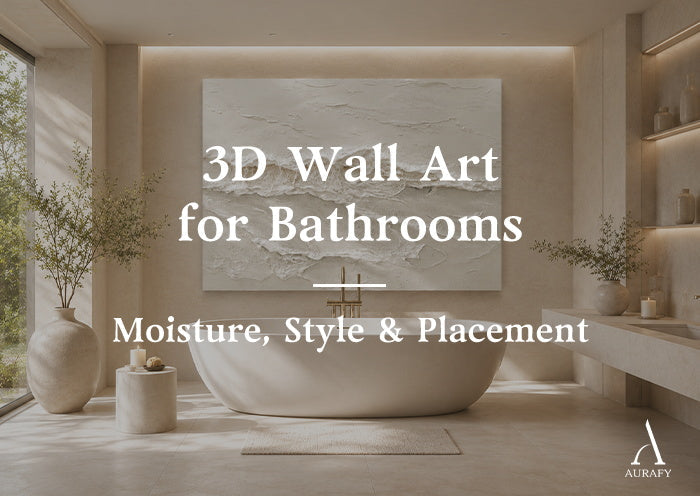
- Hanging 3D wall art in a bathroom is completely achievable — the key is choosing a piece that balances the room's hard tile and stone surfaces with tactile warmth.
- 3D wall art for bathroom displays uses sophisticated tactile modeling paste to introduce sculptural depth into an environment traditionally dominated by flat, cold materials.
- White textured wall art is the most versatile choice for a bathroom — it reflects soft light, visually opens up the space, and creates an instant spa-like atmosphere.
- Position your textured artwork under a 45-degree angled spotlight to depth-profile the hand-applied ridges and elevate the room's material register.
- Clean intricate bathroom textures safely using a soft-bristle brush or dry compressed air — never use abrasive liquid chemical cleaners near the surface.
Introduction: Moving Beyond the Tile Grid

Most people assume art belongs exclusively in the living room or bedroom — and that the bathroom is off-limits. The conventional thinking treats this room strictly as a functional, sterile environment dominated by uniform rows of porcelain and grout.
That assumption is outdated.
Using 3D wall art for bathroom spaces has become one of the most effective ways to elevate a room that most designers still treat as an architectural afterthought. By extending the material conversation of the rest of the home into this private sanctuary, you can transform a standard washroom into a space that shares the design DNA of a luxury hotel suite.
This guide explains why premium textured work suits contemporary bathrooms particularly well, how to leverage its visual properties to alter spatial perception, and exactly where and how to hang your piece to achieve a flawless gallery aesthetic.
The Visual Power of White Textured Wall Art in Compact Spaces

Color choice and spatial awareness matter more in a bathroom than in almost any other room. The footprint is typically intimate, the illumination can be clinical, and the overarching goal — for most individuals — is a sense of cleanliness, clarity, and personal retreat.
Deploying white textured wall art fulfills these design requirements through three distinct visual mechanisms:
1. Establishing a Spa-Like Sanctuary
High-end resort bathrooms and luxury wellness spas share a common visual vocabulary: pure monochromatic surfaces, an absence of loud patterns, and controlled naturalism. A white 3D textured piece integrates seamlessly into this aesthetic. The raised mineral surface catches the ambient light — whether from overhead vanity bars, frosted windows, or warm decorative sconces — and scatters it gently across the hand-formed valleys, generating a quiet, architectural presence.
2. Expanding the Perceived Room Scale
Bathrooms are frequently the most compact areas in a residential layout. While flat, dark colors can visually compress a wall, white reflects light, keeping the perimeter open and bright. The physical depth of a 3D surface accentuates this effect: the human eye reads the actual variations in structural thickness as extra spatial depth, creating a visual illusion that the wall extends further back than its physical boundaries.
3. Creating a Universal Material Bridge
A white or warm ivory textured canvas functions as a neutral visual anchor that coordinates with diverse premium materials. It pairs naturally with dark slate tiles, warm oak vanities, matte black hardware, brushed brass, and polished marble. You do not need to redesign the hard surfaces to accommodate the artwork; the artwork instantly grounds the room's existing palette.
Material Symbiosis: Pairing 3D Art with Bathroom Elements
To prevent a bathroom from feeling clinical, the art on the wall must act as a counterbalance to the room's rigid geometry. The core design principle: choose a surface texture that provides an explicit contrast to the smoothness or roughness of your existing fixtures.
|
3D Artwork Color Spectrum |
Complementary Room Materials |
Visual & Spatial Balance Principle |
|
Matte Gallery White / Warm Oat |
Polished white marble / Chrome fixtures / Smooth porcelain |
Classic Minimalist Spa: Hand-applied heavy impasto ridges break the sterile precision of high-gloss architectural surfaces. |
|
Clay Greige / Muted Sand |
Natural white oak vanities / Woven linen hand towels |
Warm Japandi Warmth: The organic texture of the mineral paste mirrors the honest, unmanufactured quality of natural timber. |
|
Monochrome Charcoal / Matte Black |
Brushed steel elements / Industrial concrete tiles / Glass enclosures |
Modern Gallery High-Contrast: The dark canvas acts as a bold architectural window, anchoring the wall without adding color noise. |
Why Luxury Contexts Demand Hand-Built Integrity
A bathroom is an intimate space experienced from short viewing distances. When brushing your teeth or relaxing in a tub, your eyes have time to focus on details. This proximity makes mass-produced, molded plastic decor panels look immediately unconvincing.
A factory-pressed replica uses a standardized template. Every ridge rises to the identical millimeter, and the surface reflects overhead light with a synthetic, predictable uniformity that betrays its industrial origins.
At AurafyArt, every piece is custom-built to order in our dedicated artist studio. No pre-fabricated molds are utilized. Independent artists handle the composition across the full canvas, using wide-blade palette knives to push, lift, and shape the heavy-body medium in real time.
Our artisans utilize a multi-pass construction method. The primary structural foundation is laid down first, allowed to stabilize, and then layered with fine secondary details — curling edges, micro-veins, and fluid sweeps. This prolonged 10 to 14-day production timeline ensures that what arrives at your home possesses an irreplaceable human touch. The subtle variations in line spacing and ridge height ensure that your artwork reads as a genuine gallery sculpture, rewarding close-up inspection.
Strategic Placement: Selecting Your Feature Wall

Even with a beautifully composed 3D piece, proper placement dictates the success of the installation. Position your canvas on a primary accent wall that maximizes its visual weight without crowding the functional flow of the room:
1. The Freestanding Bathtub Backdrop
The wall directly behind a freestanding tub is the premier visual anchor in contemporary bathroom design. It provides an open expanse where a large-scale textured canvas can dictate the ambient mood, establishing an immediate focal point upon entering the room.
2. The Vanity Flank
Hanging the piece on the wall adjacent to your vanity mirror positions the artwork directly within the user's primary line of sight. It provides an organic visual reset from the hard, reflective plane of the mirror glass.
3. The Smart Toilet Accent Wall
Utilizing the vertical space above a standard or smart toilet turns a traditionally empty, utilitarian zone into a curated design statement.
Hanging Height Rule: When mounting art above a console, vanity ledge, or wainscoting, maintain a gap of 6 to 8 inches between the base of the canvas and the architecture. For open walls, ensure the absolute center of the canvas sits between 57 and 60 inches from the floor to align directly with standard standing eye level.
Technical Lighting Layout: Activating the Sculptural Ridges
Because white and neutral-toned 3D art operates without bold color variation, the composition relies entirely on highlight and shadow contrast to reveal its forms.
Step 1: Establish the 12-to-15-Inch Offset
Install your ceiling track spotlight or adjustable recessed luminaire 12 to 15 inches out from the wall surface. This is further back than the distance used for flat prints. This intentional clearance allows the light beam to cast clean paths across the uppermost ridges without creating a harsh, top-heavy shadow band that obscures the details at the base of the painting.
Step 2: Lock the 45-Degree Beam Angle
Angle the spotlight so the beam travels diagonally across the face of the canvas at approximately 30 to 45 degrees. This shallow entry angle ensures that the light grazes the side of every hand-sculpted wave or petal, throwing the opposing recesses into deep, crisp micro-shadows. Avoid vertical downlights positioned directly over the wall, as flat overhead light fills the channels evenly, blinding the eye to the physical depth.
Step 3: Select Warm White Output
Always spec bulbs in the 2700K to 3000K range. Warm white illumination accentuates the earthy, organic undertones of sand and oat-white modeling paste, making the canvas glow. Cool white daylight bulbs (above 4000K) must be avoided, as they introduce a clinical, grey cast that strips the hand-made surface of its inherent warmth.
Frequently Asked Questions
What hardware works best for tiled or plasterboard walls?
Bathroom surfaces require specific anchors. For drywall or moisture-resistant plasterboard, always use expansion wall anchors rated for at least double the weight of the canvas to distribute the load evenly. For tiled or stone feature walls, drill precisely into the grout lines using a masonry bit and insert matching anchors, or utilize professional-grade, high-weight-capacity adhesive hanging brackets designed for non-porous surfaces. For canvases wider than 24 inches, implement a dual-point hanging system using the pre-installed D-rings on the reverse side to prevent any horizontal shifting or tilting.
How do I maintain and clean a 3D canvas without a glass cover?
Our pieces feature a gallery-grade matte varnish finish that naturally reduces surface static charge, preventing dust from actively adhering to the ridges. To clean, simply use a wide, dry, soft-bristle brush — such as a clean natural makeup brush or a soft watercolor brush — to sweep gently along the orientation of the sculpted valleys every few weeks. For deep, narrow recesses, short bursts from a can of compressed air will clear dust instantly without direct physical contact. Never use water, damp microfiber cloths, or chemical solvents, as liquid application can erode the protective matte sealant over time.
A beautifully appointed home deserves consistent aesthetic intentionality across every threshold.
The bathroom is your most private space — a room dedicated to decompression, quiet focus, and personal restoration. It deserves the same level of considered design that you afford your living room or entryway.
By breaking up flat wall expanses with a hand-sculpted, light-responsive surface, you bridge the gap between hard architectural angles and organic luxury.
The space is ready. The wall is waiting.
Browse the AurafyArt premium collections to discover the handmade 3D canvas that completes your sanctuary.
Share:
3D Office Wall Art: Upgrade Your Workspace
3D Hallway Art: Transform Narrow Spaces with Texture