


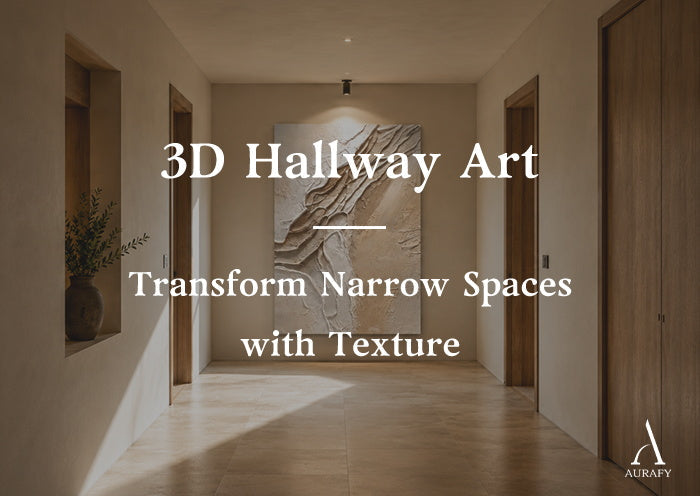
- Use 3d hallway art to turn a dark, narrow corridor into a gallery-like space without giving up any valuable floor space.
- Hang vertical 3d textured canvas art to draw the eye upward. This simple placement makes low ceilings feel taller and tight entryways feel more open.
- Choose lightweight handmade canvas over heavy 3d wood wall art for safer, easier installation in a high-traffic hallway.

The hallway is the first thing you see when you come home. It sets the tone for everything that follows.
Most people treat it as an afterthought. They leave bare white walls, hang a basic coat hook, or squeeze in a narrow console table. This bad habit turns the area into a boring corridor to somewhere else, rather than a beautiful room in its own right.
Beautiful 3d hallway art changes this without taking up a single inch of floor space. One well-chosen piece with physical depth and surface texture breaks the monotony of a long flat wall. It adds warmth to a dark entry. Ultimately, it creates the kind of first impression that makes your entire home feel more considered.
This guide covers why vertical textured canvas art works best in hallways. It compares canvas to heavier wall decor options. Finally, it explains how to arrange and light your piece effectively.
Why Vertical 3D Textured Canvas Art Works in a Hallway

Hallways present a specific visual challenge. The walls sit close together over a long, flat stretch. Ceilings often feel low relative to the length of the space. Because people walk through rather than sit in a corridor, your art must work from a passing glance.
Choosing vertical 3d textured canvas art addresses all of these spatial challenges directly:
It Breaks the Tunnel Effect: A long hallway with plain walls creates a restrictive visual tunnel. The eye travels straight down the space with nothing to stop it. A textured canvas with flowing, organic lines gives the eye a perfect place to pause. The ridges and deep shadows create enough visual complexity to hold attention effortlessly.
It Makes the Ceiling Feel Higher: This remains the most important spatial function of vertical art. When the lines and texture move upward, the eye follows. The gaze travels up the canvas surface and continues naturally toward the ceiling. The brain reads this upward movement as height, making a standard ceiling feel noticeably taller.

It Works Perfectly at Close Range: In a narrow hallway, viewers pass within arm's length of the wall. This proximity actually benefits 3D textured work. Viewers can see every individual ridge, edge, and texture variation clearly at close range. A handmade piece rewards this closeness in a way that flat prints never can.
Canvas vs. 3D Wood Wall Art: Which Suits a Hallway?

When decorating a entryway, many people consider three-dimensional options, including 3d wood wall art. Here is an honest comparison of how the two choices perform in this high-traffic setting:
Weight and Safety (Canvas Wins) Wood panels carry massive weight. A medium piece often weighs 10 to 20 pounds. In a narrow hallway, people brush past walls regularly. A heavy wood panel poses a real fall risk if the wall fixing fails over time. Canvas pieces weigh a fraction of that amount. A large handmade canvas typically weighs under 5 pounds, presenting zero safety concerns.
Surface Contact and Durability Hallway walls experience constant contact from brushing shoulders, swinging bags, or running children. Wood panels often feature sharp carved edges that catch on clothing or scratch skin. Conversely, the cured acrylic surface of our handmade 3D canvas stays firm yet completely smooth at the edges. It handles incidental contact without damaging the piece or the person passing it.
Visual Warmth and Style Wood art often projects a heavy, industrial or rustic look that clashes with contemporary minimalist or Japandi interiors. A handmade textured canvas in a neutral tone adapts to almost any interior style seamlessly. Its organic surface adds pure warmth without forcing a rigid style category onto your home.
How to Arrange 3D Wall Painting Designs for a Hall

Placement strategy matters deeply in linear spaces. Your artwork must perform well from a range of distances and angles.
Follow these two proven layout methods for a stunning result:
The Focal Point Method If your hallway ends at a closed wall rather than an open doorway, place a single large-format piece directly on that end wall. This setup gives the eye a clear destination as you move down the corridor.
Using 3d wall painting designs for hall end walls maximizes this cinematic effect. The viewer approaches the piece gradually, experiencing the artwork first as a distant focal point and then in close detail. Choose a piece that fills at least two-thirds of the wall width to anchor the space correctly.
The Gallery Rhythm Method For a long hallway with a door or window at the end, place a series of two or three matching vertical canvases in a horizontal row along one side wall. Keep the gaps between panels narrow and consistent, around 2 to 4 inches.
This arrangement creates a gallery-like rhythm that carries the eye smoothly down the hallway. The repetition reads as deliberate and premium. Because artists paint each piece by hand, the subtle variations in texture keep the arrangement from looking mechanical.
Made to Order: Why Custom Craft Matters in a Hallway
Hallways rarely have strong overhead fixtures. Instead, indirect light spills from doorways, bounces off floors, or enters from nearby windows.
This complex, angled light suits 3D textured work perfectly, but only if the surface has true physical depth. Mass-produced, mold-pressed panels lack this variation. Their uniform surface reads completely flat under indirect light, causing the dimensional effect to disappear.
Handmade work responds differently.
At AurafyArt, we build every piece to order in our dedicated artist studio. When we receive your order, an artist begins the piece from scratch in a naturally lit workspace. The painter mixes the paste and applies it by hand with a palette knife, ensuring the texture achieves the exact depth and directional movement required.
This handmade variation allows the piece to thrive under complex hallway lighting. Each ridge catches indirect light at a slightly different angle. The surface reads as genuinely three-dimensional and shifts beautifully as the daylight changes.
Lighting a Hallway Piece: Simple and Effective
You do not need a complex electrical setup to show your art at its best. One well-positioned warm light source makes a significant difference:
Ceiling-Mounted Spotlights: Install an adjustable spotlight on the ceiling, positioned approximately 12 inches out from the wall. Angle it downward toward the surface of the piece. This raking downward light deepens every shadow on the textured surface, bringing out the full dimensional quality of the work.
Color Temperature: Use warm white bulbs in the 2700K to 3000K range. Warm light makes a transitional entryway feel welcoming rather than clinical. Cool white bulbs (4000K and above) flatten textured surfaces and turn neutral tones cold and grey.
Using Existing Light: If you cannot add ceiling fixtures, position the piece on the wall that receives the most angled light from an adjacent room. Even indirect natural light from a side doorway creates enough shadow variation to make the texture visible and engaging.
Frequently Asked Questions
What happens if someone brushes against a 3D canvas in a narrow hallway?
Our acrylic modeling paste cures to a firm, resilient surface. It matches the hardness of dried plaster. Light incidental contact from a shoulder or a swinging bag will not damage the surface. The canvas edges stay smooth and rounded, eliminating any risk of catching clothes.
How high should I hang art in a hallway?
Apply the standard eye-level rule: center the piece 57 to 60 inches from the floor. If your hallway ceiling feels low, hang it slightly higher (center at 62 to 65 inches). This adjustment enhances the upward visual pull of a vertical composition and makes the space feel taller.
Can I use a single large piece in a short hallway?
Yes. In a short hallway, a single large piece works better than a grouped arrangement. A single bold piece uses the limited wall length decisively. Choose a vertical format that fills most of the available wall height for the best effect.
Your Hallway Is the Opening Line
Every well-designed home needs a clear beginning—a beautiful moment where the outside world gives way to your personal sanctuary.
Choosing dedicated 3d hallway art creates that transition. It gives a busy walkway a reason to slow down. It adds immediate depth and warmth to a room that most homes neglect. Best of all, it achieves this transformation without taking up floor space or requiring a messy renovation.
Your hallway deserves better than a bare white wall. One piece is all it takes.
Share:
3D Wall Art for Bathrooms: Style, Scale & Placement
3D Dining Room Wall Art: Style Your Dining Space