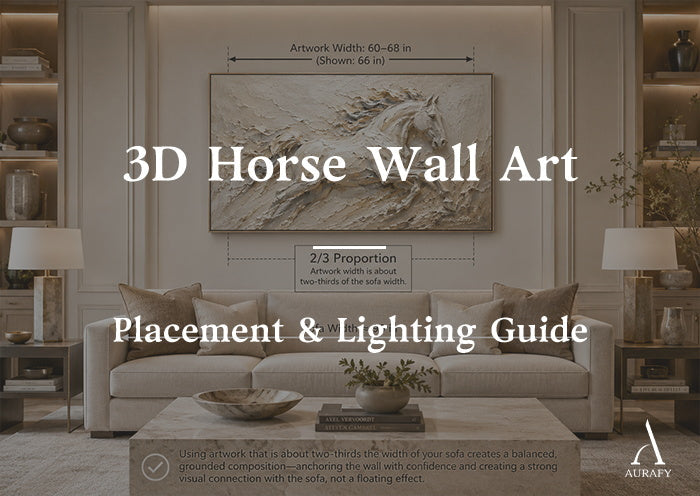
- Display handcrafted 3D horse wall art above a sofa using the two-thirds width rule — then activate the sculpted muscle shadows with a 45-degree raking spotlight.
- Choose large textured horse painting formats for high-ceiling walls and wide living rooms where flat prints lose all visual authority at scale.
- Use 3D wall art elephant pieces in executive offices and meeting rooms to add material weight, warmth, and a sense of grounded authority.
- Always install large animal pieces using a two-point D-ring system on rated wall anchors — never rely on a single hook for any canvas wider than 24 inches.
- Use warm white bulbs at 2700K to 3000K — cool white light removes the warmth from animal fur and skin textures and makes the surface look flat and grey.
A room can have excellent furniture, considered lighting, and a well-chosen palette — and still feel unfinished. The wall carries no weight. The space has no presence.
3D horse wall art addresses this at a level that flat art cannot reach. A horse rendered in physical relief — muscle forms built up in sculptural paste, a mane constructed stroke by stroke — has material presence that commands a room before anyone has read the composition.
The surface is genuinely three-dimensional. It casts real shadows. It changes as the light moves through the day.
This guide covers where to place it, how to size it, how to light it, and what makes handmade work worth choosing over mass-produced alternatives.
Large Textured Horse Painting: Which Spaces Work Best

The horse is one of the most spatially versatile animal subjects in wall art. You can orient its proportions horizontally—the full-body profile or galloping pose—or vertically—the rearing posture, the upward neck and mane. This flexibility makes it effective across multiple wall configurations.
Wide sofa walls in living rooms
For a horizontal horse composition above a sofa, apply the two-thirds proportion rule without exception.
Measure the total width of your sofa. The artwork — or the total width of a multi-panel arrangement — should span between two-thirds and three-quarters of that measurement. For a standard 90-inch three-seat sofa, this means artwork between 60 and 68 inches wide.
This proportion creates a visual anchor between the furniture and the wall above it. The art feels connected to the sofa rather than floating above it. A large textured horse painting at this scale has enough width to carry the visual weight of the wall without looking undersized or tentative.
Go wider than feels necessary. A piece that looks generous in a showroom will almost always look appropriate — or slightly conservative — on an actual living room wall.
High-ceiling walls and double-height entry halls
For walls with ceilings above 10 feet — double-height entry halls, vaulted living rooms, open stairwells — a vertical composition in a 40" × 80" format is the most effective choice.
A horse depicted in a vertical format — rearing, head raised, mane flowing upward — carries the eye along the length of the composition toward the top. The upward movement of the palette knife strokes in the mane and body forms continues this visual direction toward the ceiling.
The ceiling feels taller. The wall feels taller. The architectural scale is used rather than ignored.
For very wide feature walls with no furniture anchor, a diptych or triptych arrangement of vertical panels — two or three 40" × 60" canvases hung in a horizontal row with 2 to 4 inch gaps — fills the wall decisively while creating a gallery-like horizontal rhythm across the space.
3D Wall Art Elephant: Authority for Executive and Corporate Spaces

The elephant brings a different quality to interior design than the horse.
Where a horse composition introduces movement, energy, and organic flow, an elephant piece conveys stability, weight, and considered presence. These are qualities that suit specific spaces: executive offices, corporate boardrooms, private libraries, and the primary walls of formal reception areas.
Why elephant subjects work in professional environments
Modern corporate and executive spaces are typically built on polished marble, tempered glass, brushed steel, and lacquered surfaces. These materials are precise and controlled. They project efficiency and professionalism. They also project coldness.
A 3D wall art elephant piece in charcoal grey, weathered stone, or warm clay introduces the counterbalance these spaces need. The thick, irregular skin texture of the elephant — built up in sculptural paste with visible directional strokes — is the visual opposite of polished marble. The two surfaces read against each other, and the contrast makes both more interesting.
The elephant subject also carries specific cultural associations that translate well across professional contexts: wisdom, stability, and long memory. These associations are not literal — viewers do not consciously think through the symbolism — but they contribute to the emotional register of the room in a way that abstract work does not.
For a conference room where the art needs to remain neutral across cultural backgrounds, an elephant piece in a monochromatic neutral palette — deep grey or warm stone — reads as powerful sculpture rather than figurative art. It is present without being contentious.
Material Pairing Guide: Animal 3D Art and Interior Surfaces
|
3D Animal Theme |
Recommended Palette |
Complementary Materials |
Visual Balance Principle |
|
Flowing horse forms |
Warm sand / soft ivory / warm grey |
Walnut veneer furniture / wool rug / vintage brass light fixtures |
Japandi natural harmony: the fluid sculpture lines of the horse echo natural wood grain; warm tones connect across all surfaces |
|
Bold elephant relief |
Matte black / weathered grey / charcoal |
Micro-cement floors / black leather seating / steel furniture |
Modern gallery contrast: the dark, tactile elephant surface introduces hand-made warmth into a cold industrial environment |
|
Rearing horse silhouette |
Deep charcoal / warm oat |
Double-height entry walls / polished stone floors |
Architectural scale: the vertical format draws the eye upward; the neutral palette suits formal entry spaces without imposing a color |
|
Abstract wildlife forms |
Dusty clay / terracotta / pale ochre |
Raw linen upholstery / natural stone surfaces / ceramic vessels |
Organic modern: earth-toned animal forms read as naturalistic sculpture within an earthy, material-rich room |
Why Handmade Production Is Non-Negotiable for Animal Art

The human visual system is highly attuned to animal form. We read faces, bodies, and movement with a precision we do not apply to abstract or geometric subjects. This sensitivity makes mechanical repetition in animal art immediately visible — and immediately unconvincing.
A machine-pressed horse or elephant panel has the same problem at every scale: uniformity. Every muscle ridge on the horse sits at the same height.
Every wrinkle on the elephant skin has the same depth and angle. Under a spotlight, the surface reflects with a consistent pattern that reads as manufactured rather than made. In a room designed around quality materials and considered choices, this is a significant failure.
At AurafyArt, every animal piece is made to order in our dedicated artist studio. No molds, no templates, no pre-set patterns.
How a horse piece is built
The artist begins with the large structural forms — the body mass, the neck, the haunches — applied as broad, gestural strokes with wide-blade palette knives. These strokes establish the overall proportions and the primary directional movement of the composition.
The muscle detail comes next. Individual muscle groups are built up in layers, each one curing before the next is applied. The shoulder blade area, the neck musculature, the hindquarter forms — each receives specific attention to its structural character. The strokes follow the actual direction of the muscle fiber in the living animal.
The mane is the final and most expressive element. Long, sweeping strokes with a narrow blade build the hair forms — each stroke a different length and pressure, creating the layered, falling quality of actual horse hair. No two strokes are identical. The mane is the element that most clearly shows the hand of the artist and the speed of the mark.
How an elephant piece is built
Elephant skin is structurally different from horse musculature — the surface is deeply wrinkled, with a coarser, more block-like texture. The artist builds the primary skin folds first, establishing the large-scale pattern across the face and body. Fine wrinkle detail is added in subsequent sessions, building the micro-texture within the large folds. The eye socket is constructed with particular care — recessed deeply, with a raised brow structure above it — to give the eye its characteristic quality of depth and age.
Both subjects receive two coats of UV-resistant, low-VOC matte varnish as a final protective layer.
How to Light 3D Animal Art: A Technical Guide

Animal 3D art — particularly portrait-oriented pieces with significant facial projection — requires precise lighting. The wrong approach eliminates most of the dimensional quality the piece was built to deliver.
Step 1: Install the spotlight 12 to 15 inches from the wall
This is the most important single adjustment for deeply sculpted animal work. If the light source sits too close to the wall — at the standard 8 to 10 inches used for flatter work — the prominent facial and structural elements cast large shadows onto the sections below them.
The horse's mane shadows the body. The elephant's brow shadows the eyes. The lower sections of the composition fall into near-total darkness.
Moving the light outward to 12 to 15 inches gives the beam a shallower entry angle that clears the highest projecting elements and illuminates the full composition evenly.
Step 2: Lock in the 30 to 45 degree raking angle
The beam must travel across the face of the canvas — not straight down onto it. At 30 to 45 degrees, the light catches the lit face of every raised element and drops the recessed areas into precise, clean shadow. On a horse piece, this reveals the individual muscle forms. On an elephant piece, it deepens every skin fold into a shadow channel while leaving the raised skin ridges bright.
This is the angle that makes 3D animal work look like sculpture rather than like a textured canvas.
Step 3: Use the side-offset technique for portrait pieces
For pieces where the animal faces directly outward — a horse head portrait, a frontal elephant face — position the spotlight slightly to the left or right of the canvas center rather than directly in front of it. This off-center position gives the three-dimensional face its most natural-looking shadow: deeper on the side away from the light, lighter on the lit side. The face gains depth and the eyes gain the quality of looking outward rather than staring flatly ahead.
Color temperature
Use 2700K to 3000K bulbs throughout. Warm white light brings out the texture and warmth of animal fur and skin in a way that cool white cannot. At 4000K and above, the warm tones in earthy palettes read as grey, and the surface loses the warmth that makes animal work feel alive rather than clinical.
Frequently Asked Questions
How do I clean the detailed fur and skin textures without damaging the surface?
Use a wide soft-bristle brush — a large makeup brush or a clean natural-bristle brush — to sweep gently along the direction of the fur or skin grain every two to three weeks. For deep recesses, use short bursts from a can of compressed air. Hold the can upright and keep it at least 6 inches from the surface to avoid directing condensation onto the paste.
Never use a damp cloth, water, alcohol, or any chemical cleaner. Moisture in the recessed channels can affect the modeling paste structure over time. The protective varnish handles normal environmental exposure without any additional treatment.
Is a large horse or elephant canvas safe to hang above a sofa or desk?
Yes, with proper installation. AurafyArt large canvas pieces use a professional lightweight stretcher bar construction — a 40" × 60" piece weighs under 5 pounds, and a 40" × 80" piece stays under 8 pounds.
Despite this low weight, always use a two-point installation system for any canvas wider than 24 inches. Use the D-ring fittings on the back of the canvas as your two hanging points, fitted with wall anchors rated for at least double the piece's actual weight.
On drywall, use rated expansion anchors. On masonry, use masonry-specific fixings. Mark both points with a spirit level before drilling — a large piece hung even fractionally off horizontal is visible from across the room.
Can I commission a 3D portrait of a specific horse or animal?
Yes. AurafyArt offers custom commissions for specific animal subjects, including individual horses. The commission process begins with reference photography — front face, three-quarter profile from both sides, and full-body side profile are the most useful angles. The artist uses these to map the specific proportions, marking, and structural character of the individual animal before building begins.
Custom animal commissions typically require 14 to 21 days of production time depending on the complexity of the composition. Contact us with your reference photographs and desired dimensions to receive a quote and timeline.
The Wall Gains a Presence

An empty wall in a well-furnished room says the room is not finished. It says something is missing.
3D horse wall art fills that absence with something that flat art cannot provide: genuine physical form. A surface that casts real shadows. A composition that rewards close attention. An object that was made, slowly, by hand, for a specific purpose — to give a specific wall the presence it was waiting for.
Whether it is a flowing horse form above a sofa, a rearing silhouette on a tall entry wall, or an elephant relief behind a desk — the right piece does not decorate the room. It completes it.
Browse the AurafyArt 3D animal collection — or contact us to commission a custom piece for your specific subject and space.
Share:
3D Animal Wall Art: Custom Pet Portraits & Wildlife Guide
3D Butterfly Wall Art: Placement & Lighting Guide