


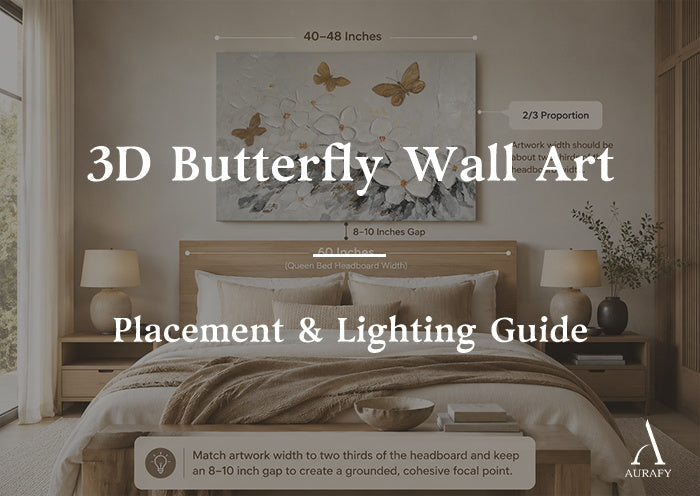
- Display handcrafted 3D butterfly wall art above a bed using the two-thirds width rule — then use a 45-degree raking spotlight to project delicate wing shadows that soften the room's hard edges.
- Choose romantic 3D butterfly bedroom art in warm oat, dusty blush, or pale plaster tones to create a calming, feminine space without introducing color noise.
- Use large 3D butterfly wall decor — a single 40" × 80" piece or a triptych — on high-ceiling walls where smaller pieces only emphasize the emptiness around them.
- Always install using a two-point D-ring system on rated wall anchors — never use a single hook for any canvas wider than 24 inches.
- Clean with a wide soft-bristle brush or compressed air only — moisture and chemical cleaners will damage the modeling paste over time.
There is a temptation, when decorating a bedroom or a feminine living space, to reach for butterfly wall decals. They are inexpensive, widely available, and they promise exactly the effect you are after.
The result is almost always disappointing.
Plastic and vinyl butterfly decals look like stickers in person. The edges lift within months. The material catches light in a way that reads as cheap at close range. And in a carefully considered interior, the gap between the promise of the product and its actual material quality is immediately visible.
3D butterfly wall art is a different category entirely. Each wing is built in sculptural relief — applied by hand using modeling paste, layered to create actual physical depth and curvature.
The piece casts real shadows. It changes under different light conditions. It holds up to close inspection. And it carries the quiet quality of something made rather than manufactured.
Romantic 3D Butterfly Bedroom Art: Sizing and Placement

The butterfly is an unusually expressive subject for a bedroom. The wing forms — curved, asymmetric, organically irregular — introduce the soft, flowing qualities that hard-edged contemporary interiors often lack. The subject is inherently associated with transformation, lightness, and beauty. In a room designed for rest and personal sanctuary, these associations support the atmosphere the space is trying to create.
Getting the placement right is what separates a piece that transforms a bedroom from one that sits on the wall without purpose.
The headboard proportion rule
The total width of your artwork should span two-thirds of the width of the headboard or bed below it.
For a queen bed at 60 inches wide, choose artwork between 40 and 48 inches wide. For a king bed at 76 inches wide, choose artwork between 48 and 56 inches wide. A piece narrower than half the bed width looks disconnected from the furniture below it. It reads as an accessory rather than a considered design choice.
Hanging height above the headboard
Position the bottom edge of the canvas 8 to 10 inches above the top of the headboard. This gap creates a visual connection between the bed and the art without crowding the headboard. The center of the canvas should sit in the upper half of the wall — high enough to read clearly from across the room, low enough to remain connected to the furniture below.
For beds without a headboard, measure from the top of the mattress or the bed frame and apply the same 8 to 10 inch gap.
Single piece vs. grouped arrangement
A single large piece with a centered butterfly composition works well as a calm, focused focal point. This approach suits wabi-sabi and Japandi bedrooms where restraint is the core principle.
A vertical grouping of two or three smaller butterfly canvases — arranged in a column above the headboard — creates a more layered, ascending arrangement. This suits spaces with higher ceilings where the wall above the headboard has significant vertical space to fill.
Large 3D Butterfly Wall Decor for High-Ceiling Spaces

High ceilings and large standalone walls present a specific challenge. A piece that works above a sofa or bed — 40 to 50 inches wide — often looks undersized against a wall that rises 12 feet or more. The art draws attention to the surrounding emptiness rather than filling it.
Large 3D butterfly wall decor is the solution for these configurations.
Single vertical format: 40" × 80"
A single vertical canvas at 40 × 80 inches — approximately 100 × 200 cm — suits double-height entry halls, tall bedroom feature walls, and walk-in wardrobe walls with significant vertical space. The proportions of the piece are well-suited to butterfly compositions: a vertical format accommodates multiple butterfly forms arranged in an ascending sequence, with the uppermost butterflies near the top of the canvas drawing the eye upward toward the ceiling.
The directional quality of this arrangement — forms rising from the base of the canvas toward the top — creates a strong upward visual movement. In a room with a high ceiling, this movement makes the ceiling feel purposefully tall rather than simply empty.
Triptych arrangement for wide walls
Three 40" × 60" vertical canvases hung in a horizontal row — with consistent 2 to 4 inch gaps between them — gives a total arrangement width of approximately 124 inches. This scale suits the widest residential walls and covers the space with the authority that smaller pieces cannot achieve.
Keep the butterfly compositions within each panel continuous across the arrangement — as though the butterflies are moving from left to right across all three panels. This creates a unified, flowing visual narrative across the full width of the wall rather than three separate images placed close together.
Material Pairing Guide: Butterfly 3D Art in Context

|
3D Butterfly Palette |
Complementary Materials |
Visual Balance Principle |
|
Warm oat / pale sand |
Raw linen curtains / white oak dressing table / bouclé armchair |
Classic Japandi: the dry, slightly granular quality of the paste echoes the texture of linen — neutral tones across all surfaces let shadow do the expressive work |
|
Dusty blush / warm terracotta |
Micro-cement floors / travertine coffee table / matte black metal shelving |
Modern romantic: the organic wing curves soften the precision of cement and stone; the warm blush tone introduces femininity without sweetness |
|
Soft ivory / warm plaster white |
Warm timber flooring / woven jute rug / aged brass fixtures |
Organic modern: the pale surface catches warm light beautifully; the butterfly forms add organic movement to a warm neutral room |
|
Pale grey-lilac / muted mauve |
White lacquered furniture / glass surfaces / chrome fixtures |
Contemporary feminine: the cool muted tone suits a more modern, graphic interior; the sculptural butterfly form prevents the palette from reading as flat |
Why Handmade Quality Defines This Category

Butterfly art exposes production quality more clearly than most subjects.
The wing is a thin, curved form. In a handmade piece, each wing has its own slight variation in curvature, thickness, and edge quality.
The leading edge of one wing curves differently from its pair. The surface of one wing catches light at a slightly different angle from the adjacent wing. These variations are what make the piece read as organic and natural rather than repetitive and mechanical.
A machine-pressed butterfly panel gives every wing the same curvature, the same edge profile, and the same surface angle. Under a spotlight, the entire surface reflects light uniformly. The piece reads as pattern rather than sculpture. In a bedroom or feminine space designed around material quality and individual character, this uniformity is immediately out of place.
At AurafyArt, every butterfly piece is made to order in our dedicated artist studio. The production process follows a strict multi-stage approach.
Stage one: Base construction
The artist mixes the flexible modeling paste to the right consistency for butterfly work — fluid enough to create thin, curved wing forms without excessive weight, stiff enough to hold the curvature as it dries. A base layer is applied and left to cure fully. This base prevents the subsequent layers from adhering to an unstable foundation, which is the primary cause of cracking in lower-quality work.
Stage two: Wing sculpting
The butterfly body and wing forms are built up in layers — each one adding height, curvature, and surface detail to the previous. The wing edges are the most important detail. The artist works each edge to a specific character: some are pulled to a fine, sharp point; others are left with a slightly rough, broken quality that catches light along the edge.
No two wings in the composition are identical. The variation is what makes the piece look like it could fly.
Stage three: Protective finish
Two coats of UV-resistant, low-VOC matte varnish are applied by hand and allowed to cure fully between coats. This seal protects the warm neutral tones from yellowing, prevents moisture from affecting the paste, and maintains the matte surface quality that gives butterfly work its soft, natural appearance.
How to Light 3D Butterfly Art Correctly

Butterfly pieces have significant surface projection — wings built in relief can project 10 to 20 millimeters from the canvas base. This depth requires careful light positioning to reveal rather than obscure.
Step 1: Position the spotlight 12 to 15 inches from the wall
The most common mistake with deeply sculpted butterfly work is placing the spotlight too close to the wall. At 8 to 10 inches — the standard distance for flatter work — the uppermost butterfly wings cast large shadows onto the lower sections of the composition. The detail in the lower half of the canvas falls into darkness.
Moving the light outward to 12 to 15 inches flattens the entry angle of the beam, which allows it to clear the top wing edges and illuminate the full canvas area evenly.
Step 2: Set the beam angle at 30 to 45 degrees
The beam should travel across the face of the canvas at a shallow angle — not straight down onto it. At 30 to 45 degrees, the light grazes the surface: catching the top face of each raised wing edge and dropping the recessed areas between wings into precise shadow. The gap between overlapping wings becomes a shadow channel. The outer edge of each wing catches a fine line of highlight.
This is the light condition that makes a butterfly composition look like it is moving rather than sitting on the wall.
Step 3: Use warm white bulbs
2700K to 3000K is the correct color temperature for butterfly work in any interior. Warm white light enhances the soft, organic quality of the wing forms and brings out the warmth of neutral tones. Cool white light above 4000K makes the same neutral tones look grey and cold — which removes exactly the warm, welcoming quality that butterfly art in a bedroom is designed to provide.
Frequently Asked Questions
How do I clean the narrow gaps between butterfly wings without damaging the surface?
Use a wide, soft-bristle brush — a large makeup brush works well — to sweep gently along the direction of the wing curves every two to three weeks. For the narrow gaps between overlapping wings, use short bursts from a can of compressed air directed into the gap. Hold the can upright and keep at least 6 inches from the surface.
Never use a damp cloth, water, or any chemical cleaner near the surface. Moisture trapped in the narrow channels between wings can affect the modeling paste structure over time. The protective varnish handles normal environmental exposure without any additional treatment.
Is a 3D butterfly canvas safe to hang above a bed?
Yes, with proper installation. AurafyArt canvas pieces use a lightweight stretcher bar construction — a 40" × 60" canvas weighs between 3 and 6 pounds. Despite this low weight, always use a two-point installation for any canvas wider than 24 inches.
Use the D-ring fittings on the back of the canvas as your two hanging points. On drywall, use wall anchors rated for at least double the weight of the piece.
On masonry, use masonry-specific fixings. Mark both fixing points with a spirit level before drilling. A canvas hung on two properly rated fixing points above a bed poses no safety concern.
Can I commission a butterfly piece in a specific color?
Yes. Because every piece is made to order, color can be specified at the time of commission. The most common requests are warm ivory, dusty blush, pale sage, and soft grey — all of which perform well under warm residential lighting and suit a wide range of bedroom palettes. For a specific color match to an existing room element, contact us with a color reference before ordering and we will confirm what is achievable within the composition.
The Room Gains Its Wings
A bedroom that is simply furnished and carefully neutral can still feel like it is missing something. The walls are present but not contributing. The space is correct but not quite complete.
3D butterfly wall art is often what fills that gap. Not through color or pattern or complexity — but through the quiet physical presence of a surface that was made by hand, built in layers, and responds to the light in the room with genuine dimensional depth.
The butterflies do not move. But the shadows they cast do.
Explore the process of creating 3D butterfly paintings by AurafyArt on Facebook!
Share:
3D Horse Wall Art: Placement & Lighting Guide
Wall Decals vs 3D Canvas Art: The Complete Guide