

- Choose a handmade black and white abstract painting using flexible acrylic polymer paste — not brittle plaster or wall filler — making the surface permanently resilient rather than prone to cracking.
- The multi-stage curing process takes 10 to 14 days and builds the surface in thin layers. Each layer cures fully before the next is applied. This is what prevents cracking at depth.
- Two hand-applied coats of low-VOC matte varnish reduce the static charge on the surface, which is what keeps dust from adhering to the texture channels over time.
- Clean with a wide soft-bristle brush every two to three weeks, following the direction of the palette knife marks. Never use water, alcohol, or any chemical cleaner.
- Flat canvas prints deteriorate within 1 to 3 years under normal residential conditions. A properly made handmade 3D piece maintains structural integrity for decades.

The buyers who ask the most questions before purchasing a large 3D textured piece are often the ones who have done the most research. They know what they want. They have seen the visual impact.
But they have also seen cheaper textured wall art deteriorate:
· Cracks appearing in the surface.
· Edges lifting from the canvas.
· White areas developing a grey, dusty haze that never quite cleans away.
Their questions are specific: Will a surface this thick eventually crack? How do you clean the narrow channels without damaging the texture? Will the white base yellow near a window?
These are the right questions. The answers depend entirely on how the piece was made — which materials were used, how they were applied, and how the surface was finished.
This article covers the material science behind a properly made black and white abstract oil painting in 3D relief: what makes it last, how to maintain it, and why it outperforms flat alternatives in every measurable dimension.
Thick Texture Painting vs. Flat Canvas Print: The Material Gap
The comparison between a handmade 3D piece and a flat canvas print is often framed as an aesthetic one. In practice, it is primarily a materials question.
What happens to a flat canvas print over time
A flat digital canvas print is ink applied to a fabric surface, typically coated with a UV laminate or PVC finish to protect the image. This coating is what gives printed canvases their slight sheen — and it is also what causes them to degrade.
PVC and standard UV laminates are sensitive to temperature and humidity cycling. This is the normal fluctuation that occurs in any lived-in room through the seasons. Over 1 to 3 years, this cycling causes the coating to expand and contract slightly more than the canvas beneath it.
The result is edge lifting, surface cracking of the coating, and gradual color loss. In a bright room with natural light, the process accelerates.
The image is also fixed from the moment of printing. There is no shadow variation, no response to changing light, and no depth to discover. The piece looks identical at 9am and 9pm. Over months and years, this visual fixedness becomes the defining characteristic of the piece — and not in a positive way.
What a handmade 3D piece does instead
A premium black and white abstract oil painting in mineral relief does not have a coating that can crack or lift. The surface is the paste itself — a material that bonds with the canvas fiber at a molecular level during the curing process. There is no separate layer that can delaminate.
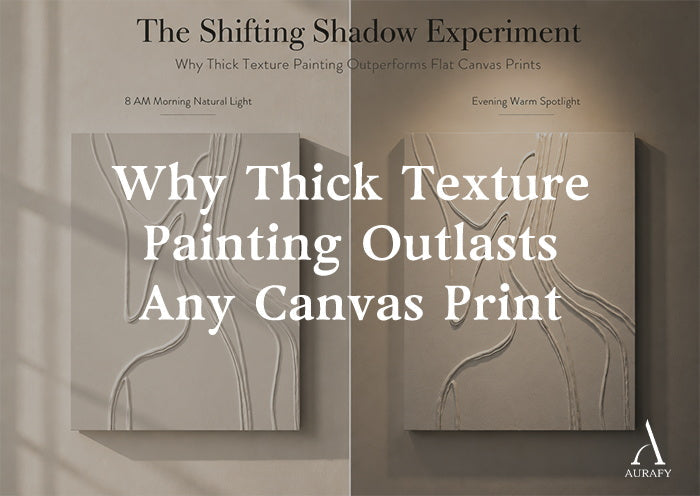
When investigating why thick texture painting outperforms flat canvas prints, the physical answer lies in its real shadow play. The surface responds to changing light throughout the day. The shadows that fall across the ridges at 8am are longer and softer than the shadows at noon, which are different again from the shadows under an evening spotlight.
The piece is genuinely different to look at at different times of day. That visual dynamism does not diminish with age. If anything, familiarity with a piece's specific surface variation makes the changing light effects more visible and more interesting over time.
The Chemistry of Thick Texture: How Heavy Impasto Cures Without Cracking

The most common failure mode in lower-quality textured art is cracking. It is the question buyers ask most often, and it reflects genuine experience with products that failed. Understanding why cracking happens — and what prevents it — requires a brief look at the materials involved.
Why low-quality textured art cracks
Most mass-produced textured wall art uses construction plaster, drywall compound, or low-grade spackle as the texture medium. These materials are designed for flat surface applications — filling holes, smoothing joints — not for sculptural use on a flexible canvas.
When applied thickly on a canvas, these materials face a specific structural problem:
· As they dry, they contract.
· This contraction puts the surface under tension.
· On a flat rigid wall, the tension dissipates.
· On a flexible canvas that moves slightly with changes in temperature and humidity, the tension concentrates — and eventually the surface cracks.
A second cause of cracking is applying thick texture in a single pass. A single thick layer traps moisture at its core. The outer surface skins over and appears dry while the interior is still wet. As the interior eventually dries and contracts, it pulls against the already-rigid outer surface and cracks it from within.
What prevents cracking in a properly made piece
At AurafyArt, every piece uses a professional-grade flexible modeling paste. This compound is formulated specifically for sculptural application on flexible supports. The formulation combines acid-neutral mineral pigments, fine marble dust for body and texture, and a high-flexibility acrylic polymer emulsion as the binder.
The acrylic polymer is the critical component. During the curing process, the polymer chains cross-link. This forms a molecular network that is significantly more resilient than any plaster or gypsum compound.
The cured surface is firm enough to hold peaks and ridges permanently, but flexible enough to move slightly with the canvas rather than against it. This is what prevents cracking under the seasonal temperature and humidity changes that affect every interior.
The layered application is equally important. No layer of texture paste is applied more than a few millimeters thick in a single session. Each layer cures fully — typically 24 to 48 hours under ambient studio conditions — before the next is applied. For a piece with 15 to 20 millimeters of final surface height, this process takes 10 to 14 working days.
This is not an inefficiency in the production process. It is the production process. Rushing it by applying subsequent layers before the previous one has cured produces exactly the moisture-trapping failure mode described above. The time is structural.
Unlike machine-pressed replicas, a handcrafted black and white abstract acrylic painting uses specialized polymers that cross-link during the slow curing process — ensuring the dimensional ridges remain permanently flexible and bond unyieldingly to the heavy-duty canvas beneath them.
The Invisible Protection Layer: Varnish, Anti-Static Defense, and UV Resistance

The surface of a completed 3D piece faces ongoing environmental exposure: airborne dust, humidity fluctuations, UV light from windows, and the occasional condensation that forms in rooms with poor ventilation. The protective finish applied to the piece is what determines how well it handles all of these over time.
Why standard varnish is not sufficient
Many textured art pieces receive a single spray coat of varnish at the end of production. Spray application is fast and consistent on flat surfaces. On a deeply textured surface with ridges, recesses, and channels of varying depth, spray application leaves the recessed areas significantly under-protected — the spray simply does not penetrate the channels in sufficient quantity.
The two-coat hand-applied standard
Every AurafyArt piece receives two separate coats of low-VOC matte varnish. Each coat is applied by hand using a brush that works the product into the recesses of the texture rather than over them.
· The First Coat: Establishes a base seal across the full surface — ridges, channels, and edges.
· The Second Coat: Applied after the first has cured, completes the protection and ensures even coverage across every section of the surface.
The varnish formulation is specifically selected for three properties: UV resistance, low VOC content, and anti-static performance.
UV resistance prevents the white base tones from yellowing under natural light exposure. White surfaces that are not UV-protected develop a cream or yellow cast over time — particularly near south-facing windows. The UV-blocking agents in the varnish intercept this degradation process.
Low VOC content ensures the piece is safe for installation in any residential space, including bedrooms used by children or adults with chemical sensitivities. The varnish is fully cured and off-gassing is complete before the piece ships.
Anti-static performance is the property that most directly affects long-term maintenance. A surface with a high static charge actively attracts airborne dust particles — they are electrostatically drawn to the surface and adhere to it. The anti-static varnish significantly reduces this charge.
Dust that lands on the surface rests there loosely rather than bonding to it. This is what makes dry cleaning effective — the dust can be swept away rather than requiring mechanical or chemical removal.
The Maintenance Standard: Touch-Free Cleaning in Practice

The maintenance approach for a properly made 3D textured piece is simpler than most buyers expect. The simplicity is a direct result of the protective finish described above.
Routine cleaning: every two to three weeks
Use a wide, soft natural-bristle brush — a large makeup brush, a wide watercolor brush, or a clean soft-bristle decorating brush — to sweep gently across the surface every two to three weeks.
The direction of the stroke matters. Follow the direction of the palette knife marks — the dominant directional flow of the texture. Sweeping against the texture direction risks catching on raised edges and creating friction that can, over many cleaning cycles, affect the surface quality.
The strokes should be light. The goal is to displace dust that is resting on the surface, not to scrub. The anti-static varnish means the dust is not bonded to the surface, so light displacement is sufficient.
Deep channel cleaning: as needed
For the narrow channels and recesses where a brush cannot reach effectively, use a can of compressed air. Hold the can upright, position it at least 6 inches from the surface, and use short bursts directed into the channel.
The short burst duration is important. A prolonged burst can direct cold condensation from the can onto the surface, which introduces the moisture that dry cleaning is specifically designed to avoid. Short bursts of one to two seconds, with a pause between each, clear the channel effectively without moisture risk.
What to avoid — absolutely
Water. Damp cloths. Alcohol. Soap solutions. Commercial surface cleaners.
Any of these introduce moisture into the texture channels that the surface is designed to exclude. Moisture at the base of a texture channel creates exactly the conditions that can, over time, affect the bond between the paste layers and the canvas fiber.
The varnish seal is highly effective against environmental moisture. Direct application of liquid bypasses it.
Investing in Material Integrity
A well-made textured abstract piece is not a decorative object with a limited useful life. It is closer to a sculptural installation — something that becomes more familiar and more interesting over time, that changes continuously with the light, and that carries the evidence of how it was made in every ridge and every edge.
The difference between a piece that cracks within two years and one that remains structurally sound for decades is not visible at purchase. It is hidden in the material selection, the curing time, and the finish application.
A true black & white abstract masterpiece in proper heavy impasto relief — made with flexible polymer paste, built in cured layers, and sealed with anti-static UV-resistant varnish — is a long-term investment in the material quality of your interior. It is why thick texture painting outperforms flat canvas prints on every quality metric. It is not a seasonal purchase, nor a decorative accent to be replaced when tastes change.
It is a surface worth looking at for twenty years. Built to last that long.
Share:
Black and White Abstract Painting for Minimalist Walls
Sizing Black and White Abstract Art Above a Sofa