


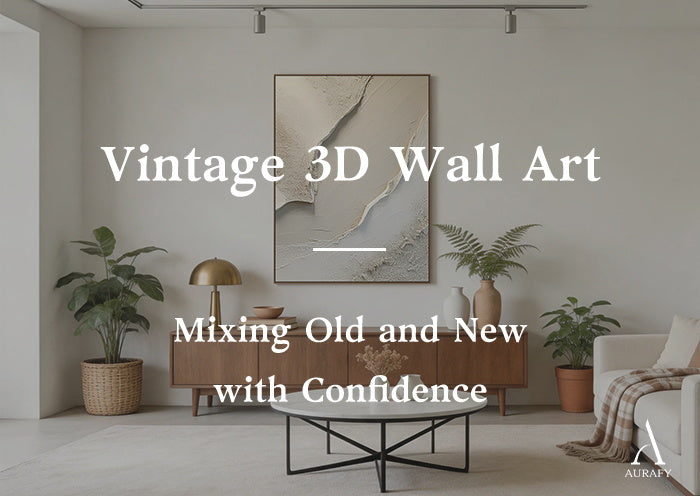
- Invest in vintage 3D wall art to build a visual bridge between aged antique furniture and clean contemporary spaces.
- Choose a vintage style textured plaster painting in muted clay or earthy tones to soften the hard edges of a modern apartment.
- Pair your piece with a distressed dark wood frame to immediately deepen its historical character and collector quality.

The most compelling interiors rarely belong to a single era.
A mid-century walnut sideboard beside a clean-lined modern sofa. A carved gilt mirror above a minimal concrete console. Antique brass hardware on a matte white kitchen. These combinations work not in spite of their contradictions, but because of them. Each era makes the other more interesting.
Vintage 3D wall art is the tool that makes this kind of mixing work. It carries the texture and material weight of something aged — rough plaster, weathered stone, the surface of an old fresco — while operating fully within a contemporary visual language. It does not belong to a single decade. It sits comfortably across all of them. And in a home that mixes furniture and objects from different periods, that flexibility is exactly what the wall needs.
Why Vintage Style Textured Plaster Painting Works Across Eras

Not all art ages well in a mixed interior. Representational prints look dated quickly. Bright color fields compete with antique furniture rather than complementing it. Mass-produced decorative canvases lack the material quality that older pieces carry naturally.
Vintage style textured plaster painting avoids all of these problems.
It has the texture of time.
Modern homes are full of smooth, flat surfaces — painted walls, lacquered furniture, printed canvases. None of these surfaces carry the visual weight of age. A plaster-textured piece does. The rough ridges, irregular edges, and matte surface read as something that has been made slowly, by hand, from physical materials. The eye reads this quality as age and depth — even in a piece that was made last month.
The colors work with aged materials.
Vintage style textured pieces typically use earthy tones: warm clay, oat, pale ochre, dusty sand, soft grey-white. These colors are not aggressive. They do not compete with the dark walnut of a mid-century cabinet, the worn leather of an antique chair, or the patinated brass of a vintage lamp. They sit alongside these materials and let them breathe.
It connects without committing.
A vintage oil painting commits you to a specific period and style. A textured abstract plaster piece does not. Its abstraction keeps it open — it can read as ancient or contemporary depending on what surrounds it. This flexibility is what makes it such an effective tool in a mixed interior.
Three Classic Mixing Styles and How 3D Wall Art Decor Fits Each
3D wall art decor adapts to mixed interior styles in ways that more specific art choices cannot. Here are three common configurations and how to use textured work in each.
Mid-Century Modern
Mid-century furniture — tapered legs, walnut veneers, clean geometric forms — has a warmth and precision that contemporary interiors often lack. It also has a tendency to look heavy and dark when grouped without relief.
Hang a piece in off-white, warm oat, or pale sand directly above a mid-century sideboard or credenza. The light neutral tone lifts the visual weight of the dark wood below it. The organic, irregular texture of the plaster surface contrasts with the clean, engineered lines of the furniture in a way that makes both look more interesting. The art reads as contemporary. The furniture reads as classic. Together, they read as considered.
French Vintage
French vintage interiors layer ornate carved mirrors, gilded frames, marble surfaces, and sculptural objects. The risk is that the room tips into theatrical rather than refined.
Use a large-format textured piece with flowing, abstract lines to introduce restraint. The absence of imagery in an abstract plaster work creates visual breathing room in a heavily decorated space. The organic surface adds texture without adding another decorative object competing for attention. Position it on the largest clear wall in the room — ideally opposite or adjacent to the carved mirror — so it anchors the space with simplicity while the other pieces provide the ornamental detail.
Industrial Loft
Exposed brick, black steel fixtures, raw concrete floors, and factory-scale ceilings create a powerful visual language — one that can easily feel cold and uninviting without the right softening elements.
Hang a large, heavily textured piece on the primary wall. Choose a warm neutral tone — soft terracotta, warm sand, pale clay — rather than stark white, which can read as too clinical against raw industrial materials. The organic surface of the plaster work introduces the handmade, human-scale quality that industrial spaces need. It does not compete with the rawness of the architecture. It answers it.
Why Unique 3D Wall Art Matters in a Mixed Interior

Collectors of vintage furniture and antique objects share a common instinct: they want things that no one else has. A mass-produced decorative panel — pressed from a mold, sprayed in a neutral tone, and sold in volume across multiple retailers — contradicts everything that a curated, mixed interior is trying to achieve.
Unique 3D wall art requires a different production model entirely.
AurafyArt builds every piece to order. We hold no inventory. When your order arrives, an artist starts your piece from scratch in our studio — mixing the modeling paste to the right consistency for that composition, applying it layer by layer with palette knives, and building the surface until the texture has the depth and irregularity the piece requires.
The marks left by this process are not incidental. They are the work. The slight variation in ridge height across the surface. The edge that was left slightly raw rather than smoothed to perfection. The place where the paste lifted and created an unexpected form. These are the details that give a handmade piece the quality of something found rather than something ordered — and they are the details that make it genuinely at home alongside antique and vintage furniture that carries its own marks of time and use.
No two pieces are the same. That is not a production limitation. It is the point.
Framing and Display: Giving Your Piece Vintage Character
The frame is often what determines whether a 3D textured piece reads as contemporary or vintage. The right frame adds period character without competing with the surface of the work. The wrong frame makes the piece look like a standard gallery canvas.
Frame selection

For a vintage or mixed interior, these options work consistently well:
A deep-profile dark walnut frame with a slightly distressed finish adds warmth and period weight. It references mid-century and antique furniture without copying it directly. The dark tone grounds the piece and makes the neutral surface of the plaster work glow by contrast.
A slim matte black frame reads as more contemporary but still carries an edge of formality. It suits industrial loft and modern eclectic interiors where the framing needs to be present but not dominant.
A narrow antique brass or aged gold frame introduces a French vintage or classical reference. Pair it with a piece in warm ivory or pale clay for maximum period effect.
In all cases, choose a frame with a deep rebate — a visible depth between the face of the frame and the surface of the canvas. This depth is essential for 3D work, which needs clearance between the raised texture and the frame edge. A shallow frame that presses against the surface damages the piece and prevents the texture from reading clearly at the edges.
Lighting for vintage effect

Warm light creates the most convincing vintage atmosphere. Use 2700K bulbs — the warmest end of the standard residential range — in adjustable wall sconces or an articulated picture light mounted above the piece. This warm, raking light deepens the shadows in the textured surface and creates the kind of soft, golden illumination associated with candlelit historical interiors.
Position the light source to the side of the piece rather than directly above it. Side lighting emphasizes the horizontal texture of plaster surfaces and creates a richer shadow pattern than downward light from above.
Frequently Asked Questions
Will a vintage style plaster piece crack or crumble over time like real aged plaster?
No. Historic plaster wall finishes crack because they are applied directly to structural surfaces that move — walls that settle, expand, and contract with temperature changes. AurafyArt pieces use a professional-grade acrylic flexible modeling paste applied to canvas or panel. This material cures to a firm but flexible surface that moves with the canvas rather than against it. It bonds permanently to the support beneath it and does not become brittle over time. Under normal indoor conditions, the surface will remain stable and intact for decades without cracking, flaking, or shedding material.
Can I add a vintage style piece to a room that is otherwise fully contemporary?
Yes — and this is one of the most effective ways to use vintage textured work. A single piece with the material quality and earthy tone of aged plaster introduces historical depth to a fully contemporary room without changing the furniture or the overall aesthetic. It creates the impression that the room has been assembled over time rather than purchased all at once — which is one of the qualities that separates a designed interior from a decorated one.
What size works best for a mixed interior feature wall?
For a feature wall in a living room or dining room, aim for a piece that covers at least two-thirds of the visible wall width. In a mixed interior with substantial furniture pieces — a carved antique mirror, a large sideboard, a statement sofa — the art needs enough scale to hold its own. A small piece will be visually dominated by the furniture around it and will look like an accessory rather than a focal point. Err on the side of larger. A piece that feels slightly ambitious on the wall is almost always more effective than one that reads as modest.
The Art of Mixing Time
The homes that feel most interesting are the ones that refuse to be pinned to a single moment. They mix centuries, styles, and materials without anxiety — and the result is a space that feels genuinely personal rather than assembled from a catalog.
Vintage 3D wall art is built for this kind of home. It carries material depth and earthy warmth that connect naturally to antique and aged furniture. It operates in an abstract visual language that keeps it current. And because every handmade piece is different, it fits into a curated interior without looking like it was placed there by a decorator following a formula.
Old and new have always looked good together. The right piece on the wall makes that combination look intentional.
Share:
3D Dining Room Wall Art: Style Your Dining Space
Large Textured Wall Art: The Complete Sizing Guide