


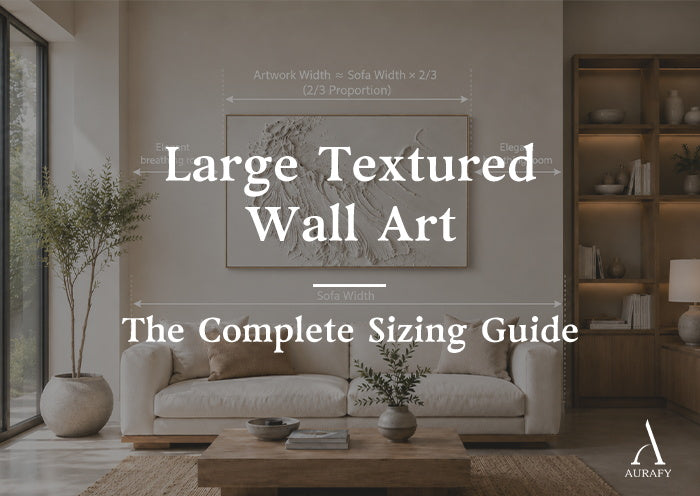
- Choose large textured wall art to anchor a big living room — one strong piece works far better than a cluster of small frames.
- Apply the two-thirds rule: your artwork should span roughly two-thirds of the sofa or furniture width below it.
- Use a single vertical 40" × 80" canvas to visually stretch a tall entryway or double-height feature wall.
- Avoid flat prints at large scale — only real physical ridges carry enough visual weight to hold a big wall.
- Hang large pieces using two heavy-duty wall anchors to distribute the weight evenly and keep the canvas stable.

You spent real money on the sofa. You found the right rug. The lighting is considered and warm.
And then there is the wall.
Blank. Flat. Unfinished. No matter how well the rest of the room comes together, a large empty wall drains the space of the confidence you worked to build into it.
Large textured wall art is the solution — not a decorative addition, but the piece that pulls everything else in the room into a coherent whole. This guide explains why scale matters, which dimensions work for which wall types, and how to hang and light a large piece safely and effectively.
Why Big Walls Need Large Textured Art

The most common mistake in decorating a large room is buying art that is too small.
It is understandable. A large piece feels like a commitment. What if it is too much? What if it overwhelms the room?
In practice, the opposite almost always happens. A small piece on a large wall looks lost. It draws attention to the emptiness around it rather than filling it. The room feels incomplete — not because there is too little art, but because the art that is there has no visual weight.
Large textured art does not make a room feel smaller. A neutral-toned 3D piece without complex imagery pushes the wall back visually. The matte, organic surface absorbs light rather than reflecting it flatly. The room feels deeper, not tighter.
Flat prints fail at large scale.
At a standard size — 20 × 24 inches, say — a quality canvas print can look acceptable. Scale that same print up to 40 × 60 inches and the limitations become clear. The surface is flat. The ink sits on the canvas without physical presence. From across a room, the piece reads as a large poster. It has no weight. No shadow. No reason to hold the eye.
A handmade 3D textured piece at the same scale behaves completely differently. The ridges and recesses that produce a few millimeters of shadow variation on a small piece produce several centimeters of visual depth on a large one. The shadows deepen. The texture becomes architectural. The piece commands the wall rather than sitting on it.
This is why large walls specifically require real physical texture — and why flat prints, however good their image quality, cannot deliver what a large wall needs.
Size Guide: Finding the Right Dimensions for Your Wall
Use this reference to match canvas dimensions to your specific wall and furniture configuration.
40" × 60" (approx. 100 × 150 cm) — The Living Room Standard

This is the most versatile large format for residential use. It suits the most common living room configuration: a three-seat sofa between 80 and 90 inches wide, positioned against a standard wall.
At 40 inches wide, this piece covers roughly two-thirds of a 60-inch sofa — sitting right at the ideal proportion. It is large enough to anchor the wall with confidence. It is contained enough to leave breathing space on either side.
This format also works well above a dining sideboard or buffet, above a bed in a master bedroom, or as a standalone piece on a wide hallway wall.
40" × 80" (approx. 100 × 200 cm) — The Best Large 3D Wall Art for Big Walls

This is the format for spaces that most art cannot touch: double-height living rooms, vaulted entryways, open-plan spaces with ceilings above 12 feet, and feature walls with no furniture to anchor them.
The vertical proportion of a 40" × 80" piece does something that wider formats cannot. The upward movement of the surface — tall strokes and lines oriented toward the top of the canvas — draws the eye upward and makes the ceiling feel higher. In a space that already has genuine architectural height, this effect is dramatic. The piece reads less like a painting and more like a architectural element in its own right.
For a standalone feature wall with no furniture reference point, this format fills the vertical space decisively without needing anything below it to justify its scale.
|
Canvas Size |
Best For |
Ceiling Height |
|
40" × 60" |
3-seat sofa wall, dining room, bedroom |
Standard (8–10 ft) |
|
40" × 80" |
Feature walls, entryways, double-height spaces |
High (10 ft+) |
|
48" × 60" |
Wide sofas (90"+), large dining rooms |
Standard to high |
|
60" × 40" (horizontal) |
Low wide walls, above fireplaces |
Standard |
Single Statement Piece vs. Multi-Panel: Which to Choose
Both approaches work. The right choice depends on the space and the style.
Single oversized textured wall art
A single large piece is the stronger choice for minimalist, wabi-sabi, and Japandi interiors. There are no visual interruptions — no gaps, no frames, no repetition. The surface reads as a continuous landscape. The eye moves across it without stopping.
This approach also suits spaces where the wall has a clear center — above a fireplace, behind a bed, at the end of a hallway. A single piece placed deliberately at that center creates a focal point with absolute clarity.
Choose this option when the room's aesthetic values restraint and when the wall has a natural anchor point.
Diptych or triptych arrangement

A multi-panel arrangement suits wide walls where a single piece would need to be impractically wide, or where the room's style is more layered and expressive.
For a diptych, use two vertical panels of identical size hung at the same height with a gap of 2 to 4 inches between them. For a triptych, apply the same logic across three panels. Keep the gap consistent. Keep the sizing identical.
The panels in a handmade set are not identical — each one is built separately, by hand, with its own surface variation. Hung together, they read as a unified composition while retaining the individual character of each piece. The arrangement creates a horizontal rhythm that suits long walls and wide rooms.
For oversized textured wall art in a very wide space — a commercial lobby, an open-plan living and dining area, a high-ceiling loft — a triptych of three 40" × 60" panels gives a total width of around 124 inches. This scale fills a wide wall decisively while remaining practical to ship and install.
Handmade at Scale: Why Large Pieces Require Real Craft
Large-format work exposes the production method behind it more clearly than any other scale.
A machine-pressed panel at 12 × 16 inches looks passable. The same panel at 40 × 60 inches makes its uniformity impossible to ignore. Every ridge repeats at the same interval. Every edge reflects light at the same angle. From across a large room, the surface reads as pattern — and pattern at this scale is not what you want on a feature wall.
AurafyArt builds every large piece to order in our studio. No inventory, no molds. When your order arrives, an artist begins your piece from scratch — mixing the paste, applying it with wide-blade palette knives, and building the surface across the full canvas area until the composition has the variation and depth the scale requires.
Large canvases demand more from the artist than small ones. A stroke that works at 16 inches needs to be recalibrated for 40 inches. The proportions of the composition, the distribution of the heavy and light areas, the placement of the most prominent ridges — all of these decisions are made in the context of the full canvas area, in real time, as the piece is built.
The result is a surface where every section has individual character. The variation that makes a small piece interesting becomes the defining quality of a large one. There are no dead zones. No areas where the surface repeats or falls flat. The entire canvas holds the eye.
This is what large-scale handmade work delivers — and what no mass-produced panel can replicate at any price.
How to Hang and Light a Large Piece
Installation: use two fixing points

AurafyArt large canvases use a lightweight professional canvas construction. A 40" × 60" piece typically weighs under 5 pounds — significantly less than a framed print of the same size. A 40" × 80" piece remains under 8 pounds.
Despite the low weight, always use two fixing points for any piece wider than 24 inches. Two points prevent the canvas from tilting as it settles, distribute the load evenly across the wall, and provide a safety margin if one fixing shifts over time.
On drywall or plasterboard, use wall anchors rated for at least double the weight of the piece. On masonry or concrete, use appropriate masonry fixings. Mark both fixing points with a level before drilling — a large piece hung even slightly off horizontal is immediately visible.
For a two-point hanging system, most large AurafyArt canvases include D-ring fittings on the back. Use a length of picture wire between them for easier leveling, or hang directly from the D-rings for a closer wall fit.
Lighting: raking light at 30 to 45 degrees
Flat overhead ambient light is the least effective way to illuminate a large textured piece. It fills in the shadows and eliminates the dimensional effect that makes the piece worth having.
Install a narrow-beam spotlight or adjustable track head on the ceiling, positioned 12 to 18 inches out from the wall. Angle it at 30 to 45 degrees from the wall surface — downward and across the face of the piece rather than directly at it.
At large scale, this raking light produces an effect that is genuinely dramatic. The shadows that fall across a 40" × 80" surface as the angle of an angled spotlight shifts are not small. They deepen and lengthen across the full height of the canvas, changing the visual character of the piece from hour to hour as the ambient light in the room changes.
Use warm white bulbs in the 2700K to 3000K range. At large scale, cool white light makes neutral textured surfaces look flat and grey. Warm light brings out the earthy, organic quality of the surface and gives the room the depth and warmth the piece is there to create.
Frequently Asked Questions
Will a large 3D textured piece crack or get damaged during shipping?
Large AurafyArt pieces ship in custom packaging built for the specific dimensions of the canvas. The acrylic modeling paste used in every piece cures to a firm but slightly flexible surface — it handles the minor flexing and vibration of transit without cracking. Each piece is wrapped in acid-free tissue paper, fitted with foam corner protectors on all four corners, surrounded by foam padding, and double-boxed in corrugated cardboard. The canvas stretcher bar provides structural rigidity across the full piece during transit. In the unlikely event of carrier damage, photograph the packaging and the piece before unpacking further and contact us — we will resolve it.
How do I choose between a 40" × 60" and a 40" × 80" for my living room?
The primary factor is ceiling height. If your ceiling is 8 to 10 feet, a 40" × 60" piece fills the available wall height comfortably above a sofa. If your ceiling is 10 feet or higher — or if the piece will hang on a wall with no furniture below it — the 40" × 80" format uses the vertical space more effectively and produces a stronger visual result. A second factor is the sofa width. For a sofa wider than 90 inches, the 40" width can start to look narrow relative to the furniture. In this case, consider a 48" × 60" format, or a diptych arrangement that gives you more total width without requiring a single very wide canvas.
Can I commission a custom size not listed on the website?
Yes. Because every piece is made to order, custom dimensions are available. If your wall requires a specific width, height, or proportion that does not match a standard format, contact us before ordering. We will confirm whether the composition works at your requested dimensions and provide a quote. Custom sizes are particularly common for double-height walls, commercial installations, and spaces with unusual architectural proportions.
One Piece. One Wall. One Room That Works.
A large living room with the right piece on the wall looks finished. Considered. Complete. The same room without it — no matter how good the furniture — looks like it is still waiting for something.
Large textured wall art is what it has been waiting for. Not a poster, not a gallery wall of small frames, not a flat canvas print scaled up beyond its natural range. A single handmade piece with real physical depth, built at the scale the wall requires, lit from the side so the surface comes alive.
The wall is the largest surface in the room. Treat it accordingly.
Browse the AurafyArt large format collection — and find the handmade piece that your wall has been waiting for.
Share:
Vintage 3D Wall Art: Mixing Old and New with Confidence
White Textured Wall Art: The Minimalist Lighting Guide