


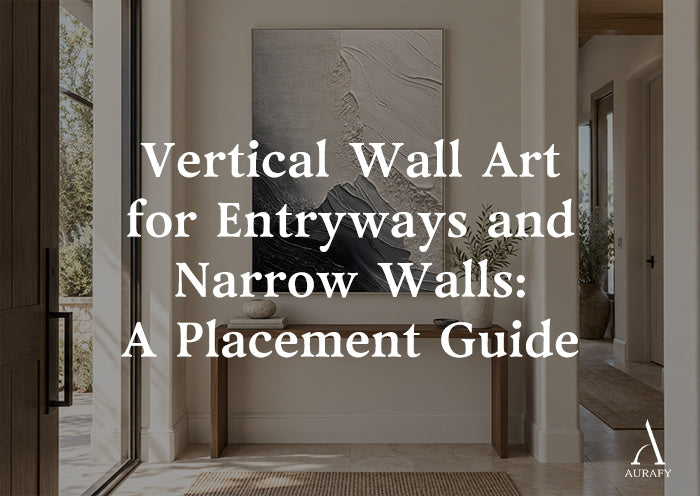
Vertical Wall Art for Entryways and Narrow Walls

Narrow walls and entryways are some of the most common places homeowners get wall art wrong — not because of the art itself, but because a piece scaled for a living room sofa doesn't translate to a four-foot-wide hallway. Vertical wall art is usually the right instinct for these spaces, but getting the placement right takes more than just picking a tall canvas.
This guide walks through the practical decisions — width, height, furniture relationships, and sightlines — that determine whether a vertical piece actually works in a narrow space.
Why Vertical Format Solves Most Narrow-Wall Problems

A narrow wall has limited width to work with, but often plenty of height, especially in entryways with nine- or ten-foot ceilings. Horizontal art forces you to either undersize the width dramatically or crop the composition awkwardly to fit. Vertical art uses the dimension the wall actually has.
Beyond simply fitting, vertical format also tends to visually elongate a narrow space, drawing the eye upward rather than emphasizing how tight the wall is side to side. This is part of why entryways, stair landings, and narrow hallway walls are natural fits for vertical pieces.
Should every narrow wall get a vertical piece, or does horizontal ever work?
Vertical is the better default for genuinely narrow walls, but a wide, shallow horizontal piece can work above a console table if the wall has enough width — the deciding factor is the wall's actual proportions, not just the general "narrow space" label.
Matching the Piece to the Wall's Width

Before choosing a piece, measure the usable wall width — the space between doorframes, light switches, or adjacent furniture, not just the total wall length.
- Leave visual breathing room on both sides of the piece; art that runs edge-to-edge on a narrow wall looks cramped
- If the wall is extremely narrow, a taller, slimmer vertical composition will look more intentional than a wider vertical piece forced into too little space
- Check the specific size range available for a piece before committing — vertical selectors, like the ones offered for pieces such as Organic Swirl Painting-Cream, Gray & Charcoal Tones-AURA001, typically span a range of widths and heights, so confirm the live options on the product page rather than assuming a single fixed size
Ceiling Height and Vertical Scale

Ceiling height changes how tall a vertical piece should feel, independent of the wall's width.
- Standard-height ceilings: a moderately tall vertical piece, hung with normal spacing above furniture, will usually fill the space well without overwhelming it
- higher ceilings, common in many entryways: taller vertical formats read as more proportional; a piece that would look tall in a standard room can look almost modest in a high-ceilinged entry
- Sloped or uneven ceilings: measure the specific wall segment where the art will hang, since the usable height may be less than the room's overall ceiling height suggests
How tall should vertical art be relative to my ceiling height?
There's no fixed ratio, but as a general guide, taller ceilings can support taller pieces without the art feeling like it's floating in too much empty space above it — check the specific size range on the piece you're considering and lean toward the taller end for high-ceilinged entries.
The Console Relationship

Many entryway and narrow-hallway walls include a console table, bench, or narrow shelf beneath the art, and that furniture piece sets the framework for scale.
- Aim for the art's width to roughly match or stay slightly narrower than the console beneath it — a piece significantly wider than its console can look unanchored
- If there's no furniture below the piece, the art needs to hold the wall on its own, which usually means sizing toward the larger end of the available range rather than the smaller one
- Leave enough clearance between the top of the console (or any objects placed on it, like a lamp or vase) and the bottom of the frame — with visible breathing room — so the piece doesn't feel stacked directly on top of the furniture
Sightlines: What You See From the Front Door

Entryway art has a job most other wall art doesn't: it's often the first thing seen from the front door, sometimes from a distance and at an angle rather than straight on.
- Consider what's visible from the entry point, not just what's visible standing directly in front of the wall
- A single, well-scaled vertical piece read from an angle down a hallway often makes more impact than a small piece that only reads clearly up close
- Avoid placing art where it will be partially obscured by an open door, coat hooks, or other fixtures — walk through the space with the door open and closed to check
Does entryway art need to look good from a distance, or just up close?
Both, but distance matters more than most people initially plan for. Since entryway art is frequently viewed from several feet away or at an angle from another room, prioritize scale and clear composition over fine detail that only reads up close.
Hanging Height
Standard guidance is to center art at roughly eye level, but entryways have some specific considerations:
- If there's a console table beneath the piece, allow enough gap between the furniture and the frame so the two don't feel merged into one block
- In taller ceiling entryways, centering strictly at "eye level" can leave the piece looking low relative to the room's proportions — a slightly higher placement can sometimes feel better balanced in these cases, particularly for a solo vertical statement piece
- If the piece will be seen primarily from a distance (down a hallway, from a front door), hang it slightly higher than you would for a piece viewed up close, so it reads clearly at an angle
Common Mistakes
- Choosing a piece too wide for the available wall, leaving no breathing room on either side.
- Ignoring ceiling height, resulting in a piece that looks short and disconnected from a tall entryway.
- Sizing the art without accounting for the console beneath it, creating a mismatched, top-heavy or bottom-heavy look.
- Forgetting to check sightlines from the front door, so the piece is partially blocked or poorly angled.
- Assuming a single fixed size instead of checking the live size selector, which can lead to ordering a size that doesn't actually fit the wall.
Quick Selection Checklist
- Measure usable wall width, not total wall length
- Note your ceiling height and lean toward taller formats for high-ceilinged entries
- Match the art's width to the console beneath it, or size up if there's no furniture
- Check sightlines from the front door and from any adjoining rooms
- Confirm exact size options on the live product selector before ordering
FAQ
What's the ideal width for vertical wall art in a narrow hallway?
There's no single ideal width — it depends on the specific wall — but leave a few inches of breathing room on each side rather than choosing a piece that spans edge-to-edge. Always check the live size selector for the piece you're considering, since available vertical widths vary by product.
Can I hang two vertical pieces side by side in an entryway instead of one large piece?
Yes, and this can work well on a wall too narrow for one large statement piece, as long as the two pieces share a clear visual relationship — similar palette, similar framing, even spacing. Uneven spacing or mismatched pieces can make a paired arrangement look accidental rather than intentional.
How high should I hang art above an entryway console table?
Leave enough gap so the art and the console don't read as a single stacked block — clear visual separation above the tabletop, and more if you plan to display a lamp or decor object on the console itself. The exact gap depends on the console's height and the piece's proportions, so adjust based on how the two look together in person.
Is vertical wall art necessary for every narrow entryway, or are there exceptions?
Vertical is the stronger default, but a wide, shallow horizontal piece can work above a console if the wall has enough width to support it without crowding. The deciding factor is the actual usable width of the wall — measure first rather than assuming vertical is always correct.
Share:
Organic Textured Wall Art for Soft Minimalist Interiors
Wall Art Ideas for Beige Cream and Neutral Living Rooms