


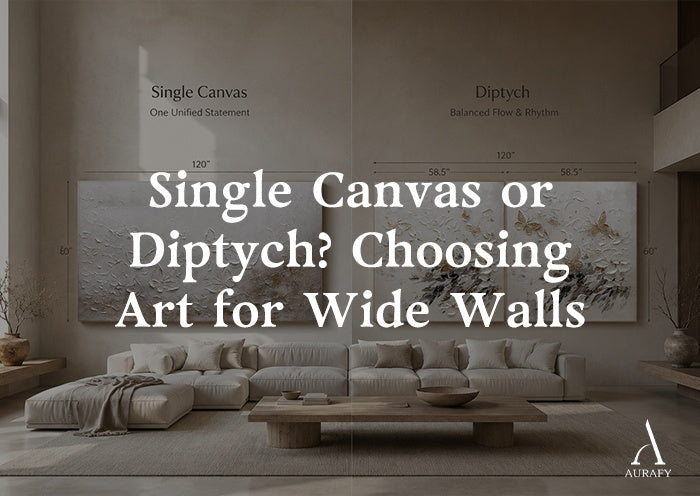
Single Canvas or Diptych? Choosing Art for Wide Walls

Single Canvas vs. Diptych

Choosing between a single canvas and a diptych depends on three main factors: the width of your wall, the visual effect you want, and the practical requirements of installing large artwork. wabi sabi diptych designs are ideal for wide architectural spaces.
A single canvas creates one uninterrupted composition. It works well when you want the artwork to feel like one strong architectural statement.
A diptych uses two connected panels to create rhythm and flexibility. It can be especially useful for wide walls, long furniture arrangements, or spaces where moving one oversized artwork would be difficult.
Neither option is automatically better. The best choice depends on how the artwork interacts with your room.
Single Canvas vs. Diptych Comparison Guide
|
Consideration |
Large Single Canvas |
Diptych Set |
|
Visual effect |
One continuous focal point |
Two-part composition with intentional separation |
|
Best suited for |
Clear feature walls and spaces with strong central focus |
Wide walls, long sofas, large open areas |
|
Texture continuity |
Completely uninterrupted surface |
Texture can flow across panels or contrast between pieces |
|
Installation |
Requires handling one large piece |
Easier movement because the artwork is divided |
|
Flexibility |
Fixed placement |
Allows small adjustments in spacing and alignment |
When a Single Large Canvas Works Best

A single canvas is often the strongest choice when the artwork itself is meant to become the primary visual anchor. large single canvas or diptych wall art each suits different layouts.
It works particularly well when:
the wall has a clear center point
the surrounding furniture is symmetrical
the room benefits from a calm, uninterrupted composition
For textured artwork, a single panel allows mineral ridges, color transitions, and surface movement to continue without interruption.
This can create a stronger sense of material continuity, especially in minimalist interiors where fewer elements carry more visual importance.
When a Diptych Works Better
A diptych divides the artwork into two related sections.
This format can be useful when:
the wall is wider than it is tall
furniture extends across a large horizontal area
a single canvas would be difficult to transport or install
The space between the two panels becomes part of the composition. how to space two canvases
Rather than being an empty gap, it creates visual breathing room and can make the artwork feel lighter within a large space.
How to Size a Diptych Correctly

The total display width of a diptych is calculated as:
Total Width = Panel 1 Width + Panel 2 Width + Gap
The gap is a design choice rather than a universal rule. Many diptychs use a relatively narrow separation, but larger rooms may allow more spacing.
The most important factor is that the two panels should still read as one intentional artwork.
For artwork above furniture, a useful starting point is to consider the total width of the complete diptych rather than the width of each individual panel.
The artwork should relate to the furniture beneath it while leaving enough surrounding wall space.
Horizontal vs. Vertical Diptych Layouts
Horizontal Diptych
A horizontal diptych is commonly used above: art for wide wall above sofa
sofas
dining tables
long consoles
wide feature walls
The two panels extend the composition across the wall and can emphasize the width of the room.
Vertical Diptych
A vertical diptych can work well in:
staircases
narrow walls
tall architectural spaces
The stacked height can draw attention upward and make use of vertical wall space.
The best orientation depends on the proportions of the room rather than the artwork format alone.
Texture and Composition: How Split Artwork Creates Rhythm
Continuous Composition
In a continuous diptych, the two panels are designed as one artwork.
Texture, color movement, and surface patterns may visually continue across the gap.
This approach works well when you want the artwork to feel like a single landscape or large-scale relief divided into two sections. set of 2 wall art
Contrasting Panels
A diptych can also use two related but distinct panels.
For example:
one darker charcoal composition paired with a lighter mineral tone
one textured panel balanced with a quieter companion piece
This creates visual rhythm while maintaining a connection between the two artworks.
Practical Installation Considerations
Large artwork decisions should consider the physical space as well as the visual design.
Before choosing a single oversized canvas, measure:
door widths
elevator dimensions
stairway turns
installation access points
A large artwork may look perfect on the wall but still create challenges during delivery or installation.
A diptych can sometimes simplify handling because the artwork is divided into smaller sections.
However, total size, materials, and destination still determine actual shipping and installation requirements.
Three Room Examples
Wide Minimalist Living Room
A large open living room with a long sofa and clean architectural lines often benefits from a wide diptych. panoramic wall decor
Two connected panels can extend across the wall while maintaining the quiet simplicity of minimalist design.
A continuous texture across both panels helps the artwork feel like one large statement.
Tall Staircase Wall
A staircase wall often emphasizes vertical movement rather than horizontal width.
A vertically oriented diptych can follow the architecture by creating height and rhythm as people move through the space.
The artwork becomes part of the movement through the home rather than simply a decoration on the wall.
Long Dining Area
A dining space with an extended table may benefit from artwork that follows the horizontal direction of the furniture.
A diptych can create balance above the table while allowing enough separation between panels to keep the composition open.
Frequently Asked Questions
Is a diptych better than one large canvas? diptych vs single large painting
Not always. A single canvas provides uninterrupted visual flow, while a diptych offers flexibility and easier handling. The right choice depends on the wall, room proportions, and desired composition.
How much space should be between diptych panels?
There is no universal measurement. Many designs use a relatively narrow gap so the panels remain connected visually, but larger spaces can work when the room scale supports them.
Are diptychs easier to install than large single artworks?
Often, yes. Dividing artwork into two panels can make transportation and handling easier. However, installation difficulty still depends on the artwork size, weight, and wall conditions.
Can a diptych be used on a narrow wall?
Yes. A vertical diptych can work well in narrow or tall spaces where height is more important than width.
Choosing the Right Format for Your Wall

A single canvas creates unity.
A diptych creates rhythm.
The best choice depends on how you want the artwork to interact with the architecture around it.
If you are selecting artwork for a wide wall, consider the wall dimensions, furniture placement, lighting, and installation conditions together. A well-planned composition will feel intentional long after it is installed.
Share:
How to Style Wabi-Sabi Art in Minimalist Homes
How to Style a Wabi-Sabi Triptych