


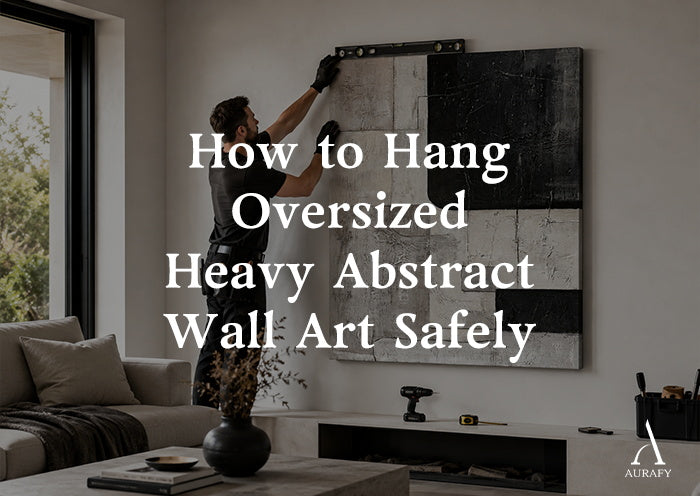
The Problem With "Easy" and "Heavy" in the Same Sentence
A simple black-and-white composition with clean lines looks easy to hang. That assumption causes more damage than almost any other mistake in art installation.
A raised mineral piece with 15 to 20 millimeters of texture is not light. A 40x60 inch painting built this way often weighs 5 to 8 kilograms, sometimes more, because of the marble powder and clay content in the paste itself. An easy abstract painting, in visual terms, can still be a genuinely heavy object in physical terms.
Most homes in North America and Europe use hollow drywall or plasterboard as their wall base. A single nail or an adhesive hook has almost no pull-out strength against this kind of weight. When it fails, it usually fails suddenly, not gradually. This guide skips the aesthetics entirely and focuses on the mechanics of keeping a heavy piece exactly where you put it.
Why Two Mounting Points Beat One

A single wire strung across the back of a frame and hung on one nail seems like the standard approach, and for light, printed art, it usually works fine. For a heavy textured piece, it creates a real structural problem.
That single wire pulls inward from both sides toward one central point. Over months or years, this inward tension can slowly warp the wooden stretcher bar behind the canvas, bending it toward the center. For large black and white minimalist abstract art, this kind of single-point wire mounting should be avoided entirely.
The safer method uses two D-ring hooks, mounted symmetrically at roughly one-third of the way down from the top edge on each side of the frame, screwed directly into solid wood. When the piece hangs from two independent wall anchors instead of one central point, the weight converts into a straight, downward shear force on each anchor. There is no inward pull left to warp the frame.
Choosing the Right Wall Anchor for Your Wall Type

Not all walls behave the same way, and the right anchor depends entirely on what is behind the surface.
Hollow drywall, no stud behind it
Drywall alone has very little pull-out strength. A standard nail can slide out almost as easily as it went in. Use a self-drilling metal toggle anchor or a heavy-duty butterfly-wing anchor instead. These anchors expand behind the drywall once installed, spreading the load across roughly 50 millimeters of surface rather than concentrating it on one small point.
Wood stud wall
If a stud sits directly behind your mounting point, this is the strongest and simplest option. Use a stud finder to locate the wood framing, typically spaced 16 or 24 inches apart. Drive a high-strength wood screw, around 3 inches long, straight through the drywall and into the stud itself. This gives the closest thing to a permanent, building-grade hold.
Solid brick or concrete wall
Common in much of Europe, masonry walls need a pre-drilled hole and a nylon wall plug. Drill the hole first with an impact drill, insert the nylon plug, then drive the screw in. The plug expands against the sides of the hole, gripping through friction against the masonry itself.
Matching Anchor Specs to Painting Weight

The table below matches common painting sizes to realistic weight ranges and the anchor setup each one needs.
Painting Size Estimated Weight Wall Type Recommended Anchor Safety Margin 40"x60" single panel, including black white and grey abstract paintings 5-8 kg (11-17.6 lbs) Hollow drywall (1/2") Self-drilling zinc toggle anchor, no pre-drilling needed Roughly 25 kg rated shear strength per anchor; two anchors support up to 50 kg combined 48"x72" oversized single panel or one panel of a diptych 8-12 kg (17.6-26.4 lbs) Hollow brick wall 8mm nylon expansion plug, 8mm drill bit, 60mm depth High pull-out resistance, enough to absorb minor wall vibration from foot traffic 120"+ triptych for hospitality or gallery spaces 25-35 kg (55-77 lbs) Solid poured concrete M6 heavy-duty sleeve anchor, 10mm drill bit Meets museum-grade permanence and resists dislodging from accidental impact As a general rule, aim for anchors rated well above the painting's actual weight rather than exactly matching it. This margin absorbs everyday wall vibration, foot traffic, and the occasional accidental bump.
Keeping the Wood Frame From Warping Over Time

Wall anchors solve the hanging problem. A separate issue happens inside the frame itself, especially in homes with strong seasonal heating and cooling.
Central heating in winter and air conditioning in summer both cause large swings in indoor humidity. Untreated or poorly cured wood absorbs and releases moisture unevenly during these swings, which is what causes visible twisting or bowing at the corners of a frame over time.
Two details prevent this. First, the wood should be kiln-dried to a moisture content of 10 to 12 percent before construction, which matches standard building codes in North America and Europe. Second, any frame wider than 40 inches should include internal cross-bracing, joined with dovetail joints at the center, along with reinforced metal corner brackets. This internal structure absorbs the surface tension that thick mineral paste naturally creates as it slowly dries and contracts over the following months.

A striking black-and-white composition is only half of what makes a heavy textured painting work in a room. The other half is what happens behind the frame and inside the wall, where nobody looks but everything depends on it.
Match the mounting hardware to the actual wall type, distribute the load across two solid anchor points, and build the frame from properly dried, cross-braced wood. Handled this way, an easy abstract painting stays exactly where you hung it, for as long as the wall itself stands.
Share:
The Hand of the Artist: Abstract Expressionism Black and White
Scaling Abstract Landscape Art for Tall Staircase Walls