

Green Minimalist Wall Art: A Single Deep-Green Focal Point

Two shoppers type the same words into a search bar. One pictures a single fern frond on a quiet canvas. The other pictures a field of deep emerald with no recognizable subject at all. Both want green minimalist wall art, yet they want different artworks. This guide uses the Green Subject-Matter Choice, a four-part check, to separate the color you love from the imagery you may or may not want, so you can choose one deep-green piece for the right reason.
If you are also considering how abstract green artwork works in a plant-filled room, read our Green Abstract Painting for Eclectic Plant-Filled Rooms guide.
Decide Whether You Want Green Color or Botanical Imagery
Begin by asking what, exactly, drew you to green. Two hypothetical buyers show how different the answers can be.
The first buyer keeps returning to images of ferns, branches and leaves. For this person, the plant is the point, and green is simply the color plants happen to be. The second buyer is drawn to the depth of emerald itself: how it darkens, how it shifts toward jade or dusk. Leaves do not interest this buyer at all. Both examples are illustrations, not real customers.
Does green minimalist wall art need to show plants? No. Deep-green color can define a minimalist artwork without recognizable leaves or botanical subjects.
The word "green" in a listing or a search tends to bundle two attractions together. Naming which one is yours is the first step in the framework: identify the desired reference, then separate palette from subject. If you describe what you want as "something with leaves," you are probably shopping for subject matter. If you describe it as "a rich, dark green," you are shopping for color. Many buyers want both, and a botanical artwork in deep green can satisfy both preferences. Abstraction becomes useful when recognizable plants are unnecessary to you.

Distinguish Abstract Green Art From Botanical Prints
Listings tend to fall into three groups, and learning to tell them apart saves disappointment.
Representational work depicts something you can name: a leaf, a stem, a branch, a plant in a pot. Nonrepresentational, or nonfigurative, work does not present a clearly identifiable literal subject. Its emphasis is color, surface and tonal change. Ambiguous work sits between the two, where marks might be read as foliage by one viewer and as plain texture by another.
What separates abstract green artwork from a botanical print? The distinction is recognizable plant imagery, not whether the artwork uses natural-looking green tones.
A green that feels earthy, mossy or forest-like does not make a painting botanical, and a viewer's impression of leaves is an interpretation, not a fact about the canvas. Be especially careful with linear texture. Parallel strokes or scraped lines can feel like stems to some people, yet they are only marks unless the product description or full-view image establishes otherwise.

When a listing is unclear, take one concrete step: compare the written description with the full-view image and any detail photographs, and note whether they agree. If the description names a plant subject the image does not show, or the image suggests foliage the description never mentions, ask the seller to clarify before buying. Until that is settled, treat the artwork as ambiguous.

When Is One Nonfigurative Green Painting the Better Choice?
Abstraction is not automatically the better option. It is the better fit for particular motivations.
When should you choose abstract green art instead of leaf imagery? Choose abstraction when the deep-green color statement matters more to you than depicting a particular plant.
Consider a few motivations. You may enjoy how a dark, saturated color holds attention and would rather the painting not depict a specific recognizable scene or subject. You may prefer that the eye rest on tone and surface. Or you may find literal plant imagery too decorative for what you want a single focal piece to do. Abstract work can still carry mood, meaning and personal associations; it simply does not anchor them to an identifiable subject.
Now the opposite cases. If you love a specific kind of foliage, or want an image a guest would immediately recognize as a plant, recognizable botanical artwork satisfies you better, and an abstract canvas would feel like a substitute. If you are unsure, apply the fourth check: would you still want this artwork if no one, including you, ever read its forms as foliage? If yes, color is doing the work. If no, the plant imagery mattered all along. Neither answer is wrong. They point to different purchases.

AURA099: Deep Emerald Without a Literal Leaf Print
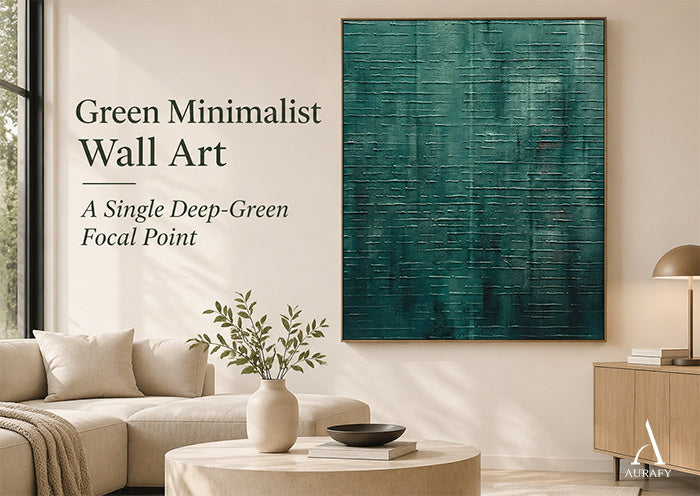
The Whisper of Depth emerald abstract artwork, AURA099, offers a concrete case for checking a product against the category you want. It is a vertical canvas built from a monochrome green field. Its range runs through deep emerald and viridian, with tonal transitions from jade toward dusk green. Textured knife strokes build layered color, and the surface shows a tonal gradient along with linear surface textures.
Is AURA099 a botanical leaf painting? No literal leaf subject is verified. AURA099 is documented as a deep-green monochrome abstraction with tonal transitions and linear texture.
That matters for the buyer. The linear textures are surface marks, not documented stems or leaves, so anyone who sees foliage in them is bringing their own association. That is a subjective response, not a product claim.
AURA099 fits the buyer who wants nonrepresentational deep green as one focal artwork. It does not fit the buyer who needs identifiable plants. Treat it as an example of the abstract category, not as a universal answer to every green search.
The AURA099 Whisper of Depth emerald abstract canvas Whisper of Depth Emerald Abstract Texture-AURA099 is the vertical product example discussed in this guide.

Make the Final Abstract-or-Botanical Buying Decision
The framework ends in three outcomes: choose abstract, choose botanical, or compare further. They reflect what is essential to this particular purchase, not fixed identities, and many buyers will feel some pull in both directions. Three hypothetical buyers show how the outcomes work.
A buyer who realizes the draw is deep emerald color, and who does not need a recognizable plant, should choose abstract. A buyer who pictures a particular branch or leaf, and would feel something missing without it, should choose botanical and look for verified botanical artwork instead. A buyer who cannot tell whether a listing is abstract or representational, who wants something between the two, or who values both color and foliage, should compare further until the subject is clear.
If the first description fits you, examine Whisper of Depth as a nonfigurative deep-green option. If recognizable plants matter, passing on it is the sound decision, and nothing about this check argues otherwise. To see other directions side by side, browse the minimalist art collection and apply the same four checks to each piece.

Frequently Asked Questions
Can a green abstract canvas suggest nature without depicting leaves?
Yes, as a subjective interpretation. Deep green often reminds people of natural settings, but that association belongs to the viewer. It does not mean the painting contains a verified plant, leaf or landscape subject.
Is monochrome green art necessarily a flat single shade?
No. One color family can include tonal transitions, gradients and surface variation. A monochrome green canvas may move from deeper to lighter tones while staying within a single hue range.
Should I choose botanical wall art if recognizable plants matter to me?
Yes. If identifiable foliage is essential, select verified botanical artwork instead. AURA099 is not documented as botanical, so it would be the wrong choice for that preference.
How can I check whether a green artwork is genuinely abstract?
Read the product description and examine the full-view image and any detail photographs together. If both indicate no identifiable subject, the work is likely abstract. A missing plant name alone is not proof, so if the evidence is mixed or unclear, ask the seller to clarify before buying.
Share:
Ordering Custom Wall Art Before Christmas: Production, Shipping & Holiday Deadlines
Blue Minimalist Wall Art: Choosing Muted Blue That Still Reads Blue