


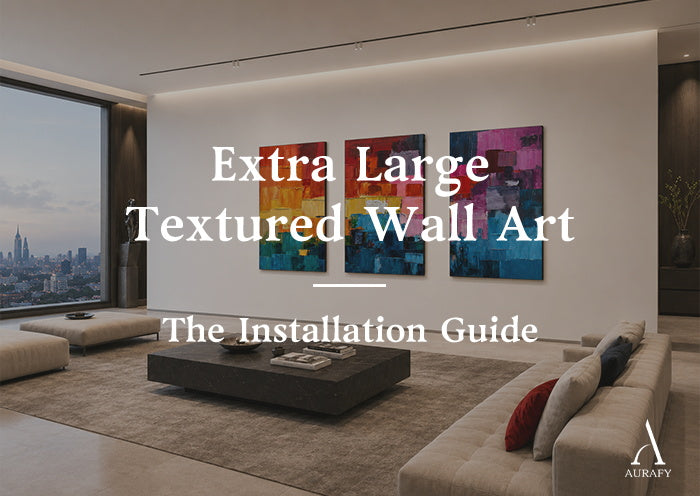
- Display extra large textured wall art to anchor high-ceiling living rooms and luxury spaces with a commanding physical presence.
- Choose hand-built textured wall art in large formats — flat printed canvas replicas lose all quality at this scale and read as oversized posters.
- Use wall anchors rated for double the painting's weight when hanging oversized 3D canvas art on drywall.
- Install a two-point hanging system using D-ring fittings to distribute the load evenly and prevent the canvas from tilting.
- Position narrow-beam spotlights at 30 to 45 degrees to rake across the deep ridges and reveal the full shadow depth of the surface.

A luxury home with a large empty wall is not finished. It is waiting.
High ceilings, wide open-plan spaces, double-height entry halls — these architectural features are impressive. They are also unforgiving. Fill a large wall with a cluster of small frames and the space looks fragmented. Scale a flat canvas print up to fill the wall and the ink surface becomes obvious and cheap. Neither solution respects the architecture.
Extra large textured wall art is built for these spaces. A piece with real physical depth — several millimeters of sculptural surface built up by hand — carries the visual weight that a large wall requires. It does not decorate the space. It anchors it.
Why Large-Scale Texture Must Be Handmade

Scale exposes everything about how a piece was made.
A machine-pressed panel at 12 inches looks passable. Every ridge is the same height, every surface catches light at the same angle — but at small scale, the eye does not have enough surface to read the repetition clearly.
Scale that same panel to 40 × 60 inches or 40 × 80 inches, and the uniformity becomes impossible to ignore.
Textured wall art at large scale needs organic variation — and that requires handwork.
At AurafyArt, every large piece is made to order in our dedicated artist studio. When your order arrives, an artist begins the piece from scratch on a full-size heavy-duty canvas. The approach changes significantly at large scale. The composition must be planned across the full surface — where the heavy texture will sit, where the surface will open into flatter, lighter areas, how the visual weight distributes across the width and height of the piece.
The artist uses wide-blade palette knives to build the surface in sections, recalibrating the stroke direction and pressure continuously as the composition develops. There is no template. The marks that result — the slight variation in ridge height from one area to the next, the edge that resolves differently on the left side than the right, the transition zones where the texture shifts from heavy to light — are the product of real-time decisions made across a real-time surface.
This is what makes extra large 3D wall art worth the scale it occupies.
A large handmade piece does not simply fill a wall. It gives the wall a surface with organic variation that rewards attention at every distance — from across the room and from arm's length. No machine-produced panel at any price point delivers this.
How to Hang Oversized 3D Canvas Art: A Step-by-Step Guide

This is the section most buyers need before they commit to a large piece. Hanging oversized 3D canvas art safely is not complicated — but it requires the right approach at each stage.
Step 1: Establish the Actual Weight of the Piece
AurafyArt large canvases use a professional lightweight stretcher bar construction. A 40" × 60" piece typically weighs under 5 pounds. A 40" × 80" piece stays under 8 pounds. These weights are significantly lower than framed prints or wood panel art of equivalent dimensions.
Confirm the exact weight of your specific piece before planning the installation. The weight determines the anchor specification, and over-specifying is always safer than under-specifying at this scale.
Step 2: Use a Two-Point Hanging System
Any canvas wider than 24 inches requires two fixing points — not one.
A single hanging point on a large canvas creates three problems: uneven weight distribution, a tendency for the canvas to rotate slowly over time, and a single point of failure if the fixing shifts. Two points eliminate all three.
AurafyArt large canvases include D-ring fittings on the reverse — typically positioned one-third of the canvas height down from the top on each side. These are designed to accept picture wire or to hang directly from wall hooks. Use the D-rings as your fixing reference for both hanging points.
Mark both fixing positions on the wall using a spirit level before drilling. At large scale, even a one-degree tilt is visible from across the room. Take the time to get this right before committing to holes in the wall.
Step 3: Choose the Right Wall Fixing for Your Wall Type
Drywall or plasterboard: Use expansion wall anchors rated for at least double the weight of the piece. For a 5-pound canvas, use anchors rated for 10 pounds minimum. For a 8-pound canvas, use anchors rated for 16 pounds or more. Standard picture nails are not appropriate for oversized work on drywall — they lack the lateral holding strength the D-ring system requires.
Masonry, brick, or concrete: Use masonry anchors and an appropriate drill bit for the wall material. Masonry walls provide significantly more holding strength than drywall, but the fixing hardware must match the wall type. Do not use drywall anchors in masonry.
Stud walls: Fixing directly into a timber stud provides the most secure installation. Use a stud finder to locate the studs before marking your fixing positions. If the studs do not align with your ideal hanging positions, use heavy-duty drywall anchors between studs as described above.
Step 4: Set the Hanging Height
For large pieces above a sofa or console, position the bottom edge of the canvas 6 to 8 inches above the top of the furniture. The center of the canvas should sit at approximately 57 to 60 inches from the floor — standard eye level.
For standalone feature walls with no furniture below, the center of the canvas should sit at eye level regardless of the ceiling height. Hanging a large piece too high on a tall wall makes it feel disconnected from the room. Eye level keeps it within the occupied zone of the space.
Packaging and Shipping: How Large Pieces Arrive Undamaged

Buyers of large-format work consistently ask the same question: how does a piece with several centimeters of raised surface survive international shipping without cracking?
The answer is in two parts: material properties and packaging specification.
The material handles transit well.
The flexible acrylic modeling paste used in every AurafyArt piece cures to a firm but slightly elastic surface. It is not brittle. Under the minor flexing and vibration of freight transit, the surface behaves like cured plaster — absorbing the stress without cracking. The canvas stretcher bar provides structural rigidity across the full piece, preventing the canvas from bending in ways that could stress the texture layer.
The packaging is built for the scale.
Every large piece ships in custom packaging sized and specified for its dimensions:
Acid-free tissue paper makes direct contact with the textured surface — protecting the ridges from abrasion without applying pressure. High-density foam corner protectors cover all four corners of the stretcher bar. High-resilience foam padding surrounds the full canvas within the outer box. The outer box is double-walled corrugated cardboard.
For very large or custom-dimension pieces — including commercial installations — we provide reinforced wooden crate packaging on request. This is recommended for any piece larger than 48 × 72 inches or for shipping routes involving multiple transit points.
If a carrier causes damage despite this packaging, photograph the outer box and the piece before unpacking fully, retain all packaging materials, and contact us. We will resolve the situation.
Size and Space Reference Guide

|
Architectural Type |
Recommended Canvas Size |
Spatial Placement Rule |
|
Standard luxury living room / wide sofa wall |
40" × 60" (approx. 100 × 150 cm) |
Canvas width should cover two-thirds of the sofa width below it. Leave equal empty wall space on each side. |
|
Double-height entry hall / tall standalone feature wall |
40" × 80" (approx. 100 × 200 cm) |
Vertical format draws the eye upward. Upward-flowing texture lines enhance the perceived ceiling height significantly. |
|
Wide corridor / commercial lobby / loft horizontal wall |
Diptych or triptych arrangement (e.g. three 40" × 60" panels = 124" total width) |
Hang panels at identical height with 2 to 4 inch gaps between them. Creates a unified horizontal rhythm across wide walls. |
|
Open-plan living and dining combined |
Single 48" × 60" or triptych of 36" × 48" panels |
Position on the wall most visible from both zones. Neutral tone ensures compatibility with both areas simultaneously. |
How to Light Extra Large 3D Art
At large scale, the difference between correct and incorrect lighting is dramatic. A large textured piece under flat overhead light looks like a large uneven canvas. The same piece under raking sidelight looks like an architectural relief.
Install spotlights at 30 to 45 degrees from the wall.
Position narrow-beam adjustable track heads or spotlights on the ceiling, 12 to 18 inches from the wall surface. Angle them so light travels across the face of the piece rather than straight at it. This raking angle sends light skimming along the textured surface, catching the lit face of each ridge and driving the shadow channels into deep contrast.
At large scale, this effect is proportionally more dramatic than at small scale. The shadows cast by a 40" × 80" textured surface under 45-degree sidelight extend across several centimeters of canvas. The piece reads as genuinely architectural — closer in visual character to a carved stone relief than to a canvas painting.
Use multiple spotlights for very large pieces.
A single spotlight covers approximately 24 to 36 inches of wall surface effectively before the light intensity drops at the edges of the beam. For pieces wider or taller than this range, use two or three spotlights positioned in a row to cover the full surface evenly. Keep the angle consistent across all fixtures — varying the angle creates uneven shadow patterns that break the visual unity of the piece.
Warm white bulbs only.
Use 2700K to 3000K bulbs throughout. At large scale, the color temperature of the light has a proportionally larger effect on the surface. Warm white light makes neutral and earthy tones glow richly. Cool white light above 4000K makes the same tones look flat and grey — and at large scale, that grey quality fills a significant portion of the room.
Frequently Asked Questions
How do I clean an extra large 3D canvas without glass protection?
Every AurafyArt piece ships with two hand-applied coats of UV-resistant, low-VOC matte varnish. This seal protects the surface from dust adhesion and minor environmental exposure. For routine cleaning, use a wide soft-bristle brush — a large makeup brush or a clean decorating brush — to sweep gently along the direction of the texture ridges every few weeks. For deep recesses, use a can of compressed air held at a safe distance. Never use water, damp cloths, or any chemical cleaner on the surface. The varnish seal handles normal environmental conditions without any additional treatment.
Can I commission a custom size larger than your standard range?
Yes. Because every piece is made to order, custom dimensions are available beyond the standard format range. For very large formats — above 48 × 80 inches — contact us before ordering to confirm the composition options, structural framing approach, and packaging specification for your specific dimensions. Commercial installations, including lobby art, hotel installations, and multi-panel corporate commissions, are handled on a project basis with dedicated timelines and specifications.
How long does production take for an extra large piece?
Standard large formats (40" × 60" and 40" × 80") typically require 10 to 21 days of production time. The extended timeline reflects the increased surface area — more layers, longer curing periods between sessions, and additional time for the varnish coats to cure fully on a larger surface. Custom sizes and multi-panel commissions carry longer lead times confirmed at the time of order. This production window is included in the delivery estimate provided at checkout.
Large Walls Deserve More Than a Large Print
The rooms with the most architectural ambition deserve art at the same scale. A villa entry hall, a double-height living room, an open-plan luxury apartment — these spaces have been designed with intention. The art on their walls should match that intention.
Extra large textured wall art is the right choice for these environments. Not because it is simply large — but because at large scale, physical depth and handmade surface variation become the defining qualities of a piece. The shadows it produces, the way the surface changes through the day, the evidence of the hand that built it across every centimeter of a four-foot canvas — none of this is available in any printed format.
The wall is ready. The piece should be too.
Share:
Colorful 3D Wall Art: The Dopamine Decor Guide
Textured Framed Wall Art: The Complete Frame Guide