


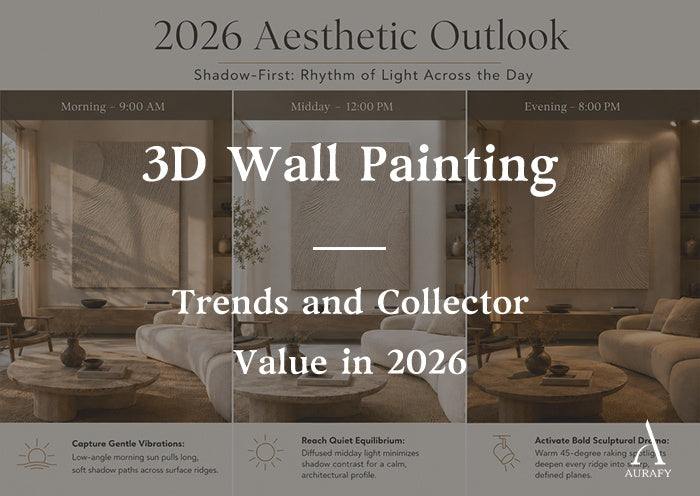
- Display handcrafted 3D wall painting to transform a flat wall into a physical sculptural landscape — one that changes with the light and carries genuine material presence.
- Follow the future trends in 3D textured art: neutral palettes, architectural scale, and shadow-first design are defining the direction of high-end wall art in 2026.
- Choose handmade over machine-pressed at every scale — the organic variation of hand-applied paste is what separates a collectable piece from a decorative panel.
- Apply the two-thirds sofa rule for living rooms and position the canvas center at 57 to 60 inches from the floor in open-plan spaces.
- Install spotlights 12 to 15 inches from the wall at 30 to 45 degrees — this raking light activates the full shadow range of a 3D surface that flat overhead light eliminates.

The most ambitious residential interiors of the last decade share a common frustration. The architecture is impressive. The furniture is carefully chosen. And the walls are flat.
A large flat canvas print above a designer sofa looks like what it is — ink on fabric, scaled up. The surface has no depth. It adds imagery but no physical presence. At large scale, the gap between the quality of the furniture and the quality of the wall art becomes impossible to ignore.
3D wall painting closes that gap. Not by being bolder or more colorful, but by being physical. A surface built up in sculptural paste — with real ridges, real recesses, and real shadows — occupies space in the room rather than simply sitting on the wall. It is the difference between a decoration and a presence.
Future Trends in 3D Textured Art: Where the Category Is Going

Two clear directions are defining how 3D textured art develops in 2026 and beyond. Both reflect broader shifts in how high-end residential interiors are being designed.
Trend one: Shadow as the primary design element
The most influential direction in contemporary 3D art is the deliberate removal of color as an expressive tool.
Highly saturated colors create immediate impact — and immediate fatigue. In a room where the occupant spends several hours a day, a bold-colored piece demands continuous attention. Over time, that demand becomes exhausting.
The counter-movement is gaining significant momentum. Pieces in warm oat, pale plaster white, dusty clay, and warm greige use almost no color. All expression comes from shadow — from the physical depth of the surface and the way light falls across it at different times of day.
This approach works because shadow is never the same twice. The shadow that falls across a ridge at 9am is longer and softer than the shadow at noon, which is different again from the sharp, deep shadow produced by a warm spotlight at 8pm. The piece changes continuously. It holds attention without demanding it.
For people who spend long hours looking at screens — at high-saturation digital content — this quality of quiet, light-responsive neutrality is specifically restorative. The trend toward shadow-first, neutral-palette 3D art is partly an aesthetic movement and partly a response to screen fatigue.
Trend two: Architectural scale
The single 40" × 60" canvas is becoming the baseline for quality 3D work in larger residential spaces. For high-ceiling rooms and double-height feature walls, the 40" × 80" vertical format and multi-panel triptych arrangements — spanning 100 inches or more across a wide wall — are increasingly standard.
This scale shift reflects a recognition that a piece needs to be proportional to its architectural context to perform well. A 24" × 30" piece on a 14-foot wall does not anchor the space. A 40" × 80" piece or a three-panel arrangement at the same wall does.
The driving factor is not simply visual preference. At large scale, the physical depth of a handmade 3D surface becomes proportionally more significant.
The shadows produced by a 15-millimeter relief on a 40" × 80" canvas extend across the full wall and create a genuine architectural effect. The same surface at small scale produces detail. At large scale, it produces landscape.
Handmade vs. Machine-Pressed: A Direct Comparison

|
|
Machine-Pressed Panels |
Handmade 3D Canvas Art |
|
Surface variation |
Mechanical repetition. Every ridge at the same height, every element at the same angle. Reads as pattern under directional light. |
Zero repetition. Every stroke is a real-time decision. Each section of the canvas has its own profile and shadow character. |
|
Material durability |
Pressed foam or bonded resin degrades under indoor temperature and humidity cycling. Edges become brittle and separate over time. |
Flexible acrylic modeling paste bonds with the canvas fiber and maintains structural integrity for decades under normal conditions. |
|
Air quality |
Industrial production resins and surface coatings can release VOCs for extended periods after installation. |
Low-VOC matte varnish applied by hand. Safe for residential use including bedrooms and spaces used by children and pets. |
|
Shadow quality |
Uniform surface produces uniform shadows — predictable and mechanically regular. |
Variable surface produces variable shadows — deepening in some sections, softening in others, shifting continuously with the light. |
|
Long-term value |
Decreasing. As the surface degrades and the mechanical pattern becomes more visible, the piece loses its appeal. |
Increasing. The handmade surface reveals more detail over time as the viewer becomes familiar with its specific qualities. |
The distinction matters most at large scale — which is precisely where machine-pressed panels are most often used. A 40" × 60" machine-pressed panel in a luxury living room exposes its production method to the room. A handmade piece at the same scale commands it.
Placement Guide: 3D Art Painting on Wall by Space Type
Wide sofa walls in living rooms
The total width of the artwork must cover two-thirds to three-quarters of the sofa width below it.
For a 90-inch sofa, this means artwork between 60 and 68 inches wide. A piece narrower than this proportion looks disconnected from the furniture — it reads as a small object above a large one rather than as a unified composition. A piece within this range creates the visual connection that makes the sofa and the wall read as a single design decision.
Position the center of the artwork at 57 to 60 inches from the floor — standard eye level. If the sofa is against the wall, leave 6 to 8 inches between the top of the sofa back and the bottom edge of the canvas.
High-ceiling walls and double-height feature walls
For standalone walls with no furniture below them — entry halls, double-height living room walls, stairwell walls — a vertical 40" × 80" canvas is the most effective single-piece solution. The vertical proportions suit the wall's height. The upward movement of the texture strokes — palette knife marks that travel from the base toward the top of the canvas — draws the eye upward and makes the ceiling feel intentionally tall rather than simply distant.
Position the center of the canvas at 57 to 60 inches from the floor regardless of ceiling height. Centering the piece at eye level keeps it within the occupied zone of the space and prevents it from feeling disconnected from the people in the room.
Wide walls with no anchor furniture
For very wide walls — a long wall in an open-plan living and dining area, a wide wall in a commercial lobby — a triptych of three 40" × 60" vertical canvases hung at the same height with 2 to 4 inch gaps creates a horizontal arrangement that fills the wall with a gallery-like rhythm. The total arrangement spans approximately 124 inches, which suits walls from 12 to 16 feet wide.
Keep the compositions within each panel coordinated — the same general direction of movement, the same palette — so the arrangement reads as a unified work rather than three separate pieces placed near each other.
How to Light a 3D Wall Painting Correctly

Lighting is the activation mechanism for a 3D piece. Get it right and the surface comes alive. Get it wrong and you have an expensive textured canvas on a wall.
Step 1: Move the spotlight 12 to 15 inches from the wall
The standard spotlight position — 8 to 10 inches from the wall — is correct for flat or low-relief work. For deeply textured 3D pieces, it is too close. At this distance, the beam angle is steep enough to create blind spots — shadow bands where the highest elements of the surface block light from reaching the lower sections.
Moving the light outward to 12 to 15 inches flattens the entry angle and allows the beam to clear the highest ridges and reach the full canvas area evenly.
Step 2: Set the angle at 30 to 45 degrees from the wall
This is the raking light angle that makes 3D art perform at its best. At this angle, the beam travels across the face of the canvas rather than at it. Each raised element catches light on its upper face and falls into shadow on its lower face. The shadows extend horizontally across the canvas — sometimes across several centimeters of surface — and shift throughout the day as the ambient light angle in the room changes.
Under flat overhead light, a 3D piece looks like a textured canvas. Under 30 to 45 degree raking light, it looks like what it is: a sculptural relief.
Step 3: Use warm white bulbs throughout
2700K to 3000K is the correct color temperature for all 3D textured work. This range produces the warm, soft light quality that enhances neutral palettes, deepens the richness of the shadows, and gives the piece its full atmospheric presence.
Avoid bulbs above 4000K. Cool white light flattens the tonal range of neutral surfaces and makes shadows look grey rather than deep. The piece loses the warmth and presence that makes it worth choosing over a flat print.
Frequently Asked Questions
Will a 3D canvas yellow or collect dust without a glass cover?
Three coats of UV-resistant, anti-static matte varnish are applied to every AurafyArt piece before it leaves the studio. This seal reduces the static charge on the surface — meaning dust adheres to it more slowly than it would to an unsealed canvas or a standard wall surface. The UV-resistant formulation prevents the neutral base tones from yellowing under normal indoor light conditions, including rooms with significant natural light exposure.
For cleaning, use a wide soft-bristle brush to sweep gently along the direction of the texture ridges every two to three weeks. For deep recesses, use short bursts from a can of compressed air.
Never use a damp cloth, water, or any chemical cleaner. Moisture in the texture channels can affect the modeling paste over time. Dry methods are sufficient and are all the piece requires.
How do I safely hang a large 3D canvas on a drywall wall?

AurafyArt large canvases use a lightweight professional stretcher bar construction. A 40" × 60" piece weighs under 5 pounds. A 40" × 80" piece stays under 8 pounds. These weights are well within the range of standard residential picture hanging hardware.
For any canvas wider than 24 inches, always use two fixing points. Use the D-ring fittings on the back of the canvas as your hanging reference — one on each side, positioned symmetrically. On drywall, use wall anchors rated for at least double the actual weight of the piece.
Mark both fixing points with a spirit level before drilling — at large scale, a canvas that is even slightly off horizontal is visible from across the room. Installed on two properly rated fixing points, a large canvas poses no safety concern and will hang flat and stable indefinitely.
The Wall as Architecture
The future of high-end wall art is not about bolder imagery or more dramatic color. It is about physical presence — surfaces that occupy space, respond to light, and carry the evidence of how they were made.
3D wall painting is at the center of this direction. It is not a trend that will be replaced by the next color cycle or the next decorating season. It is a permanent category shift: from the idea that art hangs on a wall, to the understanding that art can change what a wall is.
A handmade 3D piece built in neutral tones, lit correctly, and sized to its architectural context does not just improve a room. It completes it — in a way that no flat surface, however well designed, ever can.
Browse the AurafyArt 3D Wall Painting— and find the handmade piece that gives your wall its permanent presence.
Share:
Wall Decals vs 3D Canvas Art: The Complete Guide
How to Curate a 3D Art Gallery Wall at Home