

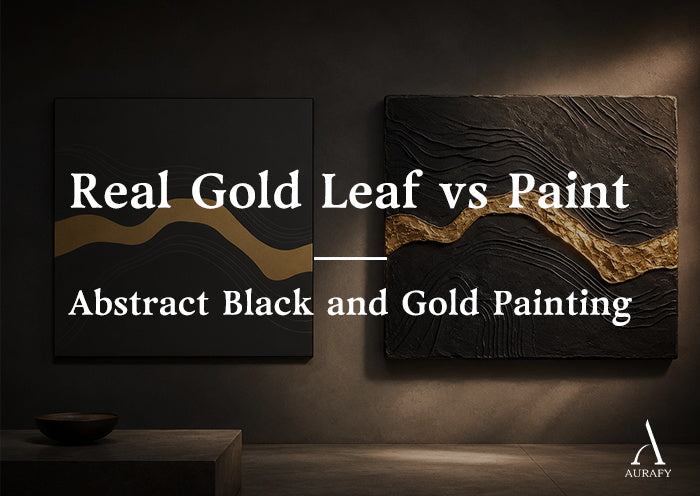
Imagine two art pieces side by side. They share identical dimensions, similar compositions, and near-identical online product photos. Yet, one costs forty dollars, while the other costs several hundred.
Hang them up, and you instantly see the difference. One radiates museum-grade luxury. The other looks like a cheap, gold-colored sticker on a canvas.
The true divide lies in the materials. Low-end factories use metallic spray paint to mimic real metal. This paint looks flat up close and darkens over time. True value demands hand-applied gold leaf layered over a 3D, hand-sculpted surface.
This technical guide clarifies the physical differences. It proves why handcrafted abstract black and gold painting holds collector value over mass-produced imitations.
Three Physical Differences Visible Up Close

Close inspection reveals a massive gap between authentic gold leaf and factory paint.
1. Edge Structure: Organic Tears vs. Rigid Stencils
Artists apply genuine gold leaf by hand onto a 3D textured surface. They press the razor-thin metal sheet into the modeling paste while it remains semi-cured. Then, the artist tears the leaf to shape by hand. This hand-application creates irregular, broken boundaries with organic tearing edges. Micro-fragments of gold bleed naturally into the black zones. No two sections ever repeat.
In contrast, automated factories blast metallic paint through a rigid stencil under high pressure. This process creates sharp, mechanical boundaries for the abstract gold black elements. The final line looks like a masked, painted zone rather than a material applied by hand.
2. Texture Integration: Natural Veins vs. Flat Coating
Genuine gold leaf conforms perfectly to every physical variation of the textured substrate. The leaf rises with every ridge and dips into every recess. It wrinkles slightly at the base of each ridge to accommodate the height changes. The gold looks embedded in the surface—like natural mineral veins running through rock. It thins out in the valleys and glows brightly on the peaks.
Factory paint behaves differently. It blankets the surface at a fixed, uniform thickness. Instead of conforming, the paint coats the substrate evenly. This uniform application actually highlights the mechanical repetition of the machine-pressed texture underneath.
3. Light Reflection: Moving Shimmer vs. Static Glare
Real gold possesses a micro-crystalline surface structure that reflects light selectively. If you shift your position by merely 10 degrees, the metallic highlight moves across the abstract gold and black canvas with you. It responds continuously to ambient daylight throughout the day. The artwork shifts and breathes naturally.
Factory metallic paint reflects light uniformly in all directions at once. The paint contains random metallic particles suspended in a flat resin binder. It cannot shift or breathe. Under any light condition, the entire gold block reflects with the same raw intensity, creating a flat, artificial sheen that reads as distracting glare.
The Durability Gap: Polymer vs. Resin

The ultimate reason why handcrafted abstract black and gold painting holds collector value lies in the chemistry of aging.
· Factory Metallic Paint: Low-grade industrial paints rely on copper-based metal powders. Copper reacts with atmospheric oxygen and humidity, causing continuous oxidation. Within one to three years, the bright gold color turns into a dull, brownish bronze. Furthermore, canvases flex naturally with seasonal temperature changes. Rigid paint resins cannot flex with the fabric. This restriction creates micro-fractures, leading to visible flaking and peeling.
· Handcrafted Gold Leaf (AurafyArt): Every premium abstract black and gold painting utilizes a highly flexible acrylic modeling paste. A meticulous 10-to-14-day layered curing process builds the surface in thin phases. As the polymer chains cure across multiple sessions, they form permanent, cross-linking molecular bonds with the gold leaf. The leaf becomes part of the surface matrix.
This flexible polymer matrix moves in tandem with the canvas. It prevents the micro-fractures that destroy factory paint. Because genuine gold is chemically inert, it never oxidizes. Two hand-brushed coats of low-VOC matte varnish add an extra protective barrier. The artwork handles environmental changes flawlessly and develops a rich, collectible patina over decades.
Preserving the Surface: The Zero-Abrasion Protocol

Gold leaf averages a thickness of 0.1 microns—roughly 1,000 times thinner than a human hair. To protect this delicate layer, collectors must follow a strict dry, zero-friction maintenance routine.
· Avoid Water: Moisture penetrates the edges of the gold sheets, weakens the adhesive layer below, and causes the leaf to peel.
· Avoid Alcohol: Alcohol-based cleaners dissolve the protective matte varnish, exposing the thin metal directly to rapid degradation.
· Avoid Degreasers: Harsh chemical solvents aggressively attack the underlying acrylic polymer matrix, melting the 3D details.
The Correct 3-Week Cleaning Routine
1. Surface Dusting: Every three weeks, sweep the canvas gently with a wide, ultra-soft natural-bristle brush. Follow the exact direction of the original palette knife marks to shift dust out of the 3D channels safely.
2. Deep Recesses: For narrow crevices, use a can of compressed air held at least 6 inches away. Apply short, 1-to-2-second bursts directed along the channels to displace debris without creating friction.
AurafyArt applies a specialty anti-static matte varnish seal to every piece. This finish heavily reduces the electrostatic charge of the canvas, so dust rests loosely on the surface instead of bonding to it.
Craft Cannot Be Replicated at Scale

Automated assembly lines easily press molds into cheap resin, spray copper paint through stencils, and ship mass volumes of an abstract gold black design.
However, a factory can never replicate the structural reality of authentic craft. Automated machines cannot mimic the unique torn edge of gold leaf resting against a hand-sculpted ridge, or the permanent cross-linking resilience forged over a two-week curing session.
These properties are architectural, material, and permanent. They ensure a handcrafted abstract black and gold painting retains its deep character and commanding presence for decades to come.
Explore the AurafyArt handcrafted gold leaf collection today.
Share:
Black and Gold Abstract Painting for Dark Luxury Walls
Stone and Leaf: Styling Black Gold Abstract Painting