- Move spotlights 12 to 15 inches from the wall: This single adjustment eliminates the downward shadow blind spot below the top ridges of a 3D surface.
- Lock the beam angle at 30 to 45 degrees: This specific angle shifts shadows sideways rather than downward, activating every gold, black, and white element simultaneously.
- Choose a 10 to 24 degree narrow beam: Wide-spread bulbs diffuse the light and destroy the contrast that makes 3D texture valuable.
- Specify 2700K to 3000K warm white bulbs (CRI 95+): Cool light above 4000K turns genuine gold leaf into a dull zinc color and makes black mineral paste look dirty grey.
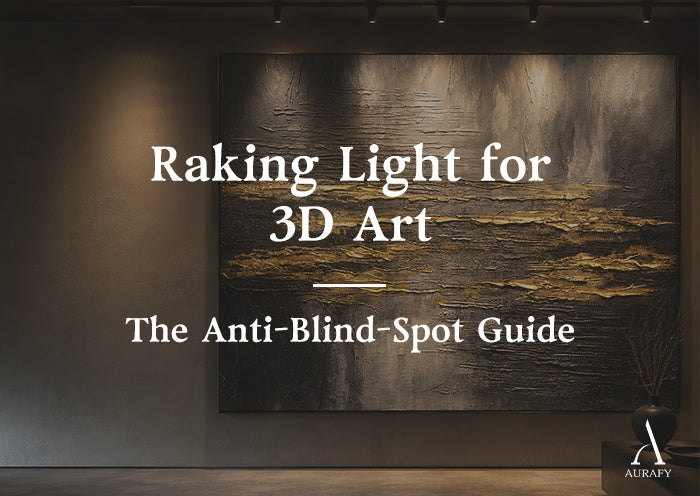
Imagine you install a significant piece of abstract painting black and gold. The artwork features handcrafted gold leaf and substantial physical relief. You turn on your existing ceiling lighting.
Suddenly, a glaring issue appears. The top third of the painting glows beautifully. The gold leaf on the upper ridges catches the light. However, the lower two-thirds of the composition sits in near-total darkness. The intricate channels, the lower gold veins, and the shadow variations in the black paste completely vanish.
This is not a product defect. It is a lighting geometry problem with a clear physical cause and a precise engineering solution.
This guide outlines the optical mechanics behind the 3D art blind spot problem. It delivers the exact fixture placement and beam angle specifications to solve it
The Physics of the Blind Spot: Why Downlights Destroy 3D Relief

Standard recessed downlights sit directly above the canvas. They send light downward at a near-vertical angle—typically 70 to 90 degrees from the wall surface.
When this steep vertical beam strikes the first ridge of a heavily textured surface, that ridge acts as a physical obstruction. The ridge blocks the light from continuing down the canvas. Everything below it falls into a dark shadow cone.
At 15 to 20 millimeters of surface relief, this obstruction causes severe visual damage. The steep downward shadow can extend several times the height of the physical ridge. On a 40 × 60 inch canvas, the upper ridges can render the bottom third of the composition virtually invisible. This empty zone is the blind spot.
Why the Gold Leaf Goes Dark
Genuine gold leaf possesses a micro-crystalline surface structure that reflects light selectively rather than uniformly. To shimmer properly, the light must arrive at an angle that bounces the reflection directly toward your eye at eye level.
A steep overhead downlight bounces the light straight down toward the floor instead. For a viewer standing in front of the art, the reflection travels away from them. The gold leaf immediately reads as dark and flat.
Why the Black Paste Produces Glare
Black mineral paste acts as the visual anchor of a black white gold abstract piece. It must absorb incident light to read as deep and velvety.
Steep overhead downlights ruin this behavior. The vertical beam hits the minor reflective particles in the matte surface uniformly, returning a harsh specular point. This flat reflection creates a cheap, plasticky grey glare across the dark canvas.
To eliminate all three issues, you must correct the lighting geometry.
The 12 to 15 Inch Offset: The Primary Engineering Fix

The 12 to 15 inch offset is the most important metric in 3D art installation.
When a spotlight sits 6 inches or less from the wall, the beam strikes the canvas at a steep, near-vertical angle. This position immediately triggers the downward shadow block.
Moving the spotlight further from the wall changes the geometry fundamentally. At 12 to 15 inches from the wall, the beam no longer runs parallel to the wall—it crosses it.
The light strikes the canvas at a shallow angle. It skims over the highest peaks rather than stopping at them. This clearing path allows the beam to reach the middle and lower sections perfectly.
- Below 12 inches: The beam angle remains too steep. The tallest top ridges still intercept the light and cast downward shadows.
- At 12 inches: The light geometry enters the optimal functional range for standard 40-to-60-inch canvases.
- At 15 inches: The setup optimizes coverage for taller 40" × 80" formats or pieces exceeding 20mm of surface relief.
Standard residential track systems sit 8 to 10 inches from the wall for general wall washing. This is too close for heavy impasto work. If you cannot relocate your existing track, install a dedicated supplementary track or an adjustable surface arm. You cannot solve a geometric blind spot by increasing bulb brightness.
The 30 to 45 Degree Beam Angle: Activating the Three-Material Surface

A premium black white and gold abstract painting contains three distinct optical materials. Each material handles light differently:
- Black Mineral Paste: Absorbs light. It relies on adjacent highlights and clean side-shadows to project depth.
- White Mineral Paste: Reflects light diffusely. It scatters the beam in all directions to create ambient warmth and brightness.
- Genuine Gold Leaf: Reflects light selectively. It requires precise angles to target the viewer's eye.
Locking the beam at 30 to 45 degrees from the wall surface activates all three materials simultaneously.
Because the light enters from the side, it strikes the upper face of each ridge at the correct angle to send the gold leaf's reflection toward the viewer. The lower face of each ridge drops into clean contrast. The white paste elements scatter the light broadly, making the gold-to-black contrast highly visible.
Most importantly, the shadows fall sideways toward the wall rather than downward onto the composition. Every section of the canvas receives light along its face, completely eliminating the blind spot.
Below 30 degrees: The light runs parallel to the wall. The beams catch extreme highlights on the very tips of the ridges, but detail disappears inside deep, over-extended shadows.
Above 45 degrees: The geometry approaches a vertical downlight, and the downward blind spot reappears.
The Full Lighting Metric Matrix

This technical metric matrix details how to light abstract painting black and gold without creating blind spots:
|
Lighting Parameter |
Common Installation Error |
Correct Specification |
Expected Optical Result |
|
Horizontal Offset |
0 to 6 inches (Standard downlight) |
12 to 15 inches |
The beam clears the top ridges and reaches the full canvas from top to bottom. |
|
Vertical Beam Angle |
70 to 90 degrees (Near-vertical) |
30 to 45 degrees (Raking) |
Shadows fall sideways, not downward. The lower blind spot disappears. |
|
Fixture Beam Spread |
60 degrees or wider (Floodlight) |
10 to 24 degrees (Narrow spot) |
Light concentrates entirely on the art surface, preserving shadow contrast. |
|
Color Temperature (CCT) |
4000K to 5000K (Cool white) |
2700K to 3000K (Warm white) |
Gold leaf reads as rich, warm gold; black paste reads as deep, velvety black. |
|
Color Rendering Index |
80 CRI or below (Standard retail) |
95 CRI or above |
High spectral accuracy ensures you see the true color of each hand-applied material. |
|
Fixture Quantity |
Single fixture for any artwork size |
One fixture per 24 to 36 inches |
Even illumination across wide formats without intensity drop-offs at the edges. |
Light as the Final Instrument
A handmade abstract painting black and gold is a physical, sculptural object. Flat vertical downlighting and correctly positioned raking light turn the same piece into two entirely different artworks. One looks like a flat canvas print; the other operates as a commanding sculptural relief.
The 12-to-15-inch offset clears the physical peaks. The 30-to-45-degree raking angle illuminates the gold, white, and black surfaces simultaneously. These are precise optical engineering specifications, not personal preferences. Apply them correctly, and your collection will perform at the gallery level it was built for.
Contact AurafyArt’s lighting consultation team with your wall height and track specifications today. We provide a custom raking light layout for every commission.
Share:
Stone and Leaf: Styling Black Gold Abstract Painting
Black White and Gold Art in Minimalist and Cream Interiors