


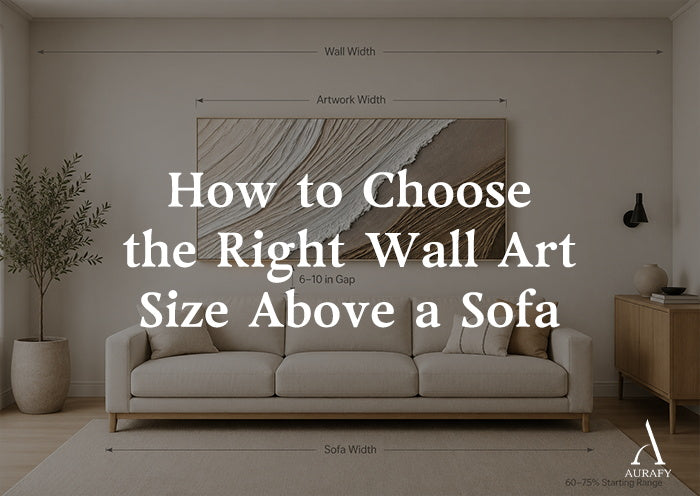
How to Choose Wall Art Size Above a Sofa

The short answer: measure your sofa's width first, then aim for wall art (or an art grouping) that spans roughly 60% to 75% of that width, leaving a few inches of visible wall on either side and centering the piece 6 to 10 inches above the sofa back. That ratio is a starting point, not a rule. The right size for your room also depends on wall width, ceiling height, and how much visual weight the rest of the room already carries. The rest of this guide walks through the measuring process step by step, with worked examples for different sofa sizes, so you can land on a size that looks intentional rather than guessed at.
Why Sofa Width Isn't the Only Number That Matters

Most sizing advice starts and ends with the sofa's width, but the sofa is only one reference point in a room that has at least three: the sofa itself, the open wall space around it, and the ceiling height that determines how much vertical room you have to work with.
A sofa that measures 84 inches wide sitting on a 12-foot wall behaves very differently than the same sofa pushed into a narrow 90-inch alcove. In the first case, the open wall gives you room to go slightly wider than the sofa if you want to. In the second, you're constrained by the wall itself regardless of what the sofa "calls for."
This is why a measurement-first approach works better than a fixed formula. You're solving for two things at once: art that relates proportionally to the sofa, and art that fits comfortably inside the wall boundary without crowding doorways, outlets, or adjacent furniture.
Step-by-Step: How to Measure for Wall Art Above a Sofa

Step 1: Measure the Sofa's Width
Measure the sofa from outer arm to outer arm, not including any pillows that overhang the frame. Round down to the nearest inch. This number becomes your baseline for the next calculation.
Step 2: Measure the Full Available Wall Width
Measure the wall from corner to corner, or between the two nearest obstacles (a doorway, a window frame, a light switch). If the sofa sits inside an alcove or between built-ins, this measurement may be smaller than the sofa's own width plus margins, and it should take priority over the sofa-based ratio.
Step 3: Apply a Starting Ratio, Then Check It Against the Wall
A commonly used starting point is to size the artwork, or the full spread of a grouped arrangement, at 60% to 75% of the sofa's width. This isn't a design law, just a proportion that tends to read as balanced because it leaves visible wall on either side of the piece, keeping the art from looking disconnected from the sofa or, at the other extreme, jammed edge to edge.
Multiply the sofa width by 0.6 and by 0.75 to get a working range, then compare that range to your actual wall width from Step 2. If the wall is narrower than the sofa-based range allows, the wall wins. Crowding a piece against a doorframe or corner molding looks more cramped than sizing slightly under the "ideal" ratio.
Step 4: Check the Vertical Space
Measure from the top of the sofa back to the ceiling or crown molding. This tells you how much height you're working with before the art starts to feel like it's competing with the ceiling line. Leaving 6 to 10 inches between the top of the sofa back and the bottom of the art keeps the piece visually connected to the furniture below it.
Step 5: Decide Between One Piece and a Grouped Layout
Once you know your target width and height range, decide whether a single large piece or a multi-piece arrangement better fits it. A single oversized piece needs to hit the target dimensions directly, while a grouped layout needs to hit the target as a combined footprint, including the gaps between frames.
Worked Examples for Different Sofa Widths

These are calculated examples based on the 60% to 75% starting ratio, not fixed recommendations for every room.
72-inch sofa (loveseat or apartment-size sofa):
60% of 72 inches is 43.2 inches; 75% is 54 inches. Target art width: roughly 43 to 54 inches. If the wall is tight, such as a sofa placed between two doorways, the lower end of that range, or slightly under it, usually reads better than forcing a wider piece.
84-inch sofa (standard three-seat sofa):
60% of 84 inches is 50.4 inches; 75% is 63 inches. Target art width: roughly 50 to 63 inches. This is one of the most common sofa sizes in US living rooms, and it lines up conveniently with several standard horizontal art widths.
96-inch sofa (large three-seat or sofa-plus-chaise):
60% of 96 inches is 57.6 inches; 75% is 72 inches. Target art width: roughly 58 to 72 inches. At this width, a single piece can start to feel like a significant visual anchor, so it's worth checking that the wall has enough clearance on either side before committing to the upper end of the range.
108-inch sofa (sectional or large sectional segment):
60% of 108 inches is 64.8 inches; 75% is 81 inches. Target art width: roughly 65 to 81 inches. Sectionals often sit against longer walls, but it's still worth measuring the actual open wall rather than assuming the full sofa length is available, since sectionals frequently wrap into a corner.
In each case, the same logic applies: calculate the range from the sofa, then confirm it against the actual wall measurement before finalizing a size.
Sofa Width vs. Wall Width: Which One Governs the Decision

When the two numbers agree, the decision is simple. When they don't, here's how to think about it.
If the wall is wider than the sofa, such as a sofa on a long, uninterrupted wall, you have room to size up to the sofa-based ratio or slightly beyond it, especially with a grouped layout that can spread wider than a single canvas comfortably would.
If the wall is narrower than the sofa's ratio would suggest, such as a sofa in an alcove, between windows, or near a doorway, the wall constraint takes over. Sizing down from the sofa-based range and leaning toward a single, moderately sized piece usually looks cleaner than forcing a wider grouped layout into a tight space.
Visual Weight: Why Two Pieces of the Same Size Can Look Different

Size alone doesn't determine how "heavy" a piece feels on the wall. Color depth, surface texture, and contrast against the wall color all affect visual weight, independent of measured dimensions.
A piece with dark, high-contrast tones or a raised textured surface tends to read as more visually substantial than a piece of the same size in soft, low-contrast tones. This matters when comparing options like a piece finished in beige, soft gray, and off-white tones against a piece with an onyx and charcoal base and a metallic-gold accent channel. Even at an identical width, the darker, higher-contrast piece will likely draw more attention and can sometimes work at a slightly smaller size than the lighter piece would need to achieve a similar visual presence.
Hanging Height: Where the Bottom of the Frame Should Land

Once size is settled, height placement finishes the job. Two references matter here.
Relative to the sofa: Leave roughly 6 to 10 inches between the top of the sofa back and the bottom edge of the art or arrangement. This keeps the piece grouped with the sofa as a single composition rather than floating separately above it.
Relative to eye level: A secondary check, often used in gallery hanging, is to center the artwork's midpoint around 57 to 60 inches from the floor. Above a sofa, this can conflict with the sofa-clearance measurement, particularly with taller sofa backs. When the two disagree, the sofa-clearance measurement generally takes priority, since the art is being hung in relation to a specific piece of furniture rather than in an empty gallery wall.
Centering: Sofa Center vs. Wall Center

If the sofa sits in the middle of the wall, this is a non-issue. But many sofas are offset, positioned closer to one side of a room to leave a walking path or accommodate a door.
In an offset scenario, center the art on the sofa itself, not on the wall. Art centered to the wall when the sofa is pushed to one side creates a visible gap that reads as a placement mistake rather than a design choice. Measure from each outer edge of the sofa to find its true horizontal center, then align the art's center point to that same measurement.
One Large Piece vs. a Grouped Layout

Both approaches can satisfy the same target width range, and the right choice usually comes down to wall proportions and how much visual complexity the room can handle.
A single large piece tends to work well when the wall is relatively plain, without competing shelving or molding; when you want a clean focal point without additional framing decisions; or when the sofa width falls in the 84-to-108-inch range, where a single horizontal piece can comfortably reach the target width.
A grouped arrangement tends to work well when the wall has some irregularity, such as an outlet, vent, or asymmetric alcove, that a single large piece would need to be sized around; when you want to combine formats or tones rather than commit to one continuous surface; or when the sofa is on the wider end (96 inches and up), where reaching the top of the ratio range with a single piece may not be available or desirable.
For a grouped layout, measure the combined width including gaps between frames, typically 2 to 4 inches, and compare that total span to your target range the same way you would a single piece.
Common Sizing Mistakes

Sizing to the wall instead of the sofa. A wide wall doesn't mean the art should be wide. If the sofa is 72 inches and the wall is 14 feet, art sized to fill the wall will overwhelm the sofa and look disconnected from the seating arrangement below it.
Hanging too high. Art hung with more than 10 to 12 inches of clearance above the sofa back starts to look like it belongs to a different part of the wall rather than to the sofa grouping.
Choosing a piece that's too narrow. Anything under roughly 50% of the sofa's width tends to look small and centered awkwardly, especially on a plain wall with no other elements to fill the visual gap.
Ignoring ceiling height. In rooms with lower ceilings, standard clearance guidance combined with a large piece can leave very little room to the ceiling or crown molding. Recheck the vertical measurement from Step 4 before finalizing a tall piece.
Not accounting for size-selector increments. Many horizontal wall art pieces are offered across a range of set sizes rather than infinite custom dimensions. Measure your target range in Step 3 before browsing, so you're comparing your actual numbers against the sizes available.
Comparing Two Options at the Same Size Range

Since horizontal proportion is usually the format that works best above a sofa, it helps to compare two pieces offered across the same size range side by side. Abstract Earth Texture Wall Art-Soft Sand Tones-AURA010 is available through a horizontal size selector from 20x40 up to 55x110, in beige, soft gray, and off-white tones, with a 3D textured acrylic surface on canvas that includes raised tactile texture and layered brushstrokes. Metallic Topography Painting-Onyx & Gold Accents-AURA033 is offered across the same 20x40 to 55x110 horizontal size range, in an onyx and charcoal palette with a continuous metallic-gold channel running through layered ridges, carved grooves, and a diagonal flow pattern.
Because both are sized through the same horizontal selector, the sizing math from earlier in this guide applies equally to either one. Given the tonal, low-contrast palette of AURA010, it may suit rooms where you want the art to size up toward the higher end of your calculated range without dominating the wall. The darker, higher-contrast palette and metallic accent of AURA033 can carry a similar presence even sized toward the lower or middle end of that same range. Neither is a "correct" choice for a given sofa width; the size selector lets you match either tone to the specific range you calculated in Step 3.
Conclusion

Choosing wall art size above a sofa comes down to a short sequence of measurements: the sofa's width, the wall's available width, a 60% to 75% starting ratio checked against both, and 6 to 10 inches of clearance above the sofa back. From there, the choice between one large piece and a grouped layout depends on how much of that calculated range you want to fill with a single surface versus several smaller ones. Treat the ratios in this guide as a starting point for your specific wall, not a fixed formula, and adjust based on what the actual space allows once you've measured it.
Frequently Asked Questions
What size wall art works above an 84-inch sofa?
For an 84-inch sofa, a useful starting range is roughly 50 to 63 inches wide, based on the common 60% to 75% sizing ratio. This range should still be checked against the actual open wall width, since a narrower wall or nearby doorway can limit how wide the piece can comfortably go. Within that range, a single horizontal piece or a grouped arrangement can both work, depending on the wall's proportions and how much visual complexity suits the room.
Should wall art be two-thirds the width of a sofa?
Two-thirds, or about 67%, falls within the commonly used 60% to 75% starting range, so it's a reasonable proportion to test, but it isn't a fixed requirement. Wall width, ceiling height, and the visual weight of the piece itself can all shift the ideal size up or down from that midpoint. Treat two-thirds as a useful first calculation to run, then adjust based on how it looks against your actual wall measurements.
How high should wall art hang above a sofa?
A common approach is to leave about 6 to 10 inches of space between the top of the sofa back and the bottom edge of the artwork. This keeps the piece visually connected to the sofa as a single grouping rather than reading as separate from it. In rooms with lower ceilings, it's worth rechecking this clearance against the distance to the ceiling or crown molding before finalizing a larger piece.
Is one large artwork better than a gallery wall above a sofa?
Neither option is inherently better; the right choice depends on the wall and sofa proportions. A single large piece tends to suit plain walls and sofas in the 84-to-108-inch range, while a grouped arrangement can be useful on walls with irregular features or when the sofa is wide enough that reaching the target width with one piece isn't practical. Both should be measured against the same sizing range calculated from the sofa's width.
Share:
Minimalist Grid Wall Art Without Visual Clutter
Large Textured Wall Art for Living Rooms