


Why a Minimalist Room Can Feel Frozen
Minimalist and contemporary homes often chase the same goal: clean lines, bare walls, quiet materials. Get it right, and the space feels calm. Get it slightly wrong, and the same room feels frozen instead, like a photo of a house rather than a lived-in one.
Flat walls and smooth stone surfaces have no movement of their own. Without something to react to daylight, a beautifully built room can sit static all day, no matter how much natural light pours through the windows.
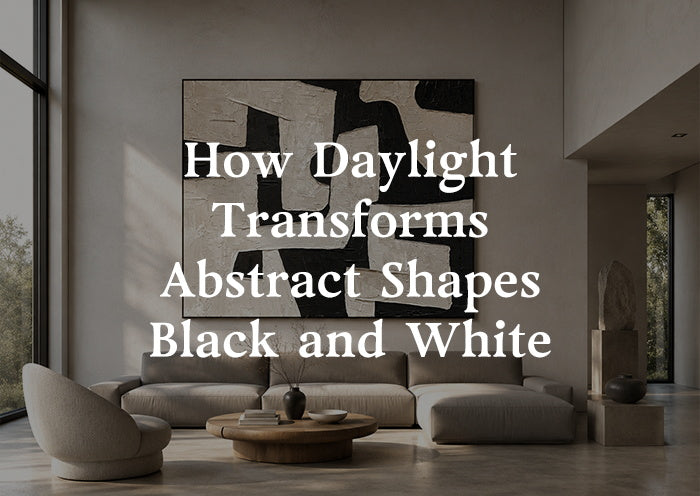
A piece built from raised abstract shapes black and white changes this. Its physical geometry catches light differently at 9 AM than it does at noon or at dusk. The wall itself starts to shift throughout the day, the same way shadows move across a courtyard or a mountain range.
How Geometric Edges Interact With Light

Unlike softer, fluid mineral textures used in more organic rooms, this style leans on sharp, deliberate edges. Think stepped planes and angular facets, closer to Bauhaus or cubist geometry than to a weathered rock face. These hard edges cut incoming light at a precise, consistent angle, which is what makes their shadows so readable.
The black and white palette plays two very different roles here. Charcoal-black mineral facets absorb almost all incoming light, holding a constant, deep tone no matter the time of day. This gives the piece a stable structural frame that never washes out.
White and light-grey facets work the opposite way. Their slightly rough, matte surface, sometimes labeled abstract black white in a piece's material description, scatters strong direct sunlight into a soft, even glow instead of a harsh reflection. Together, the black and white facets create a built-in system for absorbing sunlight in some areas and diffusing it in others.
One Piece, Three Very Different Looks in a Single Day

Because the texture is physically real, the same painting looks noticeably different depending on when you view it. Here is what that shift can look like over the course of one day.
Morning: long, low shadows
Early sunlight enters at a low, sideways angle, often from an east-facing window. At this angle, even small differences in surface height cast long shadows. A ridge only 15 to 20 millimeters deep can throw a shadow that stretches for inches across the white base. The piece looks stretched and dramatic, larger than its actual frame suggests.
Midday: texture over shadow
By noon, sunlight often comes from directly overhead or floods in through large windows at a steep angle. Those long morning shadows shrink or disappear almost entirely. With the big dramatic shadows gone, attention shifts to something smaller: the fine marble dust and mineral grain inside the white surface. Under strong, direct light, these tiny particles catch and scatter light individually, giving the white areas a subtle, granite-like sparkle up close.
Evening: soft, low-contrast fade
Once natural light fades and the room switches to warm ambient lighting or fades into blue evening light, the painting settles into a much quieter state. White areas shift toward a hazy grey. Black areas sink further into shadow and nearly disappear against the wall. The sharp contrast from earlier in the day softens into something calmer, better suited to a room winding down for the evening.
Matching Geometry to Your Room's Orientation
Not every room receives light the same way. The table below matches common window orientations to a texture ratio that responds well to each one.
|
Room Orientation |
Common Daylight Challenge |
Recommended Ratio |
How It Responds Over the Day |
|
East-facing room |
Bright morning light fades to a dull, flat afternoon |
70% matte grey-white base, 30% sharp black facets |
Morning black facets throw long angled shadows; the large white base later gathers weak afternoon skylight |
|
West-facing room |
Harsh, glaring sunset light in late afternoon |
50% matte charcoal black, 50% coarse dark-grey texture |
The heavy black surface absorbs and softens the hot, glaring evening light |
|
South-facing room with large windows |
Constant strong daylight can wash out color all day, described here as abstract black and white shapes |
40% white ridges, 40% black split channels, 20% smoky-grey transition |
The stepped 3D geometry tracks the sun's path like a sundial, shifting its shadow line steadily through the day |
Letting the Sun Set the Schedule, Not a Light Fixture

Locking a heavily textured painting under one fixed spotlight, set to one brightness and one color temperature, wastes most of what the texture can do. A piece built to interact with real daylight should be allowed to do exactly that.
Position it somewhere people naturally walk past throughout the day, such as the wall opposite a main sofa or the corner leading out to a balcony. As a person moves through the room, their own shift in viewing angle adds to the shift already happening from the sun. The result is a piece that looks slightly different almost every time someone glances at it, without any electronics or programming involved.
The Takeaway
True architectural minimalism is not about freezing a room in one static, dust-free state. It is about letting the room breathe on the same clock as the sun outside.
A well-made set of abstract shapes black and white, shaped by hand into raised mineral facets, works like a sundial mounted on the wall. It needs no power source and no schedule. It simply lets real daylight redraw its shadows every day, so the room feels a little different, and a little alive, from morning to night.
Share:
How to Curate a Whole-House Abstract Art Collection
The Hand of the Artist: Abstract Expressionism Black and White