


Horizontal Wall Art Above a Sofa: Proportion Guide

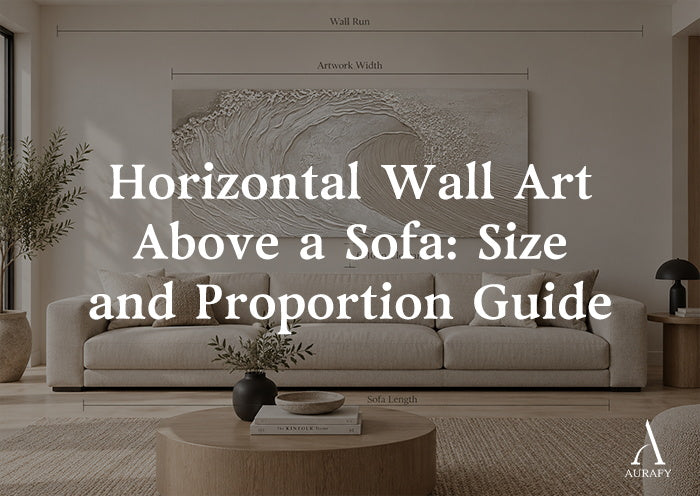
Horizontal wall art above a sofa works best when its width echoes the sofa's length, its aspect ratio suits the wall's proportions, and its placement respects standard hanging height. Get those three variables right and even a single wide piece can anchor an entire living room. Get them wrong, and even a well-made painting will look stranded, undersized, or oddly stretched across the wall. This guide breaks down exactly how to size, place, and choose horizontal wall art for sofas and sectionals of different lengths.
Why Orientation Matters Above a Sofa

A sofa is a horizontal object. Its back forms a long, low line that runs parallel to the floor, and whatever hangs above it inherits that line's visual logic. Vertical or square art has to fight the horizontal pull of the furniture beneath it. Horizontal wall art, by contrast, moves with the sofa instead of against it: the eye reads the wall as one continuous horizontal band, sofa then art, stacked in the same direction.
This is why horizontal formats read as calmer and more grounded over seating. Panoramic paintings, wide layouts, and elongated abstract compositions all extend the sofa's silhouette upward and outward rather than interrupting it. The tradeoff is that horizontal pieces are less forgiving of poor width sizing than vertical pieces hung in a cluster, because there is only one long edge doing all the visual work.
How to Measure Width for Horizontal Wall Art

The Two-Thirds Rule
The most reliable starting point is to target a width between two-thirds and three-quarters of the sofa's total length. A sofa that measures 84 inches wide pairs well with art in the 56- to 63-inch range. This proportion keeps the art from reading as a narrow afterthought while leaving enough negative space that the piece doesn't compete with the sofa's arms.
Going narrower than 60 percent of the sofa's width tends to make the art look chosen for a different room. Going wider than 80 percent can work, but only when the wall extends well past the sofa on both sides, since the art needs breathing room from nearby doorways, light switches, or corners.
Sofa Length Benchmarks
Sofa lengths vary widely, so it helps to work from real benchmarks:
- A loveseat around 60 inches wide pairs well with art in the 40- to 48-inch range.
- A standard three-seat sofa between 80 and 90 inches wide pairs well with art in the 55- to 68-inch range.
- A large sofa or sectional arm running 96 to 110 inches benefits from art in the 65- to 85-inch range, sometimes wider if the wall allows.
These are starting points, not hard limits. A low-profile sofa can carry slightly wider art than its length alone suggests, since it visually reads as longer and lower than a boxy, high-armed model of the same measurement.
Panoramic Aspect Ratios and What They Do to a Wall

Aspect ratio, the relationship between a piece's width and height, determines how "stretched" a horizontal painting feels. A gentle ratio close to 2:1 reads as a wide landscape format and suits walls with moderate height. A more extreme ratio, closer to 3:1 or beyond, reads as a sweeping band and works best on long, low walls, particularly behind sectionals.
A piece around 20x40 inches sits at a 1:2 ratio, wide enough to register as horizontal without dominating a smaller wall. Moving to 30x60 inches keeps that same proportion at a larger scale, suited to a standard three-seat sofa. At the top end, 55x110 inches pushes the same sweep to mural scale, appropriate for sectional walls with high ceilings and generous width. Choosing a ratio close to what the sofa and wall already suggest, rather than forcing a square piece into a long space, is what makes the composition feel intentional.
Proportion for Standard Sofas vs Sectionals

Standard sofas sit against a single wall segment, so the math is straightforward: measure the sofa, apply the two-thirds guideline, and center the art over that run. Sectionals complicate this because they often wrap a corner, leaving one long straight run and one shorter return.
For sectionals, proportion should be calculated against the longest unbroken run of the sofa back, not the combined length of both sections. A sectional with an 84-inch main run and a 60-inch chaise return should be treated, for sizing purposes, like an 84-inch sofa. Hanging art across the full combined length overstates the wall's usable width and typically results in a piece that looks correct on paper but oversized in the room, since the chaise portion usually sits perpendicular to the main wall.
On L-shaped sectionals, a wide horizontal piece over the main back cushion, sized to that run alone, keeps the proportion honest. The chaise side is often better left bare or paired with a smaller accent, since a second large piece there can make the corner feel crowded.
Height and Centering Above a Sofa

Horizontal art above a sofa should be centered on the sofa itself, not on the wall as a whole, since sofas are rarely centered on a full wall segment. Standard clearance between the top of the sofa back and the bottom edge of the art is 6 to 10 inches. Tighter than 6 inches can make the piece feel pinned to the furniture; looser than 10 to 12 inches starts to disconnect the art from the seating group, especially with wider formats.
Ceiling height affects this range at the margins. In rooms with 8-foot ceilings, stay closer to 6 to 8 inches of clearance to keep the grouping tight. In rooms with 10-foot or taller ceilings, push clearance toward 10 to 12 inches, or size up within the horizontal range, so the art holds its own against the extra wall height above it.
As a secondary check, the vertical center of the art should land near eye level for a standing adult, typically 57 to 60 inches from the floor. When the clearance rule and eye-level rule conflict, the clearance rule takes priority, since it keeps the art visually tethered to the furniture.
One Wide Piece vs a Horizontal Grouping

There are two ways to fill a long horizontal run above a sofa: a single wide painting, or a grouping of two or more separate horizontal pieces arranged in a row with visible gaps between them.
A single wide piece reads as one continuous statement. It simplifies the wall, avoids the alignment work of hanging multiple frames level with each other, and suits rooms where the goal is a calm, unified focal point. This is the more forgiving option for anyone hanging art without a level or much wall-planning experience.
A grouping of separate pieces, spaced with consistent gaps of 3 to 6 inches, offers more flexibility. It allows mixing tones or textures across the wall, adjusting overall width by adding or removing a piece, and working around obstacles like outlets or vents that a single wide canvas can't straddle. The tradeoff is more setup precision: uneven spacing or misaligned heights are far more noticeable across a grouping than on a single work.
Neither approach is inherently better; the choice depends on the wall's obstacles, the sofa's length, and how much visual complexity the room can absorb. A long, unobstructed wall behind a large sectional often favors a single wide piece for simplicity, while a shorter or interrupted wall may suit a considered grouping instead.
Visual Weight, Color, and Texture in Horizontal Compositions

Visual weight, how much a piece draws the eye, matters more in horizontal formats than in smaller vertical ones, because a wide piece covers more of the wall and has more opportunity to either balance or overwhelm the room. Dense, high-contrast compositions carry more visual weight per square inch than soft, tonal ones, so an oversized horizontal piece in bold contrast can dominate a room even when its footprint proportionally matches the sofa.
Texture adds a further layer of weight beyond color and contrast. A dimensional surface catches light differently across a wide format, so raking light from a window or floor lamp can make ridges, grooves, or drip patterns read as more prominent as the piece scales up. A heavily textured surface at 55x110 inches will read very differently under directional light than the same design at 20x40 inches. In rooms with strong side lighting, a wide textured piece becomes a more active visual element, so it pairs best with sofas and decor in muted or neutral tones that can absorb that extra presence.
Common Mistakes with Horizontal Wall Art Above a Sofa

The most frequent error is choosing art that's too narrow for the sofa, often because a piece looked appropriately sized in a product photo without a sofa for scale. A width under half the sofa's length tends to look like an accessory rather than a focal point, regardless of how strong the composition is.
The second common mistake is hanging too high. Because horizontal pieces already draw the eye sideways, extra vertical clearance makes the gap between furniture and art more noticeable than it would be with a vertical piece. The third mistake is pairing an extreme panoramic ratio with a short wall run, which forces the art to either overhang the sofa's ends or get visually cropped by nearby furniture and doorways. Measuring the actual wall run available, not just the sofa, before selecting an aspect ratio prevents this.
A fourth mistake, specific to groupings, is inconsistent spacing. Gaps that vary by more than an inch or two between pieces read as misaligned even when each piece is individually level, so measuring and marking gap width before hanging matters as much as measuring the pieces themselves.
Comparing Horizontal Wall Art Options for Above the Sofa

Three horizontal options illustrate how palette and texture change the sizing conversation within the same two-thirds framework.
Abstract Earth Texture Wall Art-Soft Sand Tones-AURA010 is available in horizontal sizes from 20x40 up to 55x110 inches, in beige, soft gray, and off-white tones with a 3D textured acrylic surface and layered brushstrokes. Its soft palette suits standard sofas and sectionals alike, since the muted tones scale up without adding heavy visual weight to the room.
Metallic Topography Painting-Onyx & Gold Accents-AURA033 spans the same 20x40 to 55x110 range but carries more visual weight through its onyx and charcoal base, layered ridges, carved grooves, and a continuous metallic-gold channel with diagonal flow. That built-in directional line suits a single wide placement over a long sectional run, where the diagonal movement carries across the full width of the piece.
Metallic Drip Abstract Painting-Charcoal, Silver & Gold Tones-AURA030 also runs 20x40 to 55x110 inches horizontal, combining charcoal black, silvery gray, and metallic gold in textured fields with a vertical gold drip cascade set within the horizontal composition. The interplay between its horizontal format and vertical drip detail gives it more internal contrast than a flat panoramic piece, helping it anchor a wide wall without needing to size all the way to the top of the range.
Across all three, the same logic applies: measure the sofa or longest unbroken sectional run, apply the two-thirds to three-quarters guideline, and let palette and texture, not dimensions alone, guide the final size within each product's available range.
Conclusion

Sizing horizontal wall art above a sofa comes down to a small set of measurable decisions: width proportional to sofa length, an aspect ratio that matches the wall's own proportions, consistent clearance above the sofa back, and a clear choice between one wide piece and a considered grouping. Palette and texture then determine how that sizing decision actually reads in the room, since a wide, boldly textured piece and a wide, soft-toned piece of the same dimensions can feel entirely different once hung. Working through sofa length, wall run, and lighting before choosing a size turns horizontal wall art from a guess into a proportioned, deliberate part of the room.
Frequently Asked Questions
How wide should horizontal wall art be above a sofa?
Aim for a width between two-thirds and three-quarters of the sofa's total length. An 80-inch sofa pairs well with art in the roughly 53- to 60-inch range, while a smaller loveseat around 60 inches suits pieces closer to 40 to 45 inches wide. Going much narrower than 60 percent of the sofa's length tends to look undersized, while exceeding 80 percent works only when the wall extends well beyond the sofa on both sides. Measure the sofa first, then let the wall's available width confirm or adjust the target range.
What aspect ratio works best over a long sofa?
Longer sofas and sectionals generally suit wider aspect ratios, since a gentle 2:1 horizontal proportion can look modest on an especially long wall run. A ratio closer to 2:1, achievable across sizes like 30x60 up to 55x110 inches, keeps the piece reading as clearly panoramic without stretching so thin that detail gets lost. The right ratio ultimately depends on both sofa length and available wall height, so measure the full wall run, not just the sofa, before settling on a specific proportion.
How high should horizontal art hang above a couch?
Leave 6 to 10 inches of clearance between the top of the sofa back and the bottom edge of the art. Rooms with standard 8-foot ceilings work best toward the tighter end of that range, around 6 to 8 inches, to keep the grouping visually connected. Taller ceilings, 10 feet or more, can support 10 to 12 inches of clearance without the art feeling disconnected from the sofa. As a secondary check, the piece's vertical center should land near 57 to 60 inches from the floor.
When is a horizontal triptych better than one wide piece?
A grouping of separate horizontal pieces, spaced evenly, tends to make more sense than a single wide work when the wall has obstacles, such as outlets, vents, or trim, that a single canvas can't span cleanly, or when the sofa's wall run is broken by a doorway or corner. A single wide piece is generally simpler to hang correctly and reads as a more unified focal point on long, unobstructed walls. Choose based on the wall's physical constraints and how much visual complexity the room can support, not on width alone.
Share:
Large Textured Wall Art for Living Rooms
Black and Beige Wall Art for Neutral Interiors